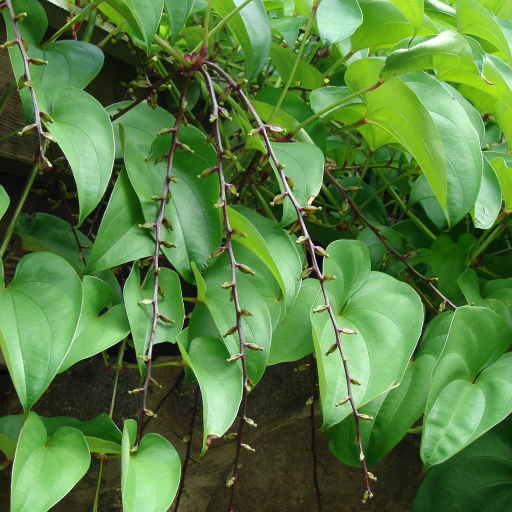
Plant Overview
Known worldwide as "Ube," the Dioscorea alata is much more than just a vibrant ingredient in Instagram-worthy desserts. This vigorous tropical climber is a staple crop across Southeast Asia and the Pacific, prized for its massive, starchy tubers that can sometimes weigh as much as a small child. Whether it is draped over a garden trellis or buried deep in the earth, this "Greater Yam" is a true giant of the botanical world.
🔍 How to Identify
- 🪁 Winged Stems: One of its most distinct features is its "winged" or square-shaped stems, which have thin, longitudinal ridges that look like tiny green fins.
- 💚 Heart-Shaped Leaves: The leaves are large, elegant, and shaped like perfect hearts (cordate). They usually grow in opposite pairs along the vine, unlike many other yam species.
- 🌀 Right-Hand Twiner: If you watch it grow, you’ll notice the vine always twines to the right (clockwise) as it climbs upward.
🏡 In Your Garden
- 🏗️ Vertical Ambition: This is a heavy-duty climber that can reach lengths of 30 feet or more. It requires a very sturdy trellis or a sacrificial tree to climb, as the weight of the foliage can collapse flimsy supports.
- 🕳️ Deep Soil Requirements: If you are growing it for the tubers, the soil must be loose and deeply tilled. Because the tubers grow vertically into the ground, compacted soil will result in stunted, misshapen yams.
⚠️ Safety & Toxicity
- 🔥 Cook Before Consuming: While famous for its sweet flavor, the raw tuber contains calcium oxalate crystals and certain saponins that can cause intense irritation to the mouth and throat. It must be boiled, baked, or steamed thoroughly before eating.
- 🐾 Pet Safety: The vines and leaves are generally not considered deadly, but they can cause digestive upset and oral irritation if chewed on by curious cats or dogs.
✨ Fun Fact
In some regions of the Philippines, Ube is treated with such reverence that it is considered "sacred." Traditional folklore suggests that if you accidentally drop a piece of Ube, you must kiss it or offer a quiet apology to avoid bad luck!

Detailed Care Instructions
To grow Dioscorea Alata, commonly known as purple yam or water yam, follow these steps:
- Choose a planting location: Select a well-draining area with partial shade or indirect sunlight. These plants prefer tropical or subtropical climates with average temperatures between 75-85°F (24-29°C).
- Prepare the soil: Ensure the soil is loose, rich in organic matter, and well-draining. Add compost or aged manure to improve soil fertility and drainage.
- Propagation: Obtain a purple yam tuber from a garden center or seed supplier. Cut the tuber into several sections, each with at least one "eye" or bud. Allow the cut surfaces to dry and heal for a day or two.
- Planting: Dig planting holes about 2-3 inches (5-7.5 cm) deep and 2-3 feet (60-90 cm) apart. Place the sections of tuber horizontally in the holes with the buds facing up. Cover the tubers with soil, ensuring they are not planted too deep.
- Watering: Initially, water the newly planted tubers thoroughly to ensure they are evenly moist. Afterward, water the yams regularly, aiming for consistent moisture but not overly saturated soil. Avoid letting the soil dry out completely.
- Mulching: Apply a layer of organic mulch around the plants to conserve moisture, suppress weeds, and maintain even soil temperatures.
- Support: As the vine grows, it may need support for climbing. Install trellises, stakes, or fences nearby, allowing the vine to twine around and climb upwards.
- Fertilization: Fertilize the plants with a balanced organic fertilizer or apply compost every few months. This will provide essential nutrients for healthy growth.
- Pest and disease control: Monitor your plants regularly for pests such as aphids, spider mites, or beetles. Use organic insecticides or appropriate pest control measures if necessary. Practice crop rotation and maintain good air circulation to minimize the risk of diseases.
- Harvesting: Dioscorea Alata typically takes about 6-9 months to mature. Harvest the yams when the foliage starts to yellow and die back. Gently dig around the plant to locate the tubers and lift them out of the soil. Handle the yams carefully to avoid bruising or damaging them.
Remember that growing Dioscorea Alata requires patience and consistent care. With proper attention to watering, fertilizing, and pest control, you can enjoy a bountiful harvest of purple yams.

Place in a bright room that is sun drenched almost all day. Or directly in a south-facing window.

To water this particular plant, it is important to take into account the environmental factors such as the soil type, humidity level, and temperature. It is recommended to water this plant regularly but not excessively, ensuring that the soil does not become waterlogged. It is also important to avoid getting the leaves wet as this can lead to fungal diseases. It is recommended to water the plant at its base or directly onto the soil to promote healthy root growth. Additionally, providing drainage in the pot or planting area can help prevent root rot. Overall, consistent and mindful watering practices can help ensure the health and vitality of this plant.
To fertilize the plant, begin by applying a balanced fertilizer that has the same ratio of nitrogen, phosphorus, and potassium (ex. 10-10-10) to the soil around the base of the plant at the start of the growing season. Repeat the application every 4 to 6 weeks depending on the growth rate and environmental conditions. It is important to avoid over-fertilizing the plant, as it can lead to excessive foliage growth but few tubers. Water the plant after fertilizing to ensure that the nutrients are absorbed well.
When cultivating the plant species of interest, an appropriate soil type would be one that is rich in nutrients and has a pH range between 5.5 to 6.5. The ideal soil would possess excellent drainage and moisture retention qualities as excessive moisture could promote root rot. The soil should also be free of any pathogens, pests, or weeds that could cause harm to the plant. The recommended soil type would be a loamy, well-draining soil that has been enriched with organic matter to improve its water-holding capacity and nutrient content, therefore providing an optimal growing environment.
Dioscorea Alata plant can be propagated using its tubers. The first step is to select a healthy and mature tuber from the parent plant. The tuber should be firm and free of any diseases or pests. The tuber should be cut into smaller pieces, each with at least one eye or bud. The cut pieces should be left to dry out for a few hours to prevent rotting.
The next step is to prepare the planting bed. The soil should be well-draining and fertile. The tuber pieces should be planted horizontally, with the buds facing upwards, at a depth of about 5-10 centimeters. The planting distance between the pieces should be about 30-45 centimeters apart.
Water the planting bed regularly, ensuring that the soil remains moist but not waterlogged. The first signs of growth should appear in about 2-3 weeks. At this point, it's important to provide support for the growing plant as it can grow up to several meters in height.
Once the plant has grown large enough, it can be harvested for its tubers. The tubers should be carefully dug up, taking care not to damage the plant or its roots. Some of the tubers can be replanted for future propagation while the rest can be used for consumption.








