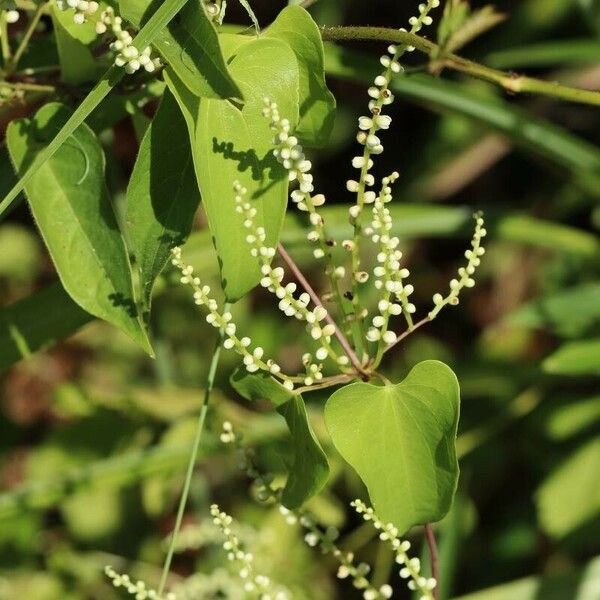
Plant Overview
Known in Japan as Yamaimo or the "Mountain Medicine," Dioscorea japonica is a graceful, twining vine that has been a staple of East Asian mountain foraging for centuries. Unlike most yams that require heavy cooking, this plant is famous for its unique ability to be eaten raw, creating a velvety, foamy texture that is a delicacy in traditional cuisine. It is a true survivor, sending its long, slender tubers deep into the earth to store energy for the winter.
🔍 How to Identify
- 🍃 The Foliage: Look for elegant, heart-shaped or arrowhead leaves that usually grow in opposite pairs. They have prominent veins that curve beautifully toward the leaf tip.
- 🌀 The Vine: This is a clockwise-twining perennial vine. It is slender and green, often turning a purplish hue where it meets the leaf stalks.
- 🥔 The Bulbils: In late summer, you’ll notice small, brown, potato-like growths called "bulbils" (or mugocha) tucked into the leaf axils. These are essentially "air potatoes" that the plant uses to clone itself.
🏡 In Your Garden
- 🌱 Deep Dive Soil: If you plan to harvest the tubers, you need very loose, deep, and sandy soil. Because the roots can grow over three feet long straight down, many hobbyists grow them in slanted PVC pipes to make harvesting easier without digging a massive hole.
- 🧗 Vertical Support: This plant is a vigorous climber. It needs a sturdy trellis or a nearby shrub to scramble over. In the right conditions, it provides a lush, green screen, but be careful—it can easily "swallow" smaller plants if left unmanaged.
⚠️ Safety & Toxicity
- 👐 Skin Sensitivity: While the tuber is edible, the raw skin and the juice contain raphides (tiny calcium oxalate crystals). Handling the peeled tuber can cause a temporary, intense "prickly" itch on your hands.
- 🐾 Pet Safety: Like many members of the Dioscorea family, the raw plant (especially the skin and leaves) can be toxic to cats and dogs if ingested in large quantities, causing digestive upset. Always cook or process thoroughly if not familiar with traditional preparation.
✨ Fun Fact
In Japan, the grated form of this yam is called Tororo. It is one of the few starchy vegetables in the world that is safe to eat raw because the enzymes it contains actually help aid digestion rather than hindering it!

Detailed Care Instructions

Place in a window with dappled sun or a spot in the middle of a room. Or directly in a window facing west or east.

When the top few inches of soil dry out, water your plants. If the top few inches of soil are still moist, do not water your plant. Wait a few days, then poke your finger into the soil to see if anything has changed. Overwatering poses a disease risk, such as the development of fungal diseases in the roots. These plants have adaptations in there leaves that allow them to survive in low water supply.







