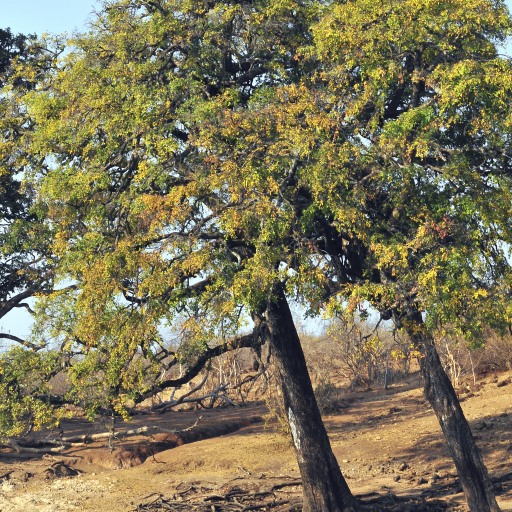
Plant Overview
Known as the "Jackalberry" or the "African Ebony," Diospyros mespiliformis is a majestic giant of the African savanna. This tree is deeply woven into local folklore and is often found growing atop ancient termite mounds, which provide the nutrient-rich, aerated soil it craves. Its wood is legendary for its density and dark color, earning it a spot among the world’s true ebony species.
🔍 How to Identify
- 🌳 The Bark: The trunk is distinctive for its dark gray to black color, featuring a rough texture that breaks into small, rectangular blocks as the tree ages.
- 🍃 The Foliage: Leaves are shiny, dark green, and elliptical with slightly wavy margins. New growth often emerges with a reddish-pink tint before hardening into deep green.
- 🍎 The Fruit: It produces small, fleshy berries that turn yellow to orange when ripe. They are crowned by a persistent, star-shaped calyx (the leafy part at the base).
🏡 In Your Garden
- 💧 Water & Location: While it is drought-tolerant once established, it naturally thrives near riverbanks. If planting at home, ensure it has deep soil to accommodate its extensive root system and provide consistent moisture during its youth.
- 🌱 Growth Habit: This is a "slow and steady" grower. It is best suited for large landscapes or "wild" gardens where it can act as a keystone species, providing shade and attracting a variety of birds and mammals.
⚠️ Safety & Toxicity
- ✅ Status: Generally safe and non-toxic.
- 🍴 Details: The fruit is completely edible for humans and is often dried or used to make traditional beers and sweets. While not known to be toxic to pets, the seeds are hard and could pose a choking hazard or cause mild digestive upset if consumed in large quantities.
✨ Fun Fact
The name "Jackalberry" isn't just a coincidence! Jackals are incredibly fond of the fallen fruit. Because the seeds pass through their digestive systems unharmed, you will often see new Jackalberry saplings sprouting directly from jackal droppings across the African plains.

Detailed Care Instructions
To grow Diospyros mespiliformis (African ebony or jackalberry), you can follow these steps:
- Climate and soil requirements: Make sure you are in a suitable climate zone, as this plant prefers tropical or subtropical regions. It thrives in well-drained, sandy or loamy soils.
- Germination: Collect fresh seeds from ripe fruits and remove the pulp. Soak the seeds in water for about 24 hours to soften the pulp and then remove any remaining pulp. You can also scarify the seeds by nicking the seed coat to help with germination.
- Potting: Fill a seed tray or pots with a well-draining potting mix. Place the seeds on top of the soil and lightly cover them with a thin layer of soil. Keep the soil moist but not waterlogged.
- Germination conditions: Place the seed tray or pots in a warm and bright area, ideally at a temperature of around 20-25°C (68-77°F). Provide indirect sunlight or use artificial lighting. The seeds may take around 2-4 weeks to germinate.
- Transplantation: Once the seedlings have developed a few leaves and are strong enough, carefully transplant them into larger pots or into a well-prepared garden bed. Keep a distance of at least 5-6 feet between plants to allow them to grow properly.
- Watering and care: Regularly water the plants to keep the soil moist but not waterlogged. During dry periods, increase the frequency of watering. Apply a balanced fertilizer according to the manufacturer's instructions to promote healthy growth.
- Sunlight: Place the plants in a location that receives full sun or partial shade. Partial shade is particularly important for young plants to protect them from intense sunlight.
- Pruning: Prune any dead or damaged branches to maintain plant health and shape. Pruning is best done during a period of active growth.
- Pest and disease control: Monitor the plant regularly for any pests or diseases like aphids or fungal infections. If necessary, use appropriate organic or chemical treatments to control them.
- Patience: Growing Diospyros mespiliformis can be a slow process. It may take several years for the plant to reach maturity and start producing fruit.
Remember to consult local resources or experts for specific care instructions tailored to your region, as conditions can vary.

Place in a bright room that is sun drenched almost all day. Or directly in a south-facing window.

The best way to water this plant is to ensure that the soil around it is moist, but not waterlogged. This can be achieved by watering it frequently but in small amounts. You can use a watering can or a hose with a small attachment to water the plant, making sure to aim at the soil, not the leaves. Alternatively, you can also use a drip irrigation system to provide a slow and steady flow of water to the plant. It is important to avoid overwatering the plant as this can lead to root rot and other issues. Monitor the soil moisture level regularly by sticking your finger about an inch into the soil. If it feels dry, it's time to water. During hot and dry weather, the plant may require more frequent watering.
To fertilize this plant, wait until it is actively growing and then apply a balanced, slow-release fertilizer according to the manufacturer's instructions. Be sure to apply the fertilizer evenly around the base of the plant, avoiding direct contact with the stem. Water the plant thoroughly after fertilizing to ensure proper absorption. Limit fertilization to once a year to prevent over-fertilization and potential damage to the plant.
Diospyros mespiliformis is a plant that requires well-drained soil that is rich in organic matter. The ideal soil for this plant should have a pH that is slightly acidic to neutral. It is preferable to use a soil mix that has a good balance of sand, silt, and clay. The soil should be able to hold moisture but not become waterlogged. Adding compost or other organic matter to the soil will help improve its fertility and aeration, ensuring optimal growth of the plant. It is important to avoid using soil that is alkaline or clayey, as this can hinder the plant's growth and development. Overall, a well-drained, nutrient-rich soil with a pH of around 6.5 is ideal for the growth of Diospyros mespiliformis.
There are several ways to propagate this plant. One common method is by collecting seeds and sowing them in a well-draining soil mixture. The seeds should be collected from mature fruit and should be cleaned and dried before planting. They can be sown immediately or stored in a cool and dry place until ready to use.
Another method is by root cuttings. This involves taking cuttings from the roots of an established plant and planting them in a well-draining soil mixture. The cuttings should be taken from healthy and disease-free roots and should be about 4-6 inches in length. Plant the cuttings in a container with the soil mixture and keep them in a warm and moist environment until they have established roots.
Air layering is also a popular propagation method for this plant. This involves taking a stem and making an incision in the bark. A small amount of rooting hormone can be applied to the wound before wrapping it with moist sphagnum moss and covering it with plastic wrap. The moss should be kept moist and in a warm environment until the roots have formed. Once roots have formed, the stem can be cut below the moss and planted in a well-draining soil mixture.
Whichever method is chosen, it is important to keep the new plants in a warm and humid environment until they have established roots and new growth. Watering should be done regularly but not excessively, and the plants should be kept out of direct sunlight until they are established.








