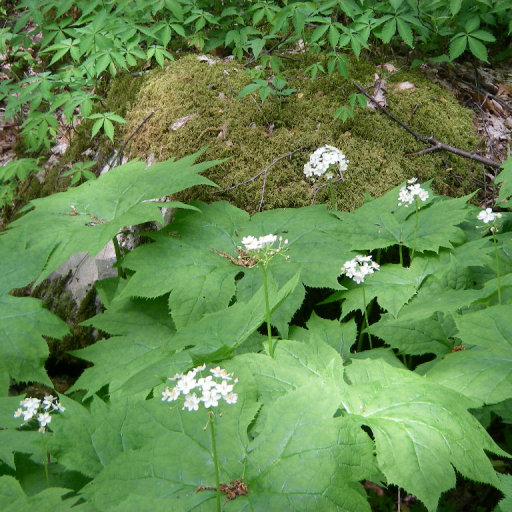
Plant Overview
Often called the American Umbrella Leaf, this Appalachian native looks like it stepped right out of a prehistoric forest. Found naturally in the cool, misty coves of the Southeastern United States, it is beloved for its massive, architectural foliage that can turn a dark corner of the garden into a lush, woodland sanctuary. While its flowers are delicate and brief, its true "wow factor" comes from its oversized leaves and striking late-season fruit.
🔍 How to Identify
- ☂️ The Foliage: Massive, twin leaves that are deeply lobed and shaped like jagged umbrellas. They can grow up to two feet wide, often hiding the stem beneath them.
- ⚪ The Blooms: Small, white, six-petaled flowers that grow in flat-topped clusters (cymes) rising just above the leaves in late spring.
- 🫐 The Fruit: After the flowers fade, they are replaced by eye-catching, pea-sized berries that turn a deep indigo blue, perched atop surprisingly bright red stalks.
🏡 In Your Garden
- 💧 The "Cool and Wet" Rule: This plant is a specialist of the "spray zone." It thrives near streams or in seepage slopes. In a home garden, it demands consistently moist, organic-rich soil; if the ground dries out, the giant leaves will wilt almost instantly.
- 🌲 Deep Shade Specialist: Unlike many perennials that need "dappled sunlight," the Umbrella Leaf is perfectly happy in deep, north-facing shade. It is a slow grower that spreads via underground rhizomes, making it a great long-term resident for a permanent woodland bed.
⚠️ Safety & Toxicity
- 🟢 General Status: Diphylleia cymosa is generally considered non-toxic to humans and common household pets.
- 🐾 Garden Etiquette: While not known to be poisonous, the berries are not considered edible for humans. It is always best to keep curious pets and children from snacking on garden ornamentals to avoid minor stomach upset.
✨ Fun Fact
The Diphylleia genus contains a famous cousin called the "Skeleton Flower" (Diphylleia grayi). While the American version (Cymosa) stays mostly white, the petals of its Japanese cousin become completely transparent like glass when they get wet in the rain!

Detailed Care Instructions
To grow Diphylleia cymosa, also known as umbrella plant or Mayapple, follow these steps:
- Purchase seeds or obtain a young plant from a reputable nursery or garden center. Alternatively, you can propagate the plant from division or rhizome cuttings.
- Choose a suitable location for the plant. Diphylleia cymosa prefers partial shade to full shade, as direct sunlight can scorch its delicate leaves. It thrives in moist, well-draining soils rich in organic matter.
- Prepare the soil by amending it with organic matter such as compost or well-rotted manure. This will improve the soil's fertility, drainage, and moisture-retention capabilities.
- Plant the seeds or young plant in the prepared soil. If planting seeds, follow the instructions on the packet for optimal spacing and depth.
- Water the plant regularly, keeping the soil consistently moist but not waterlogged. Mulching around the plant can help retain soil moisture and suppress weed growth.
- Fertilize the plant with a balanced, slow-release fertilizer in early spring, according to the manufacturer's instructions. Repeat the application once or twice during the growing season if desired.
- Monitor the plant regularly for pests and diseases, such as slugs, snails, or fungal infections. Treat any issues promptly using appropriate organic or chemical treatments.
- Provide support for the plant if necessary. As Diphylleia cymosa grows, it may require stakes or trellises to support its stems and prevent them from falling over.
- Prune the plant as needed to remove dead or damaged foliage, promote airflow, and maintain its shape. However, avoid excessive pruning, as Diphylleia cymosa prefers to maintain its natural, bushy form.
- In colder regions, provide winter protection by mulching the plant heavily or covering it with straw or leaves to insulate the roots.
By following these steps, you can successfully grow Diphylleia cymosa and enjoy its unique umbrella-like leaves and delicate white flowers.

Place in a window with dappled sun or a spot in the middle of a room. Or directly in a window facing west or east.

To properly water this plant, you should first make sure that the soil is well-draining and not waterlogged. Water the plant from the base, directly into the soil, rather than from above. Allow the soil to dry out partially between waterings, but don't let it dry out completely. Watering frequency will depend on the environment and season, so observe the plant and adjust accordingly. It's important not to overwater this plant, as it can be susceptible to root rot.
To fertilize this plant, use a balanced fertilizer with equal amounts of nitrogen, phosphorus, and potassium. Apply the fertilizer once a month during the growing season, from spring to summer. Follow the package instructions for dosage, and water the plant lightly before and after fertilizing. Avoid over-fertilizing, as it can lead to leaf burn and other signs of stress.
Diphylleia cymosa is a type of plant that requires a specific type of soil in order to grow healthily. It is recommended to use a well-draining soil that has a pH level between 5.5 and 6.5. The soil should also be rich in organic matter and have adequate levels of nutrients such as nitrogen, phosphorus, and potassium. It is best to avoid heavy or clay soils as they can hold too much moisture and lead to root rot. An ideal soil mix would consist of a combination of peat moss, perlite or sand, and compost. Additionally, it is important to ensure that the soil is kept consistently moist but not waterlogged.
To propagate this plant, you can start by collecting seeds from the flower heads. Allow the seed heads to dry out and then collect the seeds. Soak the seeds in water for a few days to loosen the outer coating. Once the seeds have soaked, plant them in well-draining soil and lightly cover them with a thin layer of soil. Keep the soil moist, but not waterlogged, and place the pot in a bright location.
Another way to propagate this plant is to take stem cuttings. Select a healthy stem, preferably one that has not yet flowered. Cut a 4-6 inch section of the stem just below a node. Remove the lower leaves and dip the cut end in rooting hormone. Plant the cutting in a pot filled with moist soil and keep it in a bright spot out of direct sunlight. Keep the soil moist and mist the leaves occasionally to keep them hydrated.
Both methods should result in new Diphylleia cymosa plants that will eventually grow to maturity. However, it is worth noting that this plant can be quite finicky and may not produce viable seeds or cuttings in all cases.
Common pests of the umbrella-leaf include Spider mites, aphids, thrips, larvae, snails. Make a habit of checking your umbrella-leaf frequently for pests so that any infestations can be caught and managed early.








