Plant Overview
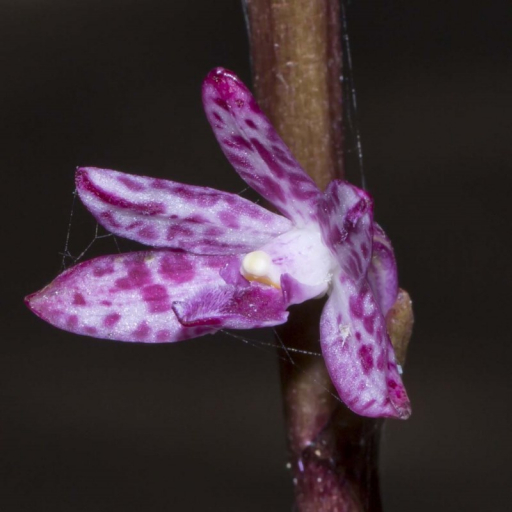
Often called the Blotched Hyacinth Orchid, this "ghostly" Australian native is a master of mystery. Unlike most plants, it has no leaves and produces no chlorophyll of its own, appearing suddenly in the summer like a vibrant, spotted wand emerging from the forest floor. It relies entirely on a complex underground partnership with fungi to survive, making it a rare and enchanting sight for hikers and nature lovers.
🔍 How to Identify
- 🌸 The Blooms: Features up to 60 waxy, star-shaped flowers that range from pale pink to bright mauve, each heavily decorated with dark magenta spots.
- 🎋 The Stem: A stiff, leafless, and upright flower spike that can grow up to 100cm tall. The stem is usually a dark reddish-brown or deep burgundy color.
- 🚫 Missing Leaves: You will never find green leaves on this plant. Instead, it has small, scale-like bracts at the base of the stem, as it doesn't need leaves to photosynthesize.
🏡 In Your Garden
- 🍄 The Fungal Connection: This orchid is a "mycoheterotroph," meaning it "steals" nutrients from mycorrhizal fungi associated with the roots of Eucalyptus trees. Because of this incredibly specific relationship, it is impossible to grow in a traditional home garden or pot.
- 🌲 Natural Habitat: If you live in Eastern or Southern Australia, you might find it in open peppermint or stringybark forests. It thrives in well-drained, sandy, or gravelly soils where its fungal partners are most active.
⚠️ Safety & Toxicity
- ✅ Status: Generally considered non-toxic.
- 🛑 Wild Ethics: While not poisonous to pets or humans, this plant is highly sensitive. Digging it up is not only often illegal due to its protected status but also futile—without its specific underground fungal network, the plant will die almost immediately upon being moved.
✨ Fun Fact
Because it lacks green chlorophyll, the Blotched Hyacinth Orchid is essentially a "parasite" of fungi! It spends most of its life entirely underground, only showing its face to the world when it needs to be pollinated by native bees.

Detailed Care Instructions
To grow Dipodium punctatum plant, also known as the hyacinth orchid or mosquito orchid, follow these steps:
- Seed collection: Look for fresh seeds on mature plants in the wild or obtain seeds from a reputable nursery or online seller. Dipodium punctatum seeds are small and dust-like.
- Germination: Soak the seeds in water for a few hours to hydrate them. Then, spread the seeds evenly on a damp paper towel or sphagnum moss. Place the towel or moss in a ziplock bag to maintain humidity. Keep the bag in a warm location, ideally between 68-77°F (20-25°C). Check regularly for germination, which can take a few weeks to several months.
- Potting: Once the seeds have germinated and developed tiny green shoots, transfer them into individual pots with a well-draining orchid potting mix composed of bark, sphagnum moss, and perlite or charcoal. Make sure the pot has drainage holes.
- Lighting: Provide the plants with bright but filtered light. Avoid direct sunlight as it can scorch the foliage. A shaded area outdoors or a spot near a bright window indoors can be ideal.
- Watering: Orchids generally prefer to dry out slightly between waterings, so water the plants when the top inch of the potting mix feels dry. Avoid over-watering, which can lead to root rot. Dipodium punctatum plants prefer more moisture during active growth and less during dormancy.
- Humidity: Hyacinth orchids appreciate higher levels of humidity. You can increase humidity by misting the plants regularly, placing them on a humidity tray filled with water and pebbles, or using a room humidifier.
- Temperature: Dipodium punctatum plants generally grow well in temperatures between 60-80°F (15-27°C). Avoid exposing them to extreme fluctuations or cold drafts.
- Fertilization: Use a balanced orchid fertilizer diluted to half the recommended strength during the growing season. Apply the fertilizer every two to four weeks, following the package instructions.
- Repotting: As the plant grows, you may need to repot it into a larger container every 2-3 years or when the potting mix starts to break down. Orchids are often repotted during their dormant period.
- Natural dormancy: Dipodium punctatum plants experience a natural dormancy period during which the foliage dies back. Reduce watering during this time and store the dormant plant in a cool, dark place. Gradually resume normal care when new growth emerges.
Remember to observe and adapt care practices according to the specific needs of your Dipodium punctatum plant, as individual requirements may vary slightly.
Dipodium Punctatum plant prefers to be watered with a moderate amount of water. You should avoid overwatering the plant as it may cause root rot. It is recommended to water the plant once a week during the growing season and once every two weeks during the dormant season. Before watering, make sure that the soil has completely dried out. To avoid getting water on the leaves and flowers, you should water directly into the soil. It is also recommended to use room temperature water. You should stop watering the plant if you notice water pooling on the surface of the soil.
To fertilize the plant, prepare a water-soluble fertilizer and dilute it with water according to the instructions on the package. Apply the fertilizer to the soil around the base of the plant, being careful not to get it on the leaves or stem. Fertilize every two to three weeks during the growing season, which is usually from spring to fall. Ensure that the soil is moist before fertilizing, as fertilizing a dry plant can lead to burns.
The Dipodium Punctatum plant requires well-draining soil that is rich in nutrients. It is important to use a soil mix that is specifically formulated for epiphytic orchids as these plants do not grow in soil in their natural environment. Such a mix should consist of bark, sphagnum moss, and perlite, as these components provide adequate drainage while retaining moisture and nutrients. The soil mix should be slightly acidic, with a pH level ranging from 5.5 to 6.5. It is best to avoid using regular potting soil as it can become compacted and cause root rot.
To propagate this plant, it is important to start with a healthy and mature specimen. The first step is to identify and locate the dormant buds on the underground rhizome. Using a sharp and sterilized knife or pruning shears, carefully slice off a section of the rhizome containing several of these buds.
The rhizome section can be potted up in a well-draining soil mix, or directly planted in a prepared garden bed. Make sure to keep the soil moist and avoid over-watering, as the plant is susceptible to root rot.
It is also possible to divide larger clumps of the plant during the dormant season, making sure each division has a healthy amount of roots and buds. These divisions can be potted up or planted in the garden.
Propagation can also be achieved through seed collection and sowing, but this method is more labor-intensive and requires patience and careful attention to the plant's specific requirements.







