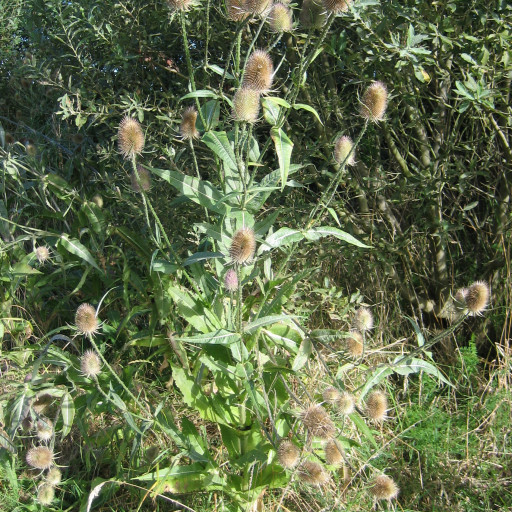
Plant Overview
Known as the Wild Teasel or "Gypsy Combs," this architectural giant stands tall in meadows and along roadsides across Europe and North America. It is famous for its prickly, egg-shaped seed heads that look like something out of a medieval fairy tale. Historically, it wasn't just a weed—it was a vital tool for the textile industry, used to "tease" and brush the nap of wool.
🔍 How to Identify
- 🌸 The "Halo" Bloom: Unlike many flowers that bloom all at once, Teasel flowers open in horizontal rings. The bloom starts in the middle of the spiky head and moves simultaneously up and down, creating two distinct bands of lavender.
- 🍃 Water-Catcher Leaves: The large, lance-shaped leaves grow in pairs along the stem and are fused at the base. This creates a "cup" (sometimes called Venus' Basin) that catches and holds rainwater.
- 🌵 Prickly Texture: The entire plant is a fortress of spines. Small, stiff prickles cover the towering stalks and the undersides of the leaf ribs, making it very unpleasant for herbivores to munch on.
🏡 In Your Garden
- 🐝 Pollinator Buffet: This plant is an absolute magnet for bumblebees and butterflies during the summer. In the autumn and winter, the dried seed heads become a vital "bird feeder" for Goldfinches, who love to pick out the seeds.
- ⏳ The Long Game: Teasel is a biennial. In its first year, it stays low to the ground as a flat green rosette. In its second year, it shoots up a dramatic flowering stalk that can reach over six feet tall.
- 🏺 Dried Decor: Because the seed heads remain stiff and upright long after the plant dies, they are highly prized for "everlasting" floral arrangements. They provide a striking silhouette in a winter garden covered in frost.
⚠️ Safety & Toxicity
- 🛡️ General Safety: Dipsacus fullonum is not known to be toxic to humans, cats, or dogs. It is generally safe to have in a wildlife-friendly yard.
- 🧤 Physical Hazard: The "danger" here is purely mechanical! The prickles are sharp and can easily pierce skin or thin gardening gloves. Always wear heavy-duty leather gloves if you plan to prune or move this plant.
✨ Fun Fact
The water collected in the leaf "cups" was once rumored to be a cosmetic miracle; folklore suggested that washing your face in "Teasel water" could remove freckles. Today, scientists believe these water-moats might actually be a defense mechanism to stop ants from climbing the stem and stealing nectar!

Detailed Care Instructions
To grow Dipsacus Fullonum, also known as Fuller's teasel, follow these steps:
- Choose a suitable location: Select a sunny spot in your garden with well-draining soil. Teasels can tolerate a range of soil types but prefer slightly acidic to neutral soil.
- Prepare the soil: Loosen the soil by removing rocks and weeds. Add organic matter such as compost or well-rotted manure to enhance soil fertility.
- Planting: Dig a hole that is slightly larger than the plant's root ball. Place the plant in the hole and backfill with soil, gently firming it around the roots. Ensure the plant is at the same level as it was in the pot, with the crown of the plant just above the soil surface.
- Watering: Water the newly planted teasel thoroughly to help settle the soil around the roots. Afterward, keep the soil consistently moist but not waterlogged. However, teasels are known to tolerate short periods of drought once established.
- Applying mulch: Spread a layer of organic mulch, such as wood chips or straw, around the base of the plant. This will help conserve soil moisture, suppress weed growth, and improve the soil structure.
- Care and maintenance: Monitor the plant regularly for pests and diseases, such as aphids or powdery mildew. If necessary, use organic pest control methods or consult a local gardening expert for guidance. Deadhead the spent flowers to encourage more blooms and prevent self-seeding.
- Support: As the plant grows taller, consider providing support in the form of stakes or a plant cage to prevent it from toppling over in strong winds.
- Harvesting and propagation: Teasels are typically grown for their unique seed heads, which can be used in floral arrangements or for carding wool. Allow the seed heads to fully mature on the plant before harvesting. To propagate, collect the seeds and sow them directly in the garden or in pots in early spring or autumn.
Remember to check your local regulations regarding the cultivation and potential invasiveness of Fuller's teasel, as it can be considered an invasive species in some areas.

Place in a bright room that is sun drenched almost all day. Or directly in a south-facing window.

To water this plant, it is important to keep the soil consistently moist but not waterlogged. The frequency of watering will depend on environmental factors such as temperature, sunlight and humidity. It is recommended to water deeply and thoroughly, allowing the excess water to drain out of the bottom of the pot or container. It is also important to avoid getting water on the leaves as this can increase the risk of fungal diseases. A good way to water this plant is to use a watering can with a narrow spout to deliver water directly to the soil. It is important to monitor the soil moisture regularly to ensure the plant is not getting too little or too much water.
To fertilize this plant, first ensure that the soil is well-draining and moist. Use a balanced fertilizer with equal parts nitrogen, phosphorus, and potassium. Apply the fertilizer once a month during the growing season, beginning in early spring and ending in late summer. Be sure to follow the package instructions for application rates. Avoid fertilizing in fall and winter as the plant enters a dormant stage.
The ideal soil for the plant should be well-draining and fertile. It should have a pH level between 6.0 and 7.5, which is slightly acidic to neutral. The soil should have good organic matter content to support the growth of the plant. Additionally, the soil should not be too dry or too wet, as the plant prefers consistently moist but not waterlogged conditions. It may also benefit from being planted in a soil that is enriched with compost or other organic materials to promote healthy growth.
To propagate this plant, one can collect its seeds and sow them during the spring season. The seeds should be sown in a well-draining soil mix, covering them with a small layer of soil. The soil should be kept moist but not waterlogged, and the seeds should be placed in a sunny spot. In a few weeks, the seeds will germinate and grow into baby plants.
Alternatively, this plant can also be propagated by taking stem cuttings during the summer months. The stem cutting should be around 6-8 inches long and should be taken from the middle portion of the plant. Remove the lower leaves from the cutting, leaving only the top few leaves intact. Dip the cut end of the stem in rooting hormone and place it in a pot filled with a well-draining soil mix. Keep the soil moist and place the pot in a warm, shady spot. After a few weeks, the cutting should root and start to produce new growth.
Common pests of the wild teasel include Spider mites, aphids, thrips. Make a habit of checking your wild teasel frequently for pests so that any infestations can be caught and managed early.








