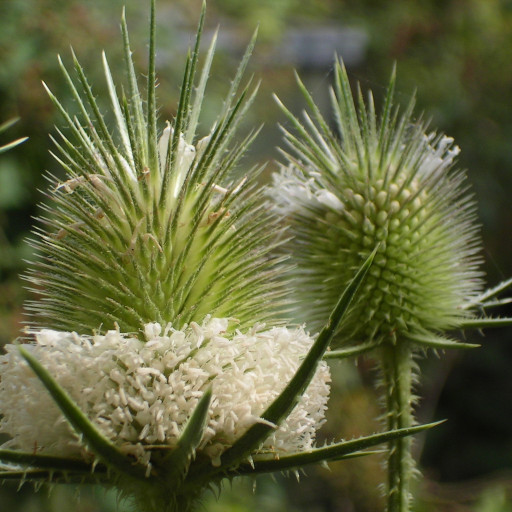
Plant Overview
The Cut-leaf Teasel is a striking, architectural giant often seen standing tall in meadows and along sunny roadsides. Known for its "laciniate" (deeply cut) leaves that look as though they’ve been sculpted by a jagged blade, this biennial plant is as tough as it is beautiful. While it originated in Europe and Asia, it has become a famous world-traveler, often prized by dried-flower enthusiasts for its prickly, egg-shaped flower heads that persist long into the winter.
🔍 How to Identify
- 🌿 Deeply Cut Leaves: Unlike its cousins, this variety features large leaves that are deeply lobed or "feathered," forming a jagged, dramatic silhouette against the stem.
- ⚔️ Prickly Stems: The entire plant is armed with stiff, downward-curving prickles, making it a "no-touch" zone for most wandering animals and gardeners.
- 🕊️ White Flower Cones: It produces large, cylindrical flower heads that bloom with tiny white flowers (occasionally pale lavender) in distinct horizontal bands that move across the cone.
🏡 In Your Garden
- 🏗️ Architectural Interest: Many hobbyists love this plant for the "skeleton" it leaves behind. The dried stalks and honey-comb-patterned heads provide a hauntingly beautiful vertical element in winter landscapes.
- ⚠️ Spreading Nature: Be mindful that this plant is a prolific self-seeder. A single head can drop thousands of seeds, and in many regions of North America, it is considered a stubborn invasive that can crowd out native wildflowers.
- 🥕 The Taproot Trap: In its first year, the plant grows as a flat green rosette. It develops a deep, sturdy taproot during this time, making it very difficult to pull out by hand once it reaches its second-year "blooming" phase.
⚠️ Safety & Toxicity
- 🌵 Mechanical Irritant: The plant is not known to be chemically toxic to humans or pets, but it is physically hazardous. The sharp spines can easily puncture skin or cause significant irritation.
- 🐾 Pet Precaution: While not a "poison" risk, the prickly flower heads can get stuck in long fur or cause mouth injuries if a curious dog tries to chew on the dried stalks.
- 🧤 Hand Protection: Always wear thick, leather gardening gloves when handling or pruning this plant to avoid "teasel-rash" caused by micro-scratches.
✨ Fun Fact
The leaves of the Teasel grow in pairs and fuse at the base to form small "cups" around the stem that collect rainwater. These pools are called phytotelmata. Legend once held that this water could cure warts or brighten the eyes, but modern scientists are more interested in whether the plant is "carnivorous," as it may absorb nutrients from insects that accidentally drown in these tiny leaf-pools!

Detailed Care Instructions
To grow Dipsacus Laciniatus plant, also known as Cut-Leaf Teasel or Wild Teasel, follow these steps:
- Choose the right location: Plant the teasel in a spot that receives full sun or partial shade. Ensure the area has well-draining soil with a pH level of 6.5 to 7.5.
- Prepare the soil: Loosen the soil in the planting area using a garden fork or tiller. Remove any rocks, weeds, or debris from the area.
- Sow the seeds: Plant the seeds directly into the prepared soil in early spring or fall. The seeds should be spaced about 12 to 18 inches apart. Sow them just below the soil surface, covering with a thin layer of soil.
- Watering: Keep the soil moist during the germination period. After the plants are established, reduce watering frequency, allowing the soil to dry out slightly between waterings. Teasels are drought-tolerant plants.
- Provide support: Teasel plants can grow quite tall and may need support to prevent them from falling over. Use stakes or garden trellises to provide support for the plants.
- Mulching: Apply a layer of organic mulch, such as wood chips or straw, around the base of the plants. This will help retain moisture in the soil and suppress weed growth.
- Pruning: Remove any dead or diseased leaves or stems to keep the plant healthy. Cut back the plants after flowering to stimulate new growth.
- Fertilizing: Dipsacus Laciniatus doesn't require much fertilization. However, you can add a balanced fertilizer once or twice during the growing season if the soil lacks nutrients.
- Protect from pests and diseases: Keep an eye out for common garden pests like aphids or slugs and take appropriate measures to control them. Ensure good air circulation around the plants to prevent diseases.
- Harvesting: Teasel seeds can be harvested when they turn brown and dry on the plants. Cut the seed heads and store them in a dry place to collect the seeds for future propagation.
By following these steps, you can successfully grow Dipsacus Laciniatus plant in your garden or outdoor space.

Place in a bright room that is sun drenched almost all day. Or directly in a south-facing window.

To water the plant, ensure that the soil is dry to the touch before watering. Carefully pour water directly onto the soil and avoid getting water on the leaves or stem of the plant. Be careful not to overwater the plant, as this can lead to root rot and other problems. Water only when the top inch of soil is dry, and adjust watering frequency based on the climate and humidity levels in your area. It is best to water in the early morning or late afternoon to avoid evaporation or scorching from direct sunlight.
The recommended fertilizing instructions for this plant include applying a balanced fertilizer with equal amounts of nitrogen, phosphorus, and potassium in spring and summer. It is advisable to dilute the fertilizer with water and use it sparingly to prevent over-fertilization. Additionally, avoid applying fertilizers directly to the plant's foliage as this can cause leaf burn. Instead, apply the fertilizer around the base of the plant and water it in thoroughly. Always follow the manufacturer's instructions and avoid using fertilizer that contains high levels of salts or heavy metals.
Dipsacus Laciniatus plant requires well-draining soil with a pH range of 6.0 to 7.5. The soil should be rich in organic matter and have a good balance of nutrients. It is recommended to use loamy soil that retains moisture but does not get waterlogged. The soil should be kept moist but not overly wet, as this can cause root rot. Adding compost or aged manure to the soil can help improve the soil's fertility and texture. It is also advisable to add sand to the soil to improve drainage and prevent waterlogging.
There are a few methods to propagate this plant. One option is to collect seeds from mature plants and plant them in well-draining soil. Another option is to take stem cuttings and place them in water or rooting hormone before planting them in soil. It is important to keep the soil evenly moist and provide plenty of light for successful root development. Once new growth appears, it is important to gradually acclimate the plant to outdoor conditions if it will be planted outside.








