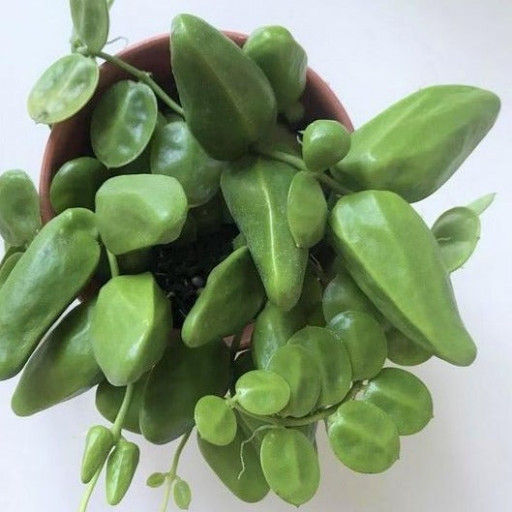
Plant Overview
Often called the Malayan Urn Plant or the Rattle Skull Plant, this bizarre climber is one of nature’s most fascinating architects. Hailing from the tropical rainforests of Southeast Asia, it doesn't just grow; it builds. It is a "myrmecophyte," meaning it has evolved a complex, symbiotic relationship with ants, providing them with custom-built housing in exchange for protection and nutrients.
🔍 How to Identify
- 🐚 The "Urn" Leaves: Its most striking feature is its large, hollow, shell-like leaves that look like green pouches or inverted urns.
- 🍃 Standard Foliage: Aside from the urns, it produces small, circular, succulent-like leaves that grow in pairs along its climbing vines.
- 🌼 Subtle Blooms: It produces tiny, inconspicuous yellowish-green flowers that often hide beneath the foliage, tucked away from plain sight.
🏡 In Your Garden
- 🐜 A Natural Apartment: In the wild, those hollow urn leaves are designed to house ant colonies. While you likely won't have ants indoors, the plant still grows these structures as a signature of its unique biology.
- ☁️ Epiphytic Nature: This plant hates being "suffocated" by heavy potting soil. Because it naturally grows on tree trunks, it thrives best in orchid bark or sphagnum moss where its roots can breathe.
- 💧 The Humidity Factor: Coming from the rainforest canopy, it craves high humidity. If the air is too dry, the "urns" may fail to develop properly or may shrivel at the edges.
⚠️ Safety & Toxicity
- 🐾 Mildly Toxic: Like many members of the Milkweed family, Dischidia major contains a milky white sap (latex) that can be irritating.
- 👄 Keep Away from Pets: If ingested by cats or dogs, the sap can cause oral irritation or digestive upset. It is best kept hanging high out of reach of curious paws or toddlers.
✨ Fun Fact
The Dischidia major is a master of recycling! It actually grows "adventitious roots" that travel inside its own hollow urn leaves to feast on the carbon dioxide and waste produced by the ants living inside. It is effectively "eating" its own roommates' leftovers!

Detailed Care Instructions
To grow Dischidia Major plant, you can follow the below steps:
- Choose the right location: Dischidia Major plants are native to tropical areas and require bright indirect light. Place the plant near a window where it can receive bright but filtered sunlight. Avoid direct sunlight as it can scorch the leaves.
- Provide the right temperature: The ideal temperature range for Dischidia Major is between 65-85°F (18-29°C). Avoid exposing the plant to extreme temperature fluctuations or drafts.
- Watering: Dischidia Major prefers consistently moist soil. Water the plant when the top inch of soil feels dry, but do not let it sit in water, as this can lead to root rot. Ensure proper drainage in the pot by using a well-draining potting mix.
- Humidity: These plants thrive in high humidity environments. You can increase humidity by placing a tray of water near the plant, using a humidifier, or misting the leaves regularly.
- Fertilization: Feed the Dischidia Major plant with a balanced liquid houseplant fertilizer diluted to half strength every 2-4 weeks during the growing season (spring and summer). Avoid fertilizing during the winter months.
- Pruning: Prune the plant to maintain its shape and remove any dead or damaged foliage. You can also trim long tendrils to control the size and promote a fuller growth habit.
- Propagation: Dischidia Major can be propagated through stem cuttings. Take a healthy stem cutting with a few nodes and place it in a well-draining potting mix. Keep the cutting in a warm and humid environment until roots develop.
- Support system: Dischidia Major is a vining plant that produces aerial roots. Provide a trellis, moss pole, or other support system for the plant to climb on.
- Re-potting: If the plant becomes root-bound or outgrows its pot, consider re-potting it into a slightly larger container with fresh potting soil. Repotting is usually done in the spring.
By following these guidelines, you can help the Dischidia Major plant to grow and thrive in your indoor space.

Place in a window with dappled sun or a spot in the middle of a room. Or directly in a window facing west or east.

To water this particular plant, you should first ensure that the soil is slightly moist and not overly dry. The amount of water required will depend on the size of the pot and the environment that the plant is in. In general, it is best to water the plant once every one to two weeks. You should be careful not to overwater the plant as this can cause root rot and other issues. One way you can tell if the plant needs water is by checking the soil moisture level using your finger or a moisture meter. If the top inch of soil feels dry to the touch, it is time to water the plant. When you do water the plant, ensure that you thoroughly saturate the soil until water comes out of the drainage holes at the bottom of the pot. Finally, it is important to allow excess water to drain away and to discard any excess water that has collected in the saucer beneath the pot.
To effectively fertilize Dischidia Major, it is recommended to use a balanced, water-soluble fertilizer with a nitrogen-phosphorus-potassium (N-P-K) ratio of 20-20-20. Dilute the fertilizer according to the manufacturer's instructions, and apply it to the soil around the base of the plant every two weeks during the growing season (spring and summer). During the dormant season (fall and winter), reduce the frequency of fertilizing to once a month. It's important not to over-fertilize, as this can damage the plant and lead to nutrient burn. Make sure to water the plant thoroughly before and after fertilizing to prevent root damage.
The optimal soil for Dischidia Major plants is a well-draining and nutritious soil mix that is slightly acidic. This mix should be made up of equal parts peat moss, perlite, and vermiculite or sand. The soil should be moist but not over-saturated, as this can lead to root rot and other issues. Adding organic matter such as compost can also provide additional nutrients to the soil. It is important to avoid using heavy, clay-like soils or those that contain too much fertilizer, as these can harm the plant.
Here are the steps to propagate Dischidia Major without using its common name:
- Get a mature Dischidia Major plant with healthy stems and leaves.
- Prepare a clean, sharp cutting tool like a pair of scissors or pruning shears.
- Look for a stem with at least 2-3 healthy leaves and cut it just below a node or leaf joint.
- Remove the bottom leaves of the stem, leaving only 1-2 leaves at the top.
- Dip the cut end of the stem in rooting hormone powder to encourage root growth.
- Plant the stem cutting in a well-draining potting mix, preferably a mix of peat moss and perlite.
- Water the cutting thoroughly and cover it with a clear plastic bag to maintain humidity.
- Place the cutting in a warm, bright location, but away from direct sunlight.
- Check the cutting regularly and keep the soil moist but not waterlogged.
- After about 4-6 weeks, new roots should start to emerge from the bottom of the cutting and new growth from the top.
- Once the new plant has developed a strong root system and several leaves, it can be transplanted into a bigger pot with fresh potting soil and grown as a mature plant.
Common pests of the malayan urn vine include Scale insect, mealybugs, spider mites. Make a habit of checking your malayan urn vine frequently for pests so that any infestations can be caught and managed early.








