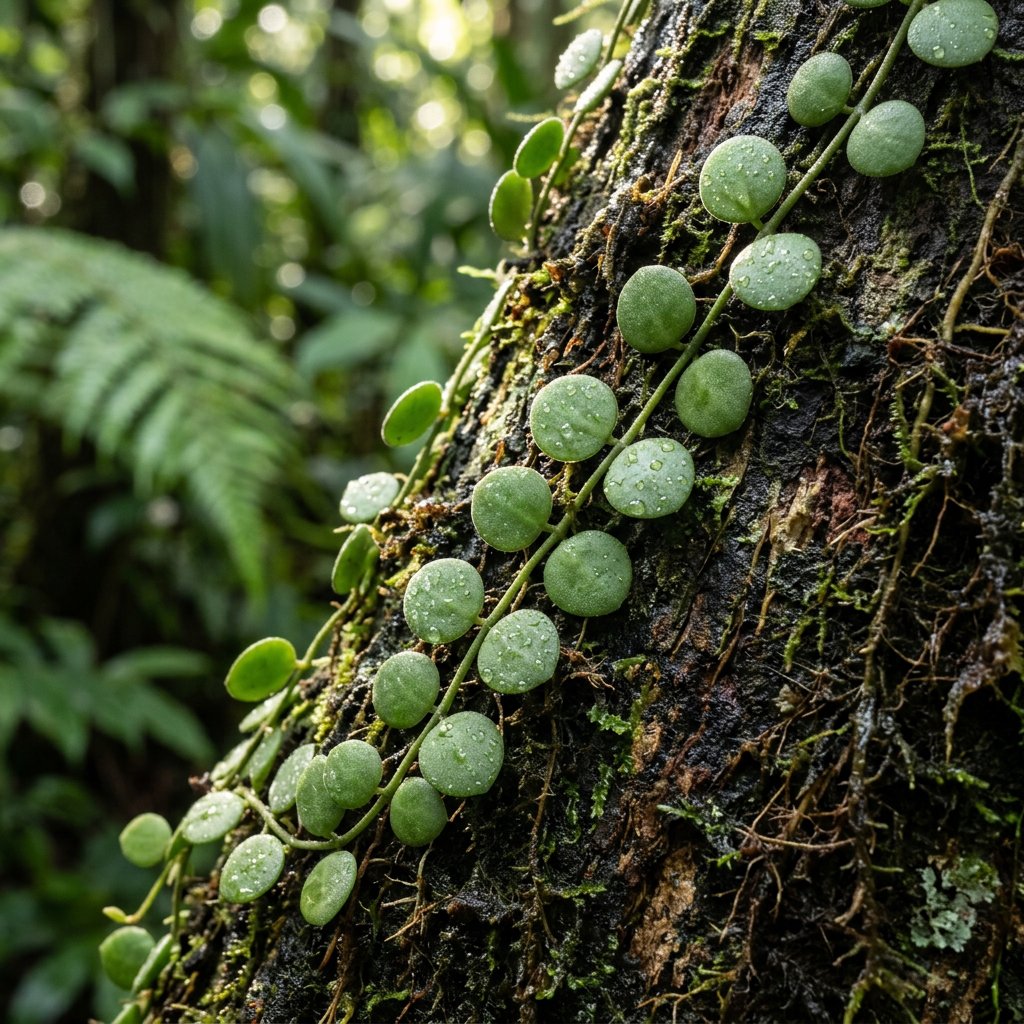
Plant Overview
Known as the "String of Nickels," this charming epiphytic climber hails from the humid tropical forests of Southeast Asia and Australia. A close relative of the popular Hoya, it is often found in the wild scrambling up mossy tree trunks or cascading from branches. Its perfectly round, coin-shaped leaves give it a playful, modern aesthetic that makes it a favorite for hanging baskets and terrariums.
🔍 How to Identify
- 🪙 Leaf Shape: Small, round, and succulent leaves that sit flat against their stems or dangle in chains, closely resembling minted coins or buttons.
- 🌿 Texture & Color: The foliage has a soft, matte finish and ranges from a dusty lime to a silvery-green, often appearing slightly "frosted" due to a waxy coating.
- 🌸 Blooms: It produces tiny, inconspicuous white or pale yellow flowers that emerge from the leaf axils, though they are often hidden by the dense foliage.
🏡 In Your Garden
- 🌳 Epiphytic Lifestyle: In nature, this plant doesn't grow in soil; it grows on trees! Because of this, it hates "wet feet." It thrives best in orchid bark, sphagnum moss, or coco coir blends that allow its roots to breathe.
- ☁️ Humidity & Light: It drinks through its leaves as much as its roots. It craves high humidity and bright, dappled light—direct afternoon sun can actually "cook" the delicate, water-filled leaves.
⚠️ Safety & Toxicity
- 🛡️ Low Risk: The String of Nickels is generally considered non-toxic to cats, dogs, and humans, making it a safe choice for a busy household.
- 💧 Sap Irritant: Like many of its cousins, the plant contains a milky white latex sap. While not deadly, this sap can cause mild skin irritation for people with sensitive skin or a stomach ache if ingested in large quantities.
✨ Fun Fact
In their native habitats, Dischidia are known as "Ant Plants." While the String of Nickels is more subtle, many of its siblings grow hollow, balloon-like leaves specifically to provide "apartments" for ants, who in turn protect the plant from pests!

Detailed Care Instructions
| Color | Yellow, White |
| Soil Ph | Neutral, Alkaline |
| Humidity | High |
| Lighting | Part Sun |
| Toxicity | Non-Toxic |
| Soil Type | Well-Drained |
| Bloom Time | Spring, Summer |
| Difficulty | Medium |
| Plant Type | Succulent |
| Hibernation | Cold Period |
| Mature Size | 12-18 In. Long, 15-24 In. Spread |
| Native Area | India, Asia, Australia |
| Temperature | 18°C - 24°C |
| Sun Exposure | Partial, Shade |
| Hardiness Zones | 11-12 |
To successfully grow Dischidia Nummularia plant, also known as String of Nickels or Button Orchid, follow these steps:
- Light: Place the plant in bright, indirect sunlight. Dischidia Nummularia thrives in bright light conditions but avoid direct sun as it could scorch the leaves.
- Temperature: The ideal temperature range for this plant is between 65-80°F (18-27°C). Avoid placing it in drafty areas or near air conditioning vents.
- Watering: Dischidia Nummularia prefers slightly moist soil. Water the plant when the top inch of soil feels dry to the touch. Avoid overwatering as it can lead to root rot. Ensure the pot has proper drainage to prevent waterlogging.
- Humidity: This plant prefers higher humidity levels. Mist the leaves regularly or place a tray of water near the plant to increase humidity. Alternatively, you can use a humidifier to maintain the desired humidity level.
- Soil: Use well-draining potting soil or create a mixture of peat moss, orchid bark, and perlite. Ensure the soil doesn't retain excess water.
- Fertilizer: Feed the plant with a balanced liquid fertilizer diluted to half the recommended strength during the growing season (spring and summer). Reduce or stop feeding during the winter months.
- Pruning: Prune the plant to control its size and appearance. Regular trimming helps maintain a compact and bushy shape.
- Propagation: Dischidia Nummularia can be propagated through stem cuttings. Cut a healthy section of the stem and remove the lower leaves. Place the cutting in water until roots form and then transfer it to a pot with well-draining soil.
- Potting: Use a small-sized pot with good drainage holes. A shallow pot is ideal for this trailing plant as it allows the stems to cascade and grow freely.
- Support: Provide support for the trailing stems using a trellis or stake if desired. This will help the plant maintain an upright growth pattern.
Remember to monitor your Dischidia Nummularia plant regularly to ensure it remains healthy and adjust care as needed.

Place in a window with dappled sun or a spot in the middle of a room. Or directly in a window facing west or east.

To water this plant, you should first ensure that the soil is completely dry before watering. This can be checked by sticking your finger into the soil, up to the second knuckle. If the soil feels moist, do not water. If it feels dry, water the plant thoroughly until water runs out of the drainage holes at the bottom of the pot. After watering, allow the soil to drain completely before putting the plant back in its usual spot. It is important not to overwater this plant, as it is susceptible to rot. Watering once every 7-10 days is usually sufficient.
To fertilize this plant, use a balanced liquid fertilizer diluted to half strength. Apply the fertilizer once a month during the growing season of spring and summer. Avoid fertilizing during the plant's dormant period in winter. Be sure to follow the manufacturer's instructions for the fertilizer and avoid over-fertilizing as this can damage the plant.
It is recommended to use a well-draining soil mix for this plant that is rich in organic matter. The soil should not be too heavy and should have good aeration to prevent waterlogging, which can lead to root rot. A mix of perlite, coarse sand, and peat moss or coconut coir can provide the ideal soil conditions. The pH of the soil should be slightly acidic, between 5.5 to 6.5. It is also important to ensure that the soil is kept consistently moist but not waterlogged, and to avoid using hard tap water that may contain high levels of minerals.
One can propagate this plant either through stem cuttings or leaf cuttings.
Stem cuttings:
- Choose a healthy stem from the mother plant that is about 3-4 inches long.
- Cut the stem below a node (where the leaves grow out from the stem) using a sharp, clean pair of scissors or pruning shears.
- Remove all the leaves except for the top few leaves.
- Dip the end of the stem cutting into rooting hormone (optional).
- Plant the stem cutting upright in a pot filled with moist potting mix or peat moss.
- Cover the pot with a clear plastic bag or container to create a mini greenhouse and keep the cutting moist.
- Place the pot in a bright, warm spot but out of direct sunlight.
- Check the cutting regularly and mist with water if the soil or plant starts to dry out.
- Within a few weeks, roots should start to grow from the stem cutting and new leaves may also emerge.
- Once the plant has established roots, remove the plastic bag or container and gradually expose it to more sunlight and less humidity.
Leaf cuttings: - Choose a healthy leaf from the mother plant that has a stem attached.
- Cut the stem just below the leaf node using a sharp, clean pair of scissors or pruning shears.
- Cut the leaf in half down the middle (but not all the way through the stem).
- Spread the two halves of the leaf apart slightly to expose the stem.
- Dip the end of the stem into rooting hormone (optional).
- Plant the leaf cutting in a pot filled with moist potting mix, making sure the stem part is buried in the soil.
- Cover the pot with a clear plastic bag or container to create a mini greenhouse and keep the cutting moist.
- Follow the same steps as for stem cuttings to care for the cutting.
- Within a few weeks, roots should start to grow from the stem cutting and new leaves may also emerge.
- Once the plant has established roots, remove the plastic bag or container and gradually expose it to more sunlight and less humidity.
Common pests of the string of nickels include Scale insect, mealybugs, spider mites. Make a habit of checking your string of nickels frequently for pests so that any infestations can be caught and managed early.








