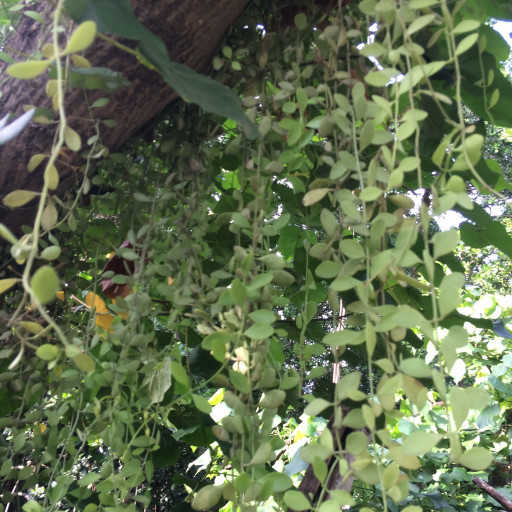
Plant Overview
Often called the "String of Nickels" or the "Pebble Plant," Dischidia oiantha is a charming epiphytic trailer hailing from the humid tropical rainforests of Southeast Asia and the Philippines. In its natural home, it spends its life dangling from tree branches, soaking up humidity and dappled sunlight. Its understated, coin-like foliage makes it a minimalist favorite for modern interiors and terrariums.
🔍 How to Identify
- 🍃 Succulent Foliage: The leaves are small, oval-shaped, and remarkably thick. They are fleshy to the touch, as they are designed to store water for lean times high up in the canopy.
- 🎨 Silvery Hues: This variety boasts a dusty, pale green or silvery-grey sheen. This "frosted" look distinguishes it from its deeper green relatives.
- 🧶 Trailing Vines: It produces long, slender, wire-like stems that can gracefully drape over the sides of a hanging basket or climb up a moss pole using tiny, clinging aerial roots.
🏡 In Your Garden
- 🌳 The "Air Plant" Mentality: Because it is an epiphyte, it hates "wet feet." It thrives best in chunky, airy mixes like orchid bark or sphagnum moss rather than traditional heavy potting soil, which can suffocate its roots.
- ☀️ Dappled Sunlight: Think of its home under the forest canopy; it craves bright, filtered light. Direct afternoon sun will scorch the leaves, while deep shade will cause the vines to become "leggy" and sparse.
- 💧 Humidity is Key: While it is drought-tolerant thanks to its succulent leaves, it breathes through its foliage. It loves being placed in a bathroom or near a humidifier to mimic the misty tropical air.
⚠️ Safety & Toxicity
- 🐾 Pet Sensitivity: While not considered highly toxic, Dischidia oiantha belongs to the same family as Milkweeds. If a curious cat or dog chews on the stems, the milky sap can cause mild stomach upset or drooling.
- 🖐️ Sticky Sap: The white latex sap can be a skin irritant for humans with sensitive skin. It is a good idea to wash your hands after pruning or to wear gloves to avoid "sap-itch."
✨ Fun Fact
In the wild, many Dischidia species are "myrmecophytes," meaning they have a symbiotic relationship with ants! The plant provides "rooms" (hollow leaves or root gaps) for ants to live in, and in exchange, the ants protect the plant from pests and leave behind nutrient-rich waste that acts as fertilizer.

Detailed Care Instructions
To grow Dischidia Oiantha, also known as the Ant Plant or String of Nickels, you can follow these steps:
- Selecting a pot: Choose a small pot with good drainage holes. Dischidia Oiantha is an epiphytic plant that can grow on trees, so a pot with a loose and well-draining medium, such as orchid bark or a mixture of coco coir and perlite, is recommended.
- Light: Place the Dischidia Oiantha in bright, indirect light. It can tolerate some direct sunlight, but too much can cause leaf burn. An east or west-facing window where it receives morning or afternoon sun is ideal.
- Watering: Keep the soil evenly moist, but avoid overwatering as it can lead to root rot. Allow the top inch of the soil to dry out between waterings. Ensure the pot has good drainage, and never let the plant sit in standing water.
- Humidity: Dischidia Oiantha prefers high humidity, so misting the leaves regularly or placing a tray of water near the plant to create a humid microclimate can be beneficial.
- Temperature: Dischidia Oiantha prefers temperatures between 60-80°F (15-27°C). It can tolerate slightly cooler temperatures but should be protected from frost.
- Fertilization: Feed the plant once a month during the growing season (spring and summer) with a diluted balanced liquid fertilizer. Avoid fertilizing during the winter months when the plant is dormant.
- Support: Dischidia Oiantha is a trailing vine, so providing some support like a trellis or letting it cascade over a pot will enhance its growth and aesthetic appeal.
- Propagation: Dischidia Oiantha can be propagated through stem cuttings. Take a cutting with a few leaves and aerial roots, and place it in a rooting medium such as perlite or water until it develops roots. Then, transplant it into a pot with well-draining soil.
- Pruning: Regular pruning can help maintain the shape and encourage bushier growth. Trim any leggy or unruly vines to keep the plant neat and tidy.
Remember to regularly monitor the health of your Dischidia Oiantha by checking for pest infestations, such as mealybugs or spider mites, and treat accordingly. With proper care, your Dischidia Oiantha should grow well and thrive.

Place in a window with dappled sun or a spot in the middle of a room. Or directly in a window facing west or east.

To water this plant properly, ensure that the soil is dry to the touch before watering. Use room temperature water and water thoroughly until it runs out of the drainage holes at the bottom of the pot. Allow the excess water to drain away and do not let the plant sit in standing water. Watering frequency will depend on environmental conditions, but it is important to avoid over-watering as this can lead to root rot. Instead, wait until the soil is dry again before watering. It may also be beneficial to mist the leaves with water to increase humidity levels around the plant.
To fertilize this plant, mix a balanced liquid fertilizer at half strength and apply it once a month during the growing season. Ensure that the soil is moist before application and water the plant lightly afterwards. Avoid fertilizing in the winter months when the plant is not actively growing.
Dischidia Oiantha plant tends to thrive best in nutrient-rich, well-draining soil. Ideal soil mixtures for this plant should be a blend of peat moss, perlite, and vermiculite or a similar porous and aerated mixture that can drain excess water easily whilst holding in sufficient moisture. It is crucial to ensure that the soil does not become too waterlogged, as this can lead to root rot or other water-based diseases and conditions. The soil should be acidic with a pH between 5.5 and 6.5, and the plant should be fertilized with a balanced liquid fertilizer during the growing season. When selecting soil to use, aim for a quality mixture that doesn't contain heavy amounts of organic matter and that drains well- this will provide your Dischidia Oiantha with the best soil environment to flourish.
Dischidia oiantha plant can be propagated through several methods. One of the easiest ways is through stem cuttings. To do this, choose a healthy stem that is about 4-6 inches long and has several nodes. Cut the stem at a 45-degree angle just below a node. Remove the bottom leaves from the stem, leaving only one or two pairs of leaves at the top. Dip the cut end of the stem in rooting hormone and plant it in a pot with well-draining soil. Water it lightly and place the pot in a bright spot but out of direct sunlight. Keep the soil moist and in a few weeks, roots and new growth should appear.
Another way to propagate Dischidia oiantha is through air layering. This method involves making a small cut in the stem, wrapping it with sphagnum moss, and covering it with plastic wrap. Roots will form at the cut area, and then the stem can be cut and planted.
Dischidia oiantha can also be propagated through leaf cuttings. Select a healthy leaf and remove it from the plant, making sure to include a small stem. Cut the leaf into several small sections, each with a portion of the stem attached. Dip the cut end of each section in rooting hormone and plant them in moist soil or sphagnum moss. Keep them in a bright spot out of direct sunlight and keep the soil moist. In a few weeks, roots and new growth should appear.
Common pests of the hanging coin vine include Scale insect, mealybugs, spider mites. Make a habit of checking your hanging coin vine frequently for pests so that any infestations can be caught and managed early.








