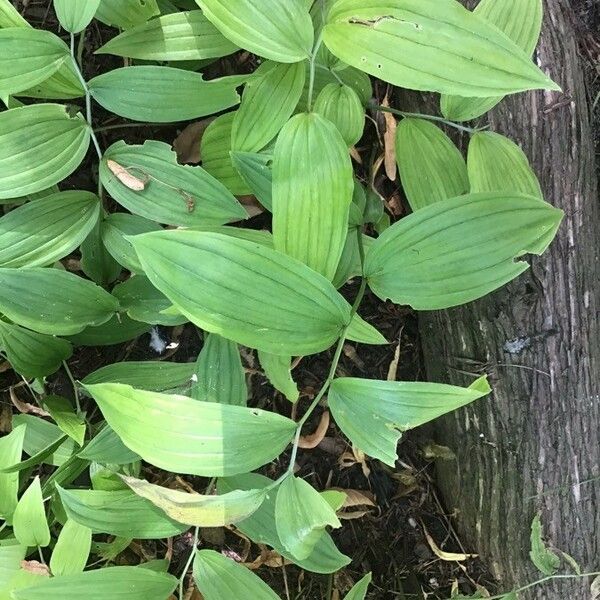
Plant Overview
Often referred to as the "Japanese Fairy Bell," Disporum sessile is a woodland gem that brings a touch of quiet elegance to the shaded corners of a garden. Native to the forests of Japan and Korea, this perennial is beloved for its nodding, bell-shaped flowers that look like tiny lanterns hanging from arching, bamboo-like stems. It carries an air of ancient forest mystery, making it a favorite for Zen-inspired landscapes and cottage shade borders.
🔍 How to Identify
- 🔔 The Flowers: Delicate, creamy-white or greenish-white bells that hang downwards (pendulous). They typically appear in pairs or small clusters at the ends of the branches.
- 🍃 Leaf Texture: Oval to lance-shaped leaves with prominent parallel veining. In many popular garden varieties, these leaves are strikingly variegated with creamy white stripes or margins.
- 🎋 Growth Habit: The plant features slender, zig-zagging stems that give it a structural, almost architectural look similar to a miniature bamboo.
🏡 In Your Garden
- 🌳 Woodland Roots: Because it originates on the forest floor, this plant thrives in dappled shade. It is the perfect solution for those "difficult" dark spots under large deciduous trees where other plants might struggle.
- 💧 Soil Secrets: It prefers "humus-rich" soil—think of the decaying leaves in a forest. It hates drying out completely; if the soil gets too parched, the leaf tips will brown and curl as a cry for help.
- 🌱 Spreading Gently: It moves through the garden via underground rhizomes. It isn't aggressive, but it will slowly form a lush, low-maintenance carpet of foliage over several seasons.
⚠️ Safety & Toxicity
- 🚫 Status: Toxic if ingested.
- 🐾 Details: While beautiful, all parts of the plant (especially the dark berries that follow the flowers) contain compounds that can cause stomach upset, vomiting, or lethargy in cats, dogs, and humans. It is best planted in areas where curious toddlers or pets won't be tempted to "sample" the fairy bells.
✨ Fun Fact
The species name "sessile" is a botanical term meaning "stalkless." It refers to the way the flowers are attached almost directly to the stem branches, appearing to hover just beneath the leaves without a long supporting neck.

Detailed Care Instructions
To grow Disporum sessile plants, follow these steps:
- Choose a suitable location: Disporum sessile plants prefer partially shaded areas, such as under trees or on the east or north side of a building. They also need well-draining soil.
- Prepare the soil: Loosen the soil and remove any weeds or grass. Disporum sessile plants prefer soil with good organic content. You can amend the soil with compost or well-rotted manure to improve its fertility and drainage.
- Planting: Dig a hole slightly larger than the root ball of the Disporum sessile plant. Place the plant in the hole at the same depth it was growing in its container, or slightly higher if the soil is heavy and tends to retain water. Backfill the hole with soil, gently firming it around the roots.
- Watering: Water the Disporum sessile plant thoroughly after planting. Keep the soil evenly moist but not waterlogged. Water regularly during dry periods, especially in the plant's first year as it establishes.
- Mulching: Apply a layer of organic mulch around the base of the plant, but avoid touching the stem. Mulch will help conserve moisture, suppress weeds, and regulate soil temperature.
- Pruning: Disporum sessile plants generally do not require extensive pruning. However, you can prune any dead or damaged stems and remove any spent flowers to maintain a tidy appearance.
- Fertilization: Disporum sessile plants do not require heavy fertilization. You can apply a balanced slow-release fertilizer once a year in early spring.
- Division: As Disporum sessile plants mature, they can become crowded. Every 3-5 years, you can dig up the plant in early spring or fall and divide the rhizomes to create new plants. Replant the divisions at the same depth as before.
- Pest and disease control: Disporum sessile plants are generally resistant to pests and diseases. However, keep an eye out for common garden pests like aphids, slugs, or snails, and take appropriate measures to control them if necessary.
By following these steps, you can successfully grow Disporum sessile plants and enjoy their attractive foliage and delicate flowers.

Place in a window with dappled sun or a spot in the middle of a room. Or directly in a window facing west or east.

Disporum Sessile plant requires regular watering to maintain healthy growth. It is important not to over-water the plant as it can lead to root rot, but the soil should never completely dry out.
To water the plant, gently pour water into the soil around the base of the plant until the soil is thoroughly moistened. It is best to avoid getting water on the leaves or stems of the plant as this can cause damage.
The frequency of watering will depend on the specific conditions of the plant's environment, such as temperature, humidity, and the type of soil it is planted in. In general, it is best to water Disporum Sessile plant when the top inch of soil feels dry to the touch.
It is also important to monitor the drainage of the soil. If the plant is left in standing water, it can lead to root rot. Ensure that the soil and pot have adequate drainage holes to prevent this from happening.
To fertilize Disporum Sessile, apply a balanced, slow-release fertilizer in the spring before new growth emerges. Repeat application every six to eight weeks during the growing season. Be careful not to over-fertilize, as this can lead to burnt leaves and weakened growth. Water thoroughly after fertilizing to help nutrients reach the root zone.
The ideal soil for Disporum Sessile plant is a well-draining soil that is rich in organic matter. It should be slightly acidic with a pH between 5.5 and 6.5. A loamy soil with a balanced mixture of sand and clay is perfect, although sandy soil can also work if mixed with compost and other organic matter. The soil should be kept moist but not waterlogged, as Disporum Sessile does not tolerate standing water. It is also recommended to mulch around the plant to help retain moisture and suppress weeds. In addition, Disporum Sessile prefers partial to full shade and should be planted in a location that receives shade for most of the day.
Disporum Sessile plant can be propagated through asexual means such as division, stem cuttings, and layering.
Division: The plant can be divided by carefully digging up the root ball of the mature plant and separating the roots into sections, ensuring that each section has a healthy root system and above ground foliage. These sections can then be replanted in soil that is rich in organic matter and provided with regular watering and fertilizing.
Stem Cuttings: Stem cuttings can be taken during the plant's growing season. Cut a 4-6 inch piece of stem with a sharp, sterilized blade. Remove the leaves from the lower half of the stem and dip the cut end in rooting hormone powder. Plant the cutting in a pot filled with a mixture of peat moss and perlite. Place the pot in a well-lit area, ensuring that the soil stays moist. The cutting should root within a few weeks and can be transplanted to its permanent location.
Layering: Layering is a method in which a portion of the plant is encouraged to root while still attached to the mother plant. Select a low-hanging stem and bury a portion of it in soil, leaving the tip exposed. Secure the buried section of stem with a small stake or rock. Once roots have formed, sever the stem from the mother plant and transplant the new plant to its permanent location.








