Plant Overview
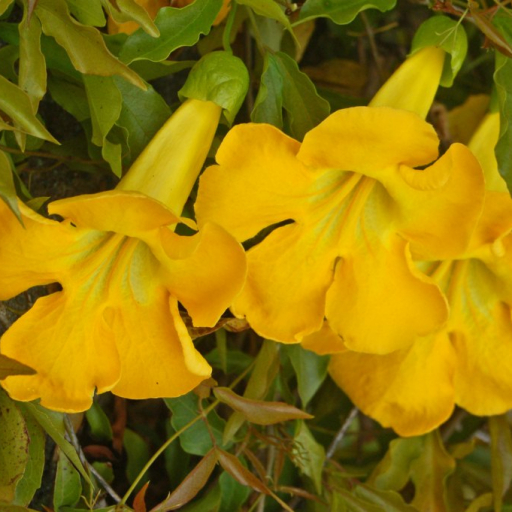
Known widely as the Cat's Claw Creeper, this woody evergreen vine is a golden-flowered powerhouse famous for its relentless ability to climb. While it produces a stunning canopy of yellow trumpets in the spring, it is also known in the gardening world as a "beautiful monster" due to its aggressive growth and specialized climbing hardware. Native to the tropical forests of Central and South America, it has traveled the world as an ornamental, often escaping the garden to "suffocate" entire trees in the wild.
🔍 How to Identify
- 🐱 The "Claws": Look closely at the leaves; the vine features unique three-pronged, hooked tendrils between the leaf pairs that look exactly like a cat’s talons, allowing it to grip even the smoothest bark.
- 🎺 Trumpet Flowers: It produces vibrant, bright yellow flowers that are funnel-shaped and can grow up to 3 inches long, usually appearing in a spectacular burst during late spring.
- 🌿 Dual Foliage: It has "opposite" leaves that are dark green and oval. Interestingly, when the plant is young and trailing on the ground, the leaves look quite different than when it is mature and climbing high.
🏡 In Your Garden
- 🥔 The Underground Secret: This plant is incredibly difficult to remove because it grows large, potato-like tubers deep underground. These tubers store water and energy, allowing the plant to survive droughts and bounce back even if the top is cut off.
- 🚀 Vertical Ambition: If you choose to grow this, give it a very sturdy trellis or a stone wall. Avoid planting it near "host" trees or native bushland, as it can quickly drape over the canopy, blocking sunlight from the plants beneath it.
- ✂️ Containment is Key: In many regions (like Florida and parts of Australia), it is considered a significant invasive weed. Regular pruning is mandatory to prevent it from spreading via its winged seeds, which are easily carried by the wind.
⚠️ Safety & Toxicity
- 🟢 General Safety: Dolichandra unguis-cati is not typically listed as a high-risk poisonous plant for humans or common household pets if touched or accidentally nibbled in small amounts.
- 🪝 Physical Injury: The primary "danger" of this plant is mechanical. The sharp, hooked tendrils can easily snag skin or clothing, and pulling the vine down from a height can result in scratches.
- 🌎 Ecological Risk: Its greatest "toxicity" is to the environment. Because it creates a dense mat on the forest floor and a heavy curtain in the trees, it can kill native vegetation.
✨ Fun Fact
The "Cat's Claw" tendrils are actually a marvel of biological engineering; they are modified leaves that have evolved specifically to find tiny crevices in tree bark, acting like a mountain climber’s grappling hook!

Detailed Care Instructions
| Lighting | Full Sun |
| Hardiness Zones | 8A - 10B |
To grow Dolichandra Unguis-cati, also known as the cat's claw, you can follow these steps:
- Choose the right location: Dolichandra Unguis-cati prefers a sunny location with well-draining soil. Ensure there is enough space for the plant to spread out as it grows.
- Planting: Dig a hole in the prepared soil that is approximately twice the size of the root ball. Place the plant in the hole and backfill with soil, gently firming it around the root ball. Water the plant thoroughly after planting.
- Watering: Keep the soil consistently moist but not waterlogged. Water the plant deeply once or twice a week during dry periods. Allow the soil to dry out slightly between waterings to prevent root rot.
- Fertilizer: Apply a balanced, slow-release fertilizer in the spring and summer to promote healthy growth. Follow the package instructions for dosage.
- Pruning: Prune the cat's claw vine in late winter or early spring to control its size and shape. Cut back any dead or damaged branches and thin out dense growth to allow airflow.
- Support: Since Dolichandra Unguis-cati is a vine, it will need support to grow properly. Install a trellis or provide a sturdy structure for the plant to climb on.
- Pests and diseases: Monitor the plant for common pests like aphids, mealybugs, or spider mites. Treat any infestations promptly using appropriate organic or chemical insecticides. Regularly inspect the plant for signs of diseases like powdery mildew or leaf spot and treat accordingly.
- Propagation: Dolichandra Unguis-cati can be propagated through stem cuttings. Take 4-6 inch long cuttings from the healthy, mature vines, remove the lower leaves, and dip the cut end in a rooting hormone. Plant the cuttings in a well-draining potting mix and keep them in a warm, humid environment until they root.
Remember to research and understand the specific requirements of the Dolichandra Unguis-cati plant and adapt the care accordingly.

Place in a bright room that is sun drenched almost all day. Or directly in a south-facing window.

Dolichandra Unguis-cati is a plant that requires regular watering in order to thrive. It is important to provide the plant with water that is free of chlorine and other chemicals that may be harmful to the plant. One way to do this is to let tap water sit for a few hours before using it to water the plant.
When watering Dolichandra Unguis-cati, it is important to avoid over-watering as this can lead to root rot and other problems. The soil should be allowed to dry out slightly between waterings, but it should never be allowed to become completely dry.
The frequency of watering will depend on a variety of factors, including the size of the plant, the temperature and humidity of the environment where it is located, and the type of soil it is planted in. In general, Dolichandra Unguis-cati should be watered every few days during the growing season, and less frequently during the winter months.
When watering, it is important to avoid getting water on the leaves of the plant, as this can lead to fungal diseases and other problems. Water should be applied directly to the soil, and care should be taken to avoid getting water on any flowers or buds that may be present.
To fertilize this plant, use a balanced fertilizer formula with equal amounts of nitrogen, phosphorus, and potassium. You can apply the fertilizer every two weeks during the growing season but reduce its frequency during the dormant season. Always water the plant before applying fertilizer to avoid burning the roots, and follow the instructions on the fertilizer package for dosage and application. You may also want to add organic compost or manure to the soil before planting or apply it as a topdressing every year to enrich the soil with nutrients. Keep in mind that over-fertilization can lead to excessive growth, weak stems, and fewer flowers. Therefore, it's essential to monitor the plant's response and adjust the fertilization accordingly.
The ideal soil for this plant should be well-draining and fertile. It should have a slightly acidic to neutral pH level between 6.0 to 7.5. The soil should be rich in organic matter and should have good moisture retention capacity, but it should not be waterlogged. It is recommended to mix the soil with sand or perlite to improve drainage and aeration. The plant prefers loose and light soil, which will allow the roots to spread without any hindrance. The recommended soil type for this plant is sandy loam, but it can also grow well in clay loam or humus-rich soil. Regular fertilization is necessary to maintain soil fertility, and the mulching technique can be used to conserve moisture and improve soil structure. It is essential to ensure that the soil does not become compact or hard, which can lead to root rot and other diseases.
To propagate this plant, first select a healthy parent plant with strong stems and leaves. Take a cutting from the parent plant that is approximately 4-6 inches in length, making sure that it includes a few healthy leaves and a section of stem. Remove any leaves from the bottom inch of the stem.
Prepare a potting mix that is well-draining and rich in organic matter. This can be done by mixing equal parts of peat moss, perlite, and vermiculite.
Dip the cut end of the stem in rooting hormone powder and insert it into the potting mix. Water the soil so that it is moist but not saturated.
Cover the pot with a plastic bag or place it inside a propagating case to create a humid environment. Place the pot in a bright location with indirect sunlight. Keep the soil moist and mist the cutting daily to maintain humidity.
After a few weeks, check for signs of root growth by gently tugging on the cutting. If there is resistance, roots have likely developed. Once there is significant root growth, the cutting can be transplanted into a larger pot or into the garden.
Continue to care for the new plant by providing it with adequate water and fertilization until it is established.








