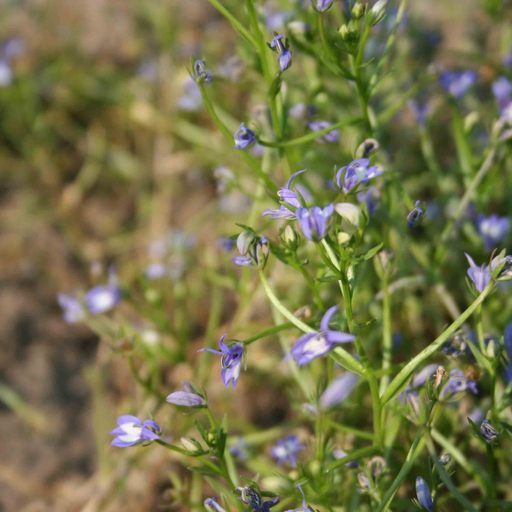
Plant Overview
Often called the Elegant Calico Flower, Downingia elegans is a tiny masterpiece of the Pacific Northwest’s wetlands. Looking like a miniature orchid or a friendly, painted "alien face," these wildflowers create vast carpets of blue and violet as seasonal pools begin to dry up in the late spring. They are the signature stars of vernal pools, specialized ecosystems that disappear as quickly as they arrive.
🔍 How to Identify
- 🌸 The "Face": Each flower features a striking white and yellow "bib" at the center, surrounded by deep blue or violet petals, often looking like a symmetrical mask.
- 🌿 Petal Structure: The flower is divided into five lobes—two narrow ones pointing upward and three broader ones forming a landing platform at the bottom.
- 🌱 Growth Habit: A low-growing annual that usually stays under 10 inches tall, often appearing in dense, colorful patches where water once stood.
🏡 In Your Garden
- 💧 The Vernal Specialist: Unlike most garden plants, this species loves "wet feet" followed by a dry finish. It is difficult to grow in standard flower beds because it requires the unique cycle of a drying mudflat or a very wet meadow.
- 🐝 Pollinator Magnet: It has evolved a specific relationship with solitary bees. If you have a rain garden or a pond edge, these flowers provide a vital nectar source for specialized local insects that ignore more common garden flowers.
⚠️ Safety & Toxicity
- ✅ Low Risk: Downingia elegans is generally considered non-toxic to humans and common household pets.
- 🚫 Not for Consumption: While not inherently dangerous, it belongs to the same family as Lobelia, which contains various alkaloids. It should be enjoyed visually rather than medicinally or as food.
✨ Fun Fact
The intricate yellow and white patterns on the lower petals aren't just for decoration—they are "nectar guides." To a bee, these patterns act like a neon landing strip, directing the insect exactly where to go to find food while simultaneously dusting them with pollen.

Detailed Care Instructions
To grow Downingia elegans (miniature lupine), follow these steps:
- Seed collection: Look for mature plants in the wild and collect seeds in late spring or early fall. Alternatively, you can obtain seeds from reputable seed banks or nurseries that specialize in native plants.
- Soil preparation: Downingia elegans prefers well-draining soil. Prepare the planting area by removing any weeds or grasses and lightly loosening the soil to aid root development.
- Seed scarification: Soak seeds in water for 24 hours or gently rub them between sandpaper to break the hard seed coat. This process, known as scarification, helps improve germination rates.
- Planting: Sow the scarified seeds directly into the prepared soil. Scatter them evenly across the planting area and lightly cover them with a thin layer of soil or vermiculite.
- Watering: Keep the soil consistently moist but avoid overwatering, as excessive moisture can lead to fungal diseases. Use a misting nozzle or sprinkle watering can to provide gentle irrigation.
- Sunlight and temperature: Downingia elegans thrives in a full sun to part shade location. Ensure the plants receive at least 6 hours of direct sunlight each day. The ideal temperature range for growth is between 60-75°F (15-24°C).
- Maintenance: Regularly monitor the soil moisture and water as needed. Remove any weeds that compete for nutrients and space. Additionally, applying a layer of organic mulch around the plants can help to conserve moisture and suppress weed growth.
- Blooming: Expect the first blooms in early spring to late summer, depending on the climate and growing conditions. Enjoy the delicate blue or purple flowers that resemble tiny lupine blooms.
- Pollinator attraction: Downingia elegans flowers attract pollinators like native bees with their nectar-rich blossoms. These plants can assist in providing food sources for pollinators in your garden.
Remember that Downingia elegans is native to specific regions and may have specific requirements. Be sure to check if it is suited to your climate and growing conditions before attempting to grow it.

Place in a bright room that is sun drenched almost all day. Or directly in a south-facing window.

To water this plant, you should make sure to water it thoroughly but infrequently. Allow the soil to dry out slightly before watering again, as this plant prefers to have its roots on the drier side. When you do water it, make sure to do so slowly and evenly, avoiding getting water on the leaves or causing water to pool around the base of the plant. It is also a good idea to use a well-draining soil mix and to ensure that the pot has drainage holes to prevent water from accumulating.
To fertilize this plant, start by selecting a balanced, all-purpose fertilizer. Dilute the fertilizer according to the manufacturer's instructions and apply it to the soil around the base of the plant, being careful not to get any on the leaves. Water the plant thoroughly after fertilizing. It is recommended to fertilize monthly during the growing season, which typically spans from spring to fall. Be sure to avoid over-fertilizing, as this can damage the plant.
Downingia Elegans requires well-draining soil that is rich in organic matter and nutrients. The soil should be slightly acidic with a pH range of 6.0 to 7.0. It thrives in sandy or loamy soils that are moist but not waterlogged. Adding peat moss, compost, or other organic matter to the soil before planting can improve soil texture and fertility. The plant prefers full sun to partial shade and requires regular watering to maintain soil moisture. Overwatering should be avoided as it can lead to root rot. Additionally, applying a balanced fertilizer once a month during the growing season can provide additional nutrients for healthy growth and flowering.
Propagation of this plant can be done through both sexual and asexual means. Sexual propagation involves collecting seeds from the mature plant during its flowering season, which can be sown in a well-drained, nutrient-rich soil. These seeds should be lightly covered with soil and kept moist until they germinate.
Asexual propagation can be done through stem cutting. Take a stem cutting from the mature plant and remove any leaves from the lower end of the stem. Dip the cut end into a rooting hormone and then plant the cutting in a well-drained, nutrient-rich soil. The cutting should be kept moist and out of direct sunlight until it roots and begins to grow.
Another method of asexual propagation is through division. Mature plants can be carefully dug up and divided into smaller sections, each with their own root system. These sections can then be potted in nutrient-rich soil and kept moist until they begin to grow.
Regardless of the propagation method used, the new plant should be cared for in a similar manner as the mature plant, with regular watering, fertilizing, and pruning as needed to maintain a healthy and vigorous plant.








