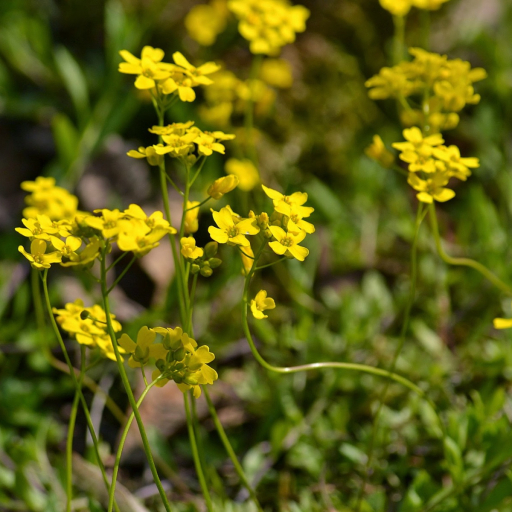
Plant Overview
Known as the Wood Whitlow Grass, this petite and charming member of the Mustard family is one of nature’s earliest spring messengers. Often found hugging the ground in meadows and rocky outcrops across the Northern Hemisphere, it is a pioneer species that thrives where others struggle. Though tiny, its ability to bloom while the ground is still waking up from winter has earned it a quiet respect among botanical enthusiasts.
🔍 How to Identify
- 🌼 The Flowers: Features very small, four-petaled flowers that start as a bright, pale yellow and often fade to a creamy white as they mature.
- 🍃 The Foliage: A tight "basal rosette" of fuzzy, oval leaves sits flat against the soil, while the flowering stems have just a few smaller, alternate leaves.
- 📏 The Seed Pods: Once the flowers fade, they leave behind distinctive, flat, elliptical pods (called silicles) that are held away from the stem on surprisingly long, thin stalks.
🏡 In Your Garden
- 🌱 Disturbed Ground Specialist: You’ll most likely find this plant in "messy" areas—sandy patches, gravel pathways, or the edges of garden beds. It loves disturbed soil where competition from taller grasses is low.
- ☀️ Short but Sweet: It is a "spring ephemeral," meaning it completes its entire life cycle quickly. It prefers the cool, moist air of early spring and will naturally wither away once the high heat of summer arrives, leaving seeds behind for next year.
⚠️ Safety & Toxicity
- ✅ Non-Toxic: Wood Whitlow Grass is generally considered safe and is not listed as a toxic plant for humans, cats, or dogs.
- 🐜 Low Irritant: While it is not poisonous, the tiny hairs (trichomes) on the leaves can occasionally trap dust or pollen, which might cause very mild irritation to someone with extremely sensitive skin or allergies if handled frequently.
✨ Fun Fact
The genus name Draba comes from the ancient Greek word drabe, meaning "acrid" or "biting." This refers to the sharp, peppery taste of the leaves, a common trait among its cousins in the Mustard family, like horseradish and watercress!

Detailed Care Instructions
To grow Draba Nemorosa, also known as wood draba or yellow whitlow-grass, follow these steps:
- Climate: Draba Nemorosa is a cold-hardy plant that thrives in cool temperate regions. Ensure your climate matches its needs before proceeding with planting.
- Location: Choose a suitable location for planting the Draba Nemorosa. It prefers well-drained soil with full sun or partial shade. Rocky or sandy soil is ideal, as long as it does not become waterlogged.
- Soil preparation: Prepare the soil by removing any weeds, rocks, or debris. Add organic matter, such as compost, to enrich the soil and improve drainage.
- Planting: Sow the seeds directly into the prepared soil. Gently press them into the soil surface without burying them, as they require light to germinate. If starting indoors, plant the seeds in pots or trays, and transplant them outside once they have grown a few inches tall.
- Watering: Keep the soil consistently moist during the germination period. Once established, the Draba Nemorosa requires less water and tolerates dry conditions.
- Maintenance: Remove any weeds that compete with the growing Draba Nemorosa. Water sparingly, only if the soil becomes dry. Avoid overwatering, as it can cause root rot.
- Propagation: Draba Nemorosa readily self-seeds, so you can collect the seeds after the plant has flowered and sow them in the desired areas. Division is another method of propagation, where you can divide the plant into smaller sections and replant them elsewhere.
- Pruning: After the flowers have finished blooming, you may want to trim back the plant to promote bushier growth and prevent it from becoming leggy.
- Protection: In areas with severe winter weather, provide some protection by mulching around the base of the plant to insulate the roots.
By following these steps, you can successfully grow Draba Nemorosa in your garden or landscape.

Place in a bright room that is sun drenched almost all day. Or directly in a south-facing window.

Draba Nemorosa is a plant that is commonly found in various regions and requires regular watering to thrive. When watering this plant, it is essential to first assess its soil moisture levels by inserting a finger into the soil. If the soil feels dry, it is time to water the plant.
One way to water this plant is by gently pouring water around the base of the plant, ensuring that the water does not splash onto the leaves or the stem. It is also essential to water this plant thoroughly, ensuring that the water reaches the roots.
Another way to water this plant is by using a watering can. This method ensures that the water is evenly distributed around the plant, which is essential for its growth and overall health. When using a watering can, it is important to pour the water slowly to avoid overwatering the plant.
It is important to note that the watering frequency for this plant may vary based on factors such as the temperature, humidity, and light conditions. Therefore, it is important to monitor the plant regularly and adjust the watering schedule accordingly.
To fertilize this plant, use a balanced fertilizer with equal parts nitrogen, phosphorus, and potassium. Apply the fertilizer in early spring before new growth starts. Follow the recommended dosage provided by the fertilizer manufacturer, and water thoroughly after application. Avoid over-fertilizing as it can lead to excessive foliage growth rather than proper flowering.
The recommended soil type for this plant is well-draining sandy loam soil with a pH between 6.0 and 7.0. It should be kept moist but not waterlogged, and soils with high fertility should be avoided as they can promote excessive foliage growth at the expense of flowering. A layer of organic mulch can be added to help retain moisture and prevent weed growth. It is important to ensure proper drainage to prevent root rot, which can be harmful to this plant. The soil should be enriched with organic matter before planting, and it is recommended to use a slow-release fertilizer periodically during the growing season.
In order to propagate this plant, you will need to take stem cuttings during the active growing season. Select a healthy stem that is at least 4 inches long and has several leaves. Using a sharp, sterile knife, cut the stem at a 45-degree angle just below a node (where a leaf is attached). Remove all but the top two leaves from the cutting.
Prepare a potting mix of equal parts perlite and peat moss, moisten it, and fill a small pot. Dip the cut end of the stem into rooting hormone powder and place it into the potting mix. Gently press the mix around the cutting.
Water the potting mix until it is moist but not saturated. Cover the pot with a clear plastic bag and place it in bright, indirect light. Keep the soil moist but not wet, and make sure it stays warm and humid. Within a few weeks, roots should form and new growth should appear. Once your cutting is well-established, it can be transplanted to a larger container or directly into the ground.








