Plant Overview
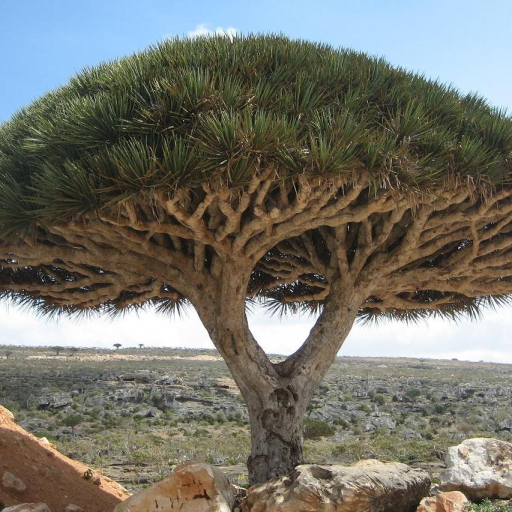
Known as the "Dragon Blood Tree" or the "Socotra Dragon Tree," this prehistoric-looking species is one of nature’s most iconic living sculptures. Native exclusively to the Socotra archipelago in Yemen, its bizarre umbrella-shaped canopy looks like something straight out of a sci-fi novel. Legend says the first tree grew from the blood spilled in a legendary battle between a dragon and an elephant, giving the tree its name and its famous crimson resin.
🔍 How to Identify
- 🌳 Growth Habit: It forms a distinct, upturned umbrella or mushroom shape as it matures. This structure is an evolutionary marvel designed to provide maximum shade to the root system, reducing evaporation in its harsh desert home.
- 🍃 Foliage: Densely packed, stiff, sword-shaped leaves sprout only from the ends of the youngest branches. Unlike many plants, these leaves point upward to capture moisture from the air.
- 🪵 Bark and Resin: The trunk is thick and branches dichotomously (forking into two). If the bark is damaged, it "bleeds" a thick, dark red sap that hardens into a glass-like resin.
🏜️ Habitat & Ecology
- ☁️ Mist Harvesters: These trees live on high, rocky limestone plateaus. Because rain is rare, they survive by "combing" moisture out of the morning fog. The unique canopy shape funnels this water down the branches directly to the trunk and roots.
- ⏳ Slow & Vulnerable: The Dragon Blood Tree is incredibly slow-growing, sometimes taking decades to reach a few feet in height. Because of climate change and overgrazing by goats, these ancient trees are currently considered a vulnerable species in the wild.
⚠️ Safety & Toxicity
- 🐾 Pet Safety: Like most members of the Dracaena genus, the leaves contain saponins. If ingested by cats or dogs, it can cause vomiting, drooling, and dilated pupils.
- 🩸 The Resin: The red resin has been used for centuries in traditional medicine and as a dye. While not typically toxic to humans, it is highly pigmented and will permanently stain skin, clothing, and porous surfaces.
✨ Fun Fact
The "Dragon’s Blood" resin was so highly prized in the 18th century that it was used as a primary ingredient in wood varnishes. Many experts believe it was this specific resin that gave the legendary Stradivarius violins their deep, signature mahogany glow.

Detailed Care Instructions
To successfully grow a Dracaena Cinnabari plant, also known as the Dragon Blood Tree, here are some steps to follow:
- Climate and Location:
- Choose a suitable climate where the temperature is warm and mild. Dracaena Cinnabari grows best in USDA hardiness zones 10-12, with temperatures between 65-85°F (18-29°C).
- Place the plant in a bright area with indirect sunlight. If grown indoors, ensure it receives sufficient light from a window.
- Choose a suitable climate where the temperature is warm and mild. Dracaena Cinnabari grows best in USDA hardiness zones 10-12, with temperatures between 65-85°F (18-29°C).
- Soil and Potting:
- Use well-draining soil that is rich in organic matter. Add perlite or sand to enhance drainage.
- Use a pot with drainage holes to prevent waterlogging. Choose a slightly larger pot to allow room for growth but avoid excessive space as it can lead to moisture retention around the roots.
- Use well-draining soil that is rich in organic matter. Add perlite or sand to enhance drainage.
- Watering:
- Water the plant thoroughly, allowing the soil to dry partially before watering again. Avoid overwatering, as too much moisture can cause root rot.
- Adjust watering frequency depending on the climate and season. In summer, when the plant is actively growing, water more frequently than during winter when it enters a dormant phase.
- Water the plant thoroughly, allowing the soil to dry partially before watering again. Avoid overwatering, as too much moisture can cause root rot.
- Fertilization:
- Apply a balanced, slow-release fertilizer during the growing season (spring and summer) to provide necessary nutrients for healthy growth.
- Follow the instructions on the fertilizer packaging for the correct dosage and frequency.
- Apply a balanced, slow-release fertilizer during the growing season (spring and summer) to provide necessary nutrients for healthy growth.
- Pruning:
- Prune any dead or damaged leaves regularly to maintain the plant's appearance and health. Remove any crossing branches or dense growth to promote airflow and prevent disease.
- Prune any dead or damaged leaves regularly to maintain the plant's appearance and health. Remove any crossing branches or dense growth to promote airflow and prevent disease.
- Propagation:
- The most reliable way to propagate Dracaena Cinnabari is through seeds. Collect ripe seeds and plant them in well-draining soil, keeping them moist until germination occurs.
- Alternatively, you can try air layering or stem cuttings, though these methods might have lower success rates.
- The most reliable way to propagate Dracaena Cinnabari is through seeds. Collect ripe seeds and plant them in well-draining soil, keeping them moist until germination occurs.
- Protection and Care:
- Protect the plant from strong winds, as they can damage the delicate branches.
- Monitor for pests such as spider mites, scales, or mealybugs. If infestations occur, treat them with appropriate insecticides or organic pest control methods.
Remember, Dracaena Cinnabari grows slowly, and it may take several years to reach its distinctive tree-like form. Patience is key when growing this unique and fascinating plant.
- Protect the plant from strong winds, as they can damage the delicate branches.

Place in a bright room that is sun drenched almost all day. Or directly in a south-facing window.

When watering this plant, it is important to remember that it prefers moderate levels of moisture. To achieve this, we recommend watering the soil evenly and consistently, but not too frequently or too heavily. Always check the soil moisture before watering, and make sure that the top inch or so of soil is dry before watering again. It's also a good idea to use room temperature water and avoid letting water sit in the saucer or pot for extended periods of time, as this can lead to root rot. Overwatering is a common mistake, so be mindful of this and adjust your watering habits accordingly. Finally, make sure that the plant has good drainage and that the soil doesn't become waterlogged.
To provide proper fertilizing instructions for Dracaena Cinnabari plant, follow these guidelines:
- Choose a balanced, water-soluble fertilizer specifically formulated for houseplants.
- Dilute the fertilizer as per the manufacturer's instructions. Use a half-strength solution to avoid over-fertilization, which can harm the plant.
- Apply the diluted fertilizer to the soil during the growing season (spring and summer). Avoid fertilizing during the dormant phase (fall and winter) when growth slows down.
- Water the plant thoroughly before fertilizing to prevent root damage. Ensure the soil is moist but not waterlogged.
- Pour the diluted fertilizer directly onto the soil around the base of the plant. Avoid getting it on the leaves or stems, as this may cause damage.
- Use a sufficient amount of fertilizer to dampen the soil but avoid excess runoff. Adjust the quantity as needed based on the plant's size and the size of its container.
- Wait for a few minutes after fertilizing, then carefully drain any excess fertilizer from the saucer or tray underneath the pot to prevent root rot.
- Monitor the plant's response to the fertilizer. If new growth appears healthy and vibrant, you have fertilized properly. However, if leaves start to brown or display signs of burning, reduce the fertilizer concentration or frequency.
Remember, it is crucial to follow the specific needs of your Dracaena Cinnabari plant regarding light, temperature, and humidity alongside proper fertilization to ensure optimal growth and health.
The ideal soil for the plant that cannot be named should be well-draining and rich in nutrients. It should have a pH level between 6.0-7.5. A mixture of peat moss, perlite, and sand can create a suitable environment for the plant's growth. The soil should be slightly acidic to neutral and have good aeration to promote healthy root growth. The plant prefers sandy and loamy soils that are not too heavy and hold moisture well. The use of organic fertilizers is recommended to provide the plant with the essential nutrients it needs to thrive. A regular watering schedule and occasional misting will also be beneficial to maintain humidity levels and prevent the soil from drying out completely.
Dracaena cinnabari can be propagated through several methods, including leaf cuttings and stem cuttings. Here's a detailed guide on how to propagate the plant:
- Preparation: Start by gathering the necessary tools and materials, which include pruning shears, a clean and sharp knife, a rooting hormone (optional but recommended), a suitable planting medium (such as a well-draining potting mix or a mix of sand and perlite), small pots or containers, and a misting bottle.
- Selecting the parent plant: Choose a healthy parent plant that has vibrant foliage and is free from any diseases or pests. Make sure the plant is mature enough to produce viable cuttings, usually around 2-3 years old.
- Leaf cuttings method:
a. Take a healthy and mature leaf from the parent plant. Use clean pruning shears to cut the leaf close to the stem. Alternatively, you can select a lower leaf that is naturally shedding or damaged, as it can still be used for propagation.
b. Cut the leaf into sections, ensuring that each section is at least 3-4 inches long. Each section should have an intact section of the leaf blade and a small portion of the petiole or stem.
c. Apply a rooting hormone to the cut ends of the leaf sections, if desired, as it can help promote root development.
d. Fill small pots or containers with the chosen planting medium.
e. Insert the leaf sections into the planting medium, burying about half of their length. Ensure that the leaf blade is facing upward, while the cut end is inserted into the medium.
f. Place the pots or containers in a warm and bright location with indirect sunlight. Keep the soil slightly moist but not soggy, and avoid overwatering.
g. Mist the leaf sections regularly with water using a misting bottle to promote humidity around the cuttings.
h. After a few weeks or months, new roots should begin to develop from the cut ends. Once the roots are well-established, individual plants can be transplanted into larger pots or the desired growing location.
- Stem cuttings method:
a. Select a healthy stem section from the parent plant that is around 4-6 inches long. Make sure the stem is firm and not overly woody or succulent.
b. Using a clean and sharp knife, make a clean cut just below a leaf node or joint. Remove any lower leaves or side branches from the stem.
c. Apply a rooting hormone to the cut end of the stem, if desired.
d. Fill small pots or containers with the chosen planting medium.
e. Insert the cut end of the stem into the planting medium, burying about half of its length. Ensure that the stem is positioned upright.
f. Place the pots or containers in a warm and bright location with indirect sunlight. Keep the soil slightly moist but not soggy, and avoid overwatering.
g. Mist the stem cutting regularly with water using a misting bottle to maintain humidity around the cutting.
h. Within a few weeks to a couple of months, new roots should start to develop from the cut end. Once the roots are well-established, the individual plant can be transplanted into a larger pot or the desired growing location.
Remember to be patient during the propagation process, as success rates may vary. It's essential to provide appropriate care to the cuttings or stem until they are established as independent plants.
Common pests of the dragon's blood tree include Scale insect, mealybugs, spider mites, thrips. Make a habit of checking your dragon's blood tree frequently for pests so that any infestations can be caught and managed early.








