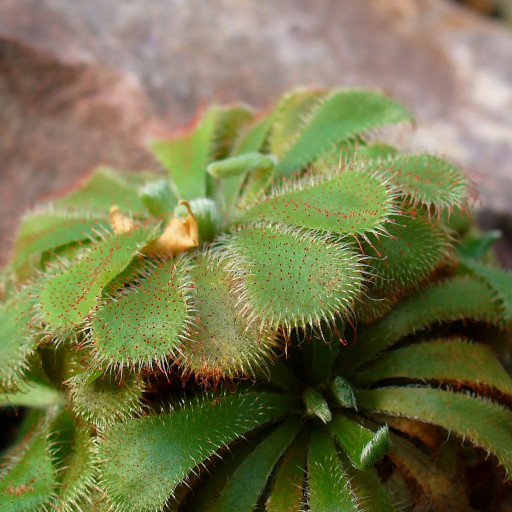
Plant Overview
Known affectionately as the Alice Sundew, this South African beauty is one of the most popular carnivorous plants for beginners and collectors alike. It forms a perfect, shimmering rosette of leaves that look like they are perpetually covered in morning dew. However, for a small fly, those sparkling droplets are a deceptive and deadly invitation to dinner.
🔍 How to Identify
- 🌿 The Rosette: It grows in a tight, circular pattern of wedge-shaped leaves that typically sit flat against the soil, reaching about 2-3 inches in diameter.
- 💎 The "Dew": Each leaf is fringed with reddish tentacles tipped with clear, sticky mucilage that glitters brilliantly in the sunlight.
- 🌸 The Bloom: During its growing season, it sends up a tall, wiry stalk—safely away from its traps—to display small, five-petaled pink or purple flowers.
🏡 In Your Garden
- 💧 Mineral Sensitivity: This plant is a specialist in "starvation" soils. It has a sensitive root system that cannot handle the minerals found in tap water or standard potting soil. To keep it happy, only use distilled, reverse osmosis, or rainwater.
- ☀️ Light Hunter: The Alice Sundew uses its color to communicate. If the leaves are deep red, it is getting the perfect amount of light; if they turn lime green, it’s a sign the plant is "hungry" for more sun.
- 🦟 Natural Pest Control: It is a fantastic companion for indoor plant lovers. It acts as a living glue trap, effectively snapping up fungus gnats and fruit flies that might be pestering your other houseplants.
⚠️ Safety & Toxicity
- ✅ Safe for Households: The Alice Sundew is non-toxic to humans, cats, and dogs. It doesn't contain the harsh alkaloids found in some other exotic species.
- 🩹 Physical Fragility: While it won't hurt you, you can hurt it! Touching the sticky tentacles causes the plant to waste significant energy as it tries to "digest" your finger, which can lead to the individual leaf turning brown and dying.
✨ Fun Fact
The Alice Sundew is a master of "slow-motion hunting." Once an insect is trapped in the sticky glue, the entire leaf will slowly curl inward over several hours to wrap around the prey, ensuring no nutrients escape its digestive enzymes!

Detailed Care Instructions
| Humidity | Normal |
| Lighting | Full Sun |
| Difficulty | Medium |
| Temperature | 22°C - 32°C |
| Hardiness Zones | 8 - 10 |
To grow Drosera aliciae plants, also known as Alice sundews, follow these steps:
- Climate: Determine if your climate is suitable for growing Drosera aliciae. They are native to South Africa and thrive in warm and humid conditions. If you live in a colder region, consider growing them indoors or in a greenhouse.
- Lighting: Provide bright, indirect sunlight or use artificial grow lights if growing indoors. Drosera aliciae requires at least 6-8 hours of sun exposure daily.
- Soil: Use a well-draining soil mix suitable for carnivorous plants. A recommended mix is a combination of peat moss, sand, and perlite or vermiculite in equal parts. Avoid using regular potting soil as it can retain too much moisture.
- Watering: Keep the soil consistently damp, as Drosera aliciae prefer moist conditions. Use distilled or rainwater for watering, as tap water may contain minerals that can harm the plant. Do not let the soil dry out completely, but avoid waterlogging.
- Humidity: Maintain high humidity levels by using a humidity tray or placing the pot on a tray filled with water. This helps mimic their natural environment. Alternatively, you can use a humidifier or mist the plants regularly.
- Feeding: Drosera aliciae are insectivorous plants that obtain nutrients by trapping and digesting insects. They will catch their own prey, but you can also supplement their diet with small insects like fruit flies or mosquitoes. Avoid using chemical fertilizers, as they can harm the plant.
- Dormancy: In their natural habitat, Drosera aliciae experience a period of dormancy during colder months. Reduce watering and provide cooler temperatures (around 50-55°F or 10-13°C) during this time. Resume regular care when new growth appears in spring.
- Repotting: Transplant the plant to a slightly larger pot when it becomes root-bound. Use the same type of soil mix as mentioned earlier. Repotting is usually done in early spring.
With proper care and attention to their specific needs, Drosera aliciae plants should thrive and produce vibrant leaves topped with sticky tentacles to capture their insect prey.

Place in a bright room that is sun drenched almost all day. Or directly in a south-facing window.

To water this plant, you should first make sure that the soil is completely dry before adding water. It is important to use distilled or rainwater, as this plant is sensitive to tap water due to its mineral content. Fill a tray with water and allow the plant to sit in the water for up to 30 minutes, allowing it to absorb as much water as it needs. Do not over-water the plant as this can cause root rot. It is also recommended to mist the leaves of the plant with distilled or rainwater to increase humidity levels around the plant.
To fertilize the plant, use a diluted solution of liquid carnivorous plant fertilizer during the growing season. Apply the fertilizer once every two to three weeks, taking care to not over-fertilize as this can harm the plant. During the dormant season, do not fertilize the plant.
The ideal soil for this plant is a mixture of peat moss and sand. The peat moss provides the plant with the necessary water retention while the sand provides good drainage. It's also important to ensure that the soil mixture is acidic, with a pH level of around 5.5. In addition, the soil should be free of any nutrients that could harm the plant, such as fertilizers or minerals. The plant should be potted in a container that allows for good airflow and drainage, as well as providing ample space for the roots to grow. The soil should be kept consistently moist, but not waterlogged, and the plant should be kept out of direct sunlight.
Drosera Aliciae can be propagated through the division of its root system or by seed. For division, the plant should be carefully removed from its container and the root system should be gently separated into smaller sections. Each section should contain at least one healthy root and a portion of the stem and leaves. The new sections can then be potted individually in a mix of peat and sand.
To propagate through seed, the plant should be allowed to flower and produce seed pods. Once the pods have dried and turned brown, they can be harvested and the seeds can be sown in a mix of peat and sand. The seeds should be lightly covered with the soil mix and kept moist but not waterlogged. They will germinate within a few weeks if kept in the appropriate conditions, including a warm and humid environment with plenty of sunlight.
It is important to note that Drosera Aliciae is a sensitive plant and requires careful propagation techniques to ensure successful propagation and growth. Careful attention should be paid to the plant's watering and nutrient needs, as well as its lighting and humidity requirements.








