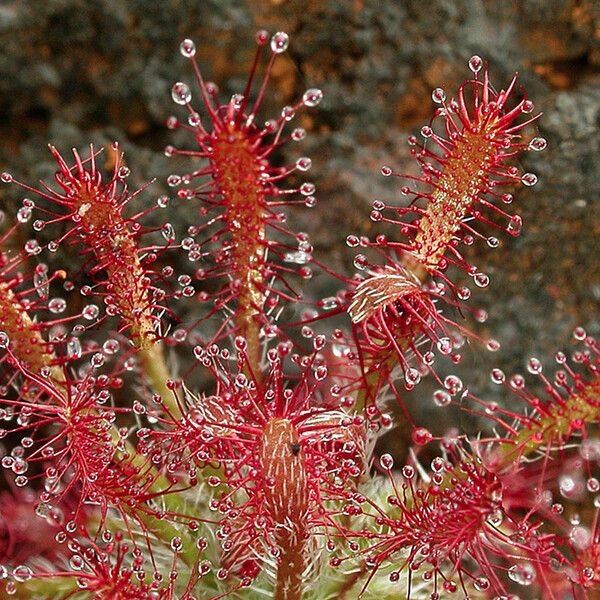
Plant Overview
The New Caledonian Sundew is a shimmering jewel from the remote islands of the South Pacific. Often called the "Glistening Trapper," this carnivorous beauty evolved in isolation for millions of years, developing a sophisticated way to survive in nutrient-poor soils. It looks like a collection of ruby-tipped pins, frozen in time and waiting to catch its next meal under the tropical sun.
🔍 How to Identify
- 🌿 The Rosette: This plant grows in a compact, circular arrangement of leaves that hug the ground, usually staying quite small and dainty, making it perfect for terrariums.
- 💎 Glistening Tentacles: Each leaf is fringed with vibrant red or bright green "tentacles" tipped with clear, sticky drops of mucilage that sparkle like morning dew to lure unsuspecting insects.
- 🌸 Tall Blooms: To protect its pollinators from being accidentally eaten, the plant sends up a surprisingly tall, thin stalk to display its small white or pale pink flowers far above the sticky traps.
🏡 In Your Garden
- 🏝️ Island Roots: Hailing from the unique "ultramafic" soils of New Caledonia, this sundew is used to environments rich in minerals like nickel but very low in nitrogen. It thrives best in a specialized mix of peat moss and perlite or silica sand.
- 💧 The Purest Sip: This species is incredibly sensitive to salts and chemicals. It should only be watered with distilled, reverse osmosis, or rainwater. It prefers the "tray method," where the pot sits in a shallow saucer of water to mimic its native boggy habitat.
⚠️ Safety & Toxicity
- 🐾 Pet & Human Safe: The New Caledonian Sundew is non-toxic to cats, dogs, and humans. It does not possess any venom or triggers that could harm a curious pet.
- 🐜 Gnat Patrol: While safe for us, it is a formidable predator for small indoor pests. It is an excellent biological control for fungus gnats and fruit flies in the home.
✨ Fun Fact
New Caledonia is often referred to as a "lost world" of botany; Drosera neocaledonica is part of a prehistoric lineage of plants that has remained largely unchanged since the age of the dinosaurs!

Detailed Care Instructions
To grow Drosera neocaledonica, also known as the New Caledonia sundew, follow these steps:
- Environment: Create a suitable environment for the plant. Drosera neocaledonica is a tropical plant, so it requires warm temperatures and high humidity. Maintain a temperature range of 70-80°F (21-27°C) during the day and 60-70°F (15-21°C) at night. Use a humidifier or place the plant on a tray filled with water and pebbles to increase humidity levels.
- Lighting: Provide bright, indirect light. Drosera neocaledonica thrives in strong, filtered light. You can place it near a south or west-facing window or use fluorescent lights if natural light is insufficient.
- Soil: Use an acidic, well-draining soil mix. A good option is a mixture of sphagnum moss, perlite, and sand. Avoid using soil with high mineral content or high levels of nutrients as this can harm the plant.
- Watering: Keep the soil consistently damp but not waterlogged. One method is to water the plant from below by filling the tray beneath the pot with water. This allows the roots to absorb water without soaking the leaves. Use distilled or rainwater since tap water usually contains minerals that can damage the plant.
- Feeding: Drosera neocaledonica is carnivorous and obtains nutrients from insects. Allow the plant to catch its own prey, such as small flies, mosquitoes, or gnats. Do not feed it meat, as the plant may struggle to digest it.
- Potting: Plant the Drosera neocaledonica in a terrarium or a container with good drainage holes. Make sure the pot is not too large for the plant as it prefers crowded conditions.
- Dormancy: Drosera neocaledonica has a period of dormancy in the cooler months. During this time, lower the temperature slightly and reduce watering. It is normal for the plant to lose its leaves or appear dormant. Resume regular care when new growth starts to emerge in spring.
By following these guidelines, you can successfully grow Drosera neocaledonica and enjoy its unique carnivorous nature.

Place in a dark room with little light, like a dark bedroom or a spot far away from a window or directly in a north-facing window.

The plant in question belongs to the family of carnivorous plants commonly known as sundews. It requires specialized care due to its unique feeding mechanism.
To water Drosera Neocaledonica, one should avoid using tap water as it may contain minerals that could harm the plant. Instead, one should use distilled or rainwater. The soil should be kept moist, but not waterlogged, as excessive moisture can lead to root rot. Watering should be done from the bottom, as watering from above can damage the sensitive leaves.
Additionally, it is important to avoid fertilizing the plant, as it obtains its nutrients mainly from the insects it catches. Overfeeding can cause the plant to become weak and unhealthy.
Lastly, the plant requires a high humidity environment, with temperatures between 70-80°F (21-27°C). A humidifier or placing the plant on a tray of pebbles with water can help maintain the necessary moisture levels.
- Mix a specialized soil mix suitable for carnivorous plants, consisting of peat moss and perlite or sphagnum moss.
- Place the plant in a sunny area with bright but indirect light.
- Water the plant frequently with distilled or rainwater to avoid mineral buildup.
- Avoid fertilizing the plant with traditional fertilizers, as they may harm the plant.
- Instead, feed the plant with insects, such as fruit flies or gnats, or with specialized carnivorous plant food, which can be purchased online or at plant nurseries.
- Use caution when feeding the plant, as too much food may harm it. Only feed the plant once every 2-3 weeks.
- Remove any dead plant material or insects from the plant regularly to prevent rot or fungal growth.
- Keep the plant in a warm and humid environment. A humidity tray or a humidifier can help maintain the proper level of moisture.
The appropriate soil to use for this particular plant should be a well-draining mix with low nutrient content. It should have a pH level of around 4.5-5.5 and be composed of a blend of sphagnum moss, perlite, and sand. The soil should be moist but not waterlogged, as the plant is susceptible to root rot. Avoid using soils that contain high levels of minerals, as this may harm the plant. It is recommended to repot the plant every year or two to ensure the soil remains healthy and nutrient-poor.
To propagate this plant, you will need to take stem cuttings from a mature plant. Choose a healthy stem with several leaves attached, and make a clean cut just below a leaf node. Remove the lowest leaves from the stem, leaving only a few at the very top.
Dip the cut end of the stem in rooting hormone, and plant it in a pot filled with a well-draining soil mix. Water the cutting thoroughly and place it in a bright spot, but out of direct sunlight. Keep the soil moist but not waterlogged, and cover the pot with a plastic bag or dome to increase humidity.
After a few weeks, you should start to see new growth from the cutting. Once it has established roots and a few new leaves, you can remove the plastic covering and treat it like a mature plant. With proper care, your new plant should thrive and grow into a mature Drosera Neocaledonica.








