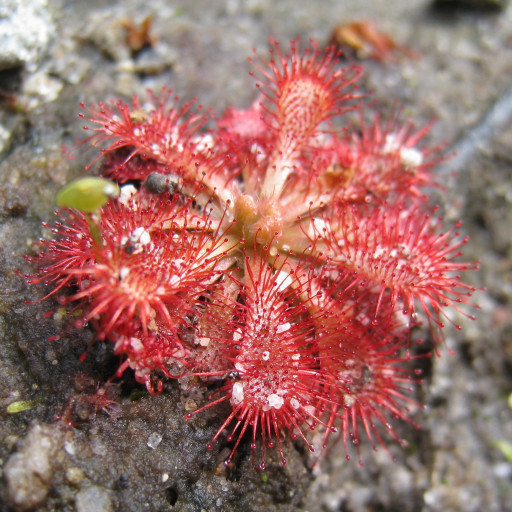
Plant Overview
Often called the Spoon-leaved Sundew, this shimmering carnivorous plant looks like a collection of tiny, ruby-encrusted jewels resting on the soil. Native to Southeast Asia, Australia, and New Zealand, it is one of the most popular "starter" carnivorous plants for hobbyists. It doesn’t just sit quietly; it is an active hunter, using its glistening "dew" to lure and trap unsuspecting gnats.
🔍 How to Identify
- 🥄 The Leaf Shape: Each leaf is shaped like a tiny spatula or spoon, forming a flat, symmetrical rosette that hugs the ground.
- 💎 The Glistening Tentacles: The leaves are covered in bright red "hairs" (trichomes) topped with clear, sticky droplets of mucilage that sparkle in the sunlight.
- 🌸 The Flower Spike: It sends up a surprisingly tall, leafless stalk topped with tiny pink or white flowers that bloom one by one to keep pollinators far away from its hungry leaves.
🏡 In Your Garden
- 💧 Mineral Sensitivity: This plant thrives on "pure" water like rain or distilled water. Because it evolved in nutrient-poor bogs, the minerals found in tap water can actually "burn" its delicate root system.
- ☀️ The Redder, The Better: While it can survive in partial shade, the deep red coloration is a sign of a happy plant. High light levels trigger the production of the red pigments that make the "dew" look so attractive to insects.
- 🦟 Natural Pest Control: It is a fantastic companion for indoor herb gardens or greenhouses, as it acts as living flypaper for fungus gnats and fruit flies.
⚠️ Safety & Toxicity
- ✅ Non-Toxic Status: The Spoon-leaved Sundew is considered non-toxic to humans, cats, and dogs.
- 🖐️ Sticky Fingers: While not poisonous, the mucilage is incredibly sticky. It isn't harmful to touch, but it’s best to avoid handling the leaves so the plant doesn't waste energy regenerating its "glue."
✨ Fun Fact
The "dew" on a Sundew is a complex cocktail of chemicals. It contains both a super-strong adhesive to keep the insect from escaping and powerful digestive enzymes that dissolve the prey’s soft tissues, allowing the plant to "eat" the bug's nutrients through its leaves!

Detailed Care Instructions
| Lighting | Full Sun |
To grow Drosera spatulata, also known as the spoon-leaved sundew, follow these steps:
- Light: Choose a location that receives bright, indirect sunlight or grow the plant under artificial lights. Direct sunlight can scorch the leaves.
- Temperature: Keep the plant at a temperature between 60-75°F (15-24°C). It can tolerate higher temperatures during the day, but cooler temperatures are necessary at night.
- Soil: Use a well-draining soil mix that mimics the plant's natural sandy soil habitat. A mix of peat moss and perlite or sand works well.
- Watering: Sundews require consistently moist soil. Keep the soil evenly moist but not waterlogged. Use distilled water or rainwater to prevent minerals from tap water building up in the soil.
- Humidity: Sundews thrive in high humidity environments. You can increase humidity around the plant by placing the pot on a tray filled with water or using a humidifier.
- Feeding: Drosera spatulata is a carnivorous plant that nourishes itself by capturing and digesting insects. Allow the plant to catch its food naturally, but if it isn't attracting enough insects, you can supplement its diet with small insects like fruit flies or pinhead crickets.
- Dormancy: Some Drosera spatulata varieties require a winter dormancy period. Reduce watering during this time and keep the plant in cooler temperatures, around 50-60°F (10-15°C). Resume regular care in spring when new growth appears.
- Propagation: Sundews can be propagated by seeds or vegetatively through leaf cuttings or division. Leaf cuttings involve carefully cutting a leaf and placing it on a moist substrate until the roots develop. Division is done by separating the plant into smaller pieces with roots intact.
By following these guidelines, you should be able to successfully grow and care for Drosera spatulata. Remember to always research the specific needs of your plant variety and adjust care accordingly.

Place in a bright room that is sun drenched almost all day. Or directly in a south-facing window.

Drosera Spatulata is a type of carnivorous plant that needs to be watered carefully and properly to ensure its health and growth. When watering Drosera Spatulata, it is important to consider the following steps:
1. Use distilled or rainwater: Drosera Spatulata is sensitive to minerals and chemicals found in tap water. Therefore, it is best to water it with distilled or rainwater to avoid any harmful substances.
2. Water only when the soil is dry: Drosera Spatulata requires moist soil but does not like to be waterlogged. Therefore, it is important to water only when the top layer of soil is dry to avoid overwatering.
3. Water from the bottom: It is recommended to water Drosera Spatulata from the bottom by placing the pot in a water-filled saucer for a few minutes. This allows the plant to absorb water through its roots without soaking its delicate leaves.
4. Avoid watering the leaves directly: Drosera Spatulata has sticky, glandular leaves that are designed to capture insects. Directly watering the leaves can damage the surface or wash away the plant's digestive enzymes.
By following these steps, you can ensure the proper watering of Drosera Spatulata and promote the growth and health of this unique and fascinating plant.
To fertilize this plant, dilute a water-soluble fertilizer at half strength and apply it directly to the soil. Avoid fertilizing the leaves of the plant. Fertilize once every two weeks during the growing season. Make sure to water the plant before and after fertilizing to prevent burning the roots.
The ideal soil for the plant should be acidic and low in nutrients. A mixture of peat moss and coarse sand or perlite is typically recommended to ensure good drainage and moisture retention. The pH level of the soil should be between 4.0 and 5.5. It is also important to avoid using soils that contain fertilizers or other additives that could harm the plant.
To propagate this plant, start by taking cuttings from the healthy shoot tips of the plant and remove any lower leaves to leave only a few leaves at the top. Dip the cut end in a rooting hormone and plant it in a pot filled with a well-draining, sterile potting mix. Water the cutting thoroughly and cover the pot with a plastic bag to create a mini greenhouse, providing moisture and warmth for the cutting. Place in bright, indirect light and mist regularly to keep the soil moist. After a few weeks, new growth should appear, indicating successful propagation.








