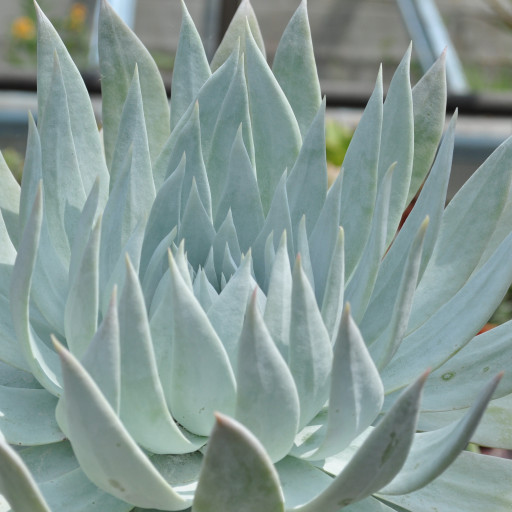
Plant Overview
Known as the Giant Chalk Dudleya, this stunning succulent is the "silver ghost" of the Baja California cliffs. With its massive, luminous rosettes that can grow up to 18 inches wide, it looks like a piece of frozen moonlight tucked into a rock crevice. It is highly prized by collectors for its almost supernatural white glow and its architectural, star-like symmetry.
🔍 How to Identify
- ❄️ The Chalky Coating: The leaves are covered in a thick layer of white epicuticular wax (farina), giving the plant a powdery, ghostly appearance.
- 📐 Rosette Shape: It forms a single, large, solitary rosette of broad, fleshy, spoon-shaped leaves that taper to a sharp point.
- 🌼 Spring Blooms: In late winter to spring, it sends up tall, reddish-pink flower stalks topped with clusters of pale yellow, star-shaped flowers.
🏡 In Your Garden
- 🚫 Hands Off: The "chalk" on the leaves is delicate; touching it will leave permanent fingerprints and smudge the protective coating, which never grows back on that specific leaf.
- 💧 The "No-Crown" Rule: In the garden, it is vital to water only the soil around the base. If water sits in the center of the rosette (the crown), the plant is highly susceptible to fungal rot.
- ☀️ Summer Slumber: Unlike many garden plants, this Dudleya often goes dormant in the hot summer months. It prefers to stay dry during this time, mimicking the Mediterranean climate of its native home.
⚠️ Safety & Toxicity
- ✅ Safe for All: Dudleya brittonii is considered non-toxic to humans, cats, and dogs.
- 🌵 Physical Care: While not "sharp" like a cactus, the tips of the leaves can be firm. The primary risk is to the plant itself—rough handling can easily snap the brittle, heavy leaves.
✨ Fun Fact
The white powder on the leaves isn't just for looks—it is one of the most UV-reflective substances found in the entire plant kingdom! It acts as a high-SPF natural sunscreen, protecting the plant from the intense desert sun and helping it retain moisture.

Detailed Care Instructions
| Lighting | Full Sun |
| Hardiness Zones | Min 9A |
To grow Dudleya brittonii plant, follow these steps:
- Find a suitable location: Dudleya brittonii plants thrive in well-draining soil, so it's important to choose a location with sandy or rocky soil. They prefer full sunlight, so select a spot that receives at least 6 hours of direct sunlight each day.
- Prepare the soil: If your soil is heavy or poorly draining, amend it by adding sand, gravel, or organic matter to improve drainage. This will prevent waterlogged roots and avoid root rot.
- Propagation: Dudleya brittonii plants can be propagated from offsets or by seeds. If using offsets, gently separate them from the mother plant and allow them to callus for a few days before planting. If using seeds, sow them in well-draining soil and lightly cover them. Keep the soil moist until germination occurs.
- Planting: Dig a hole twice the size of the plant's root ball and place the plant inside. Backfill the hole with soil and gently firm it around the plant. Avoid burying the stem or creating a depression that collects water.
- Watering: Dudleya brittonii plants are drought-tolerant, so water sparingly. During the first few weeks after planting, water the plant thoroughly to establish its root system. After that, water only when the soil is completely dry, typically every 2-3 weeks. Avoid overwatering, as it can lead to root rot.
- Fertilizing: Dudleya brittonii plants are adapted to nutrient-poor soils and generally do not require fertilization. However, if you feel that your plant needs a boost, you can use a diluted liquid cactus or succulent fertilizer during the growing season, following the instructions on the label.
- Pruning and maintenance: Dudleya brittonii plants do not require extensive pruning. Remove any dead or withered leaves as they occur. If the plants become too crowded, you can divide the offsets and replant them elsewhere.
- Protection: Ensure that the plant has good airflow around it to prevent fungal diseases. Watch out for pests like snails or slugs and remove them by hand or use organic pest control methods if necessary.
By following these steps, you can successfully grow Dudleya brittonii plants and enjoy their unique beauty. Remember to always check local regulations and restrictions before harvesting or removing plants from the wild.

Place in a bright room that is sun drenched almost all day. Or directly in a south-facing window.

To water this particular plant, it is important to take into consideration its specific needs. First, it is important to determine the ideal watering schedule based on the climate and environment that the plant is in. Generally, it is recommended to water the plant once every 2-3 weeks during the growing season and once every 4-6 weeks during the dormant season.
When watering, it is important to avoid overwatering as this can lead to root rot and damage the plant. To prevent this, make sure that the soil is well-drained and that excess water can easily flow out. It is also recommended to avoid getting water on the leaves of the plant as this can lead to damage and discoloration.
One way to ensure that the plant is receiving enough water without overwatering is to use the "soak and dry" method. This involves soaking the soil thoroughly and allowing it to dry out completely before watering again.
Overall, the key to watering this plant is to be mindful of its specific needs and to avoid overwatering. By providing the right amount of water and maintaining good soil drainage, you can help your Dudleya Brittonii plant thrive.
To fertilize this plant, apply a balanced, slow-release fertilizer in early spring or late fall. Use a fertilizer with a low nitrogen content, and avoid over-fertilization as it can burn the plant. Water the plant before and after fertilizing, and do not fertilize during periods of drought or extreme heat.
To grow Dudleya Brittonii plant, it is recommended to use a well-draining soil mix. The soil should be gritty, porous, and have good aeration. A good mix would consist of 50% coarse sand or pumice and 50% soilless mix or compost. Avoid using heavy soils that retain moisture for a long time. The soil pH for this plant should be slightly acidic to slightly alkaline, around 6.0 to 7.5. It is also best to plant this species in a location with full to part sun exposure and protect it from harsh afternoon sun. Regular watering is necessary during the growing season, but water should be reduced during dormancy.
Dudleya Brittonii plant can be propagated by taking stem and leaf cuttings from mature plants.
Step 1: Choose a healthy and mature Dudleya Brittonii plant for propagation.
Step 2: Prepare the potting mix for propagation. A mix of sandy soil, perlite, and peat moss will work well.
Step 3: Cut a stem from the parent plant. Make sure the cutting has at least two leaves and is around 2-3 inches long.
Step 4: Remove the lower leaves of the stem cutting, leaving only the top two.
Step 5: Dip the cut end of the stem cutting into rooting hormone.
Step 6: Plant the stem cutting in the prepared potting mix and water thoroughly.
Step 7: Place the pot in a warm and sunny spot.
Step 8: Water the soil whenever it feels dry to the touch.
Step 9: After a few weeks, roots should start to form. Once this happens, the new plant can be transplanted into a larger pot or into the ground.
It's important to note that Dudleya Brittonii is a protected plant and can only be propagated legally by licensed growers.
Common pests of the britton's dudleya include Scale insect, mealybugs, thrips. Make a habit of checking your britton's dudleya frequently for pests so that any infestations can be caught and managed early.








