Plant Overview
Known as Greene’s Liveforever, this stunning succulent is a rare jewel native only to the rugged Channel Islands off the coast of California. It earns its poetic nickname from its incredible longevity and ability to survive on sheer sea cliffs where few other plants dare to grow. With its frosty, silver-blue rosettes, it looks like a cluster of calcified sea stars clinging to the rocks.
🔍 How to Identify
- ❄️ Chalky Coating: The leaves are covered in a thick, white waxy powder called "farina," which acts as a natural sunscreen and gives the plant a ghostly, ethereal glow.
- 🐚 Rosette Shape: It grows in dense, low-clumped rosettes. The leaves are fleshy, strap-shaped, and usually pointed at the tips.
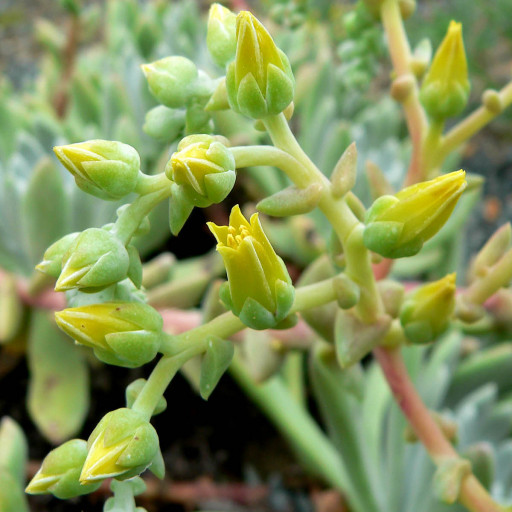
- ☀️ Summer Blooms: In late spring or summer, it sends up tall, reddish stalks topped with clusters of delicate, pale-yellow star-shaped flowers.
🏡 In Your Garden
- 🌊 Drainage is Vital: Because it evolved on rocky cliffs, it cannot tolerate standing water. In a garden or pot, it needs extremely gritty, well-draining soil—ideally tilted at an angle so water doesn't pool in the center of the rosette.
- 💤 Summer Nap: Unlike many garden plants, Dudleya goes dormant in the heat of summer. It prefers to stay dry during this time; overwatering while it’s resting is the most common way to lose this "Liveforever."
⚠️ Safety & Toxicity
- ✅ Safe Status: Dudleya greenei is considered non-toxic to humans, cats, and dogs.
- 🖐️ Handle with Care: While not poisonous, the waxy "dust" on the leaves is very sensitive. Touching the leaves will leave permanent fingerprints that don't go away until new leaves grow, which can make the plant more vulnerable to sunburn.
✨ Fun Fact
The genus name Dudleya was chosen to honor William Russell Dudley, the first head of the botany department at Stanford University. These plants are so long-lived that some individual specimens in the wild are estimated to be nearly 100 years old!

Detailed Care Instructions
| Humidity | Dry |
| Lighting | Full Sun |
| Difficulty | Medium |
| Hardiness Zones | 9B - 11 |
To grow Dudleya greenei, also known as Greene’s dudleya, you can follow these steps:
- Choose a suitable location: Dudleya greenei plants are native to rocky slopes and cliffs, so they prefer well-draining soil with good air circulation. Select a sunny spot for optimum growth.
- Prepare the soil: Amend the soil with organic matter, such as compost, to improve drainage and fertility. Avoid heavy clay soils, as they can cause root rot.
- Planting: Dig a hole slightly larger than the root ball of the plant. Place the Dudleya greenei in the hole, ensuring that the root ball is level with the soil surface. Backfill the hole with soil, gently firming it around the plant.
- Watering: Dudleya greenei is a drought-tolerant plant, so it does not require frequent watering. Water the plant deeply but infrequently, allowing the soil to dry out between waterings. During the dormant period in summer, reduce watering even further.
- Mulching: Apply a layer of organic mulch around the plant to retain moisture and suppress the growth of weeds. Avoid placing the mulch too close to the base of the plant to prevent rot.
- Fertilization: Dudleya greenei plants are not heavy feeders and do not typically require fertilization. However, you can apply a balanced, slow-release fertilizer once or twice a year to promote healthy growth.
- Pruning: Dudleya greenei generally does not require much pruning. However, you can remove any dead or damaged leaves or spent flower stalks to maintain a neat appearance.
- Protection: Protect the plant from extreme temperatures, frost, and excessive rainfall. If a cold spell is expected, cover the plant with a cloth or place a temporary frost cover over it.
- Propagation: Dudleya greenei can be propagated from offsets or leaf cuttings. Remove offsets when they are a few inches tall and replant them in well-draining soil. Allow leaf cuttings to callus for a few days before planting them in a sandy soil mix.
Remember to check for any specific care instructions or recommendations for Dudleya greenei if you obtained it from a specialist nursery or botanical garden.

Place in a bright room that is sun drenched almost all day. Or directly in a south-facing window.

The plant in question belongs to the Crassulaceae family and is known for its rosette-shaped leaves. To water this plant, one should first check the soil moisture level by inserting a finger about an inch into the soil. If the soil feels dry, the plant can be watered. It is important not to overwater the plant, as it is susceptible to root rot. Therefore, watering should be done sparingly and only when the soil is completely dry. The plant should be watered at the base rather than from above, as this can damage the leaves and lead to fungal growth. Finally, the plant should be placed in a well-draining pot to prevent water from accumulating at the roots.
To fertilize this plant, use a 10-10-10 NPK fertilizer dissolved in water. Apply the fertilizer once every two weeks during the growing season, following the manufacturer's instructions for dosage. Avoid over-fertilizing, as this can burn the plant's roots and damage its overall health. It is also a good idea to water the plant before fertilizing and to avoid fertilizing during periods of drought or stress.
Dudleya greenei is a plant species that belongs to a specific plant genus. To provide the best soil for this plant, it is important to consider its natural habitat and growing conditions. Typically, Dudleya greenei grows in dry, rocky areas with well-draining soil. Therefore, it is best to use a soil mix that mimics these conditions by using a combination of sand, small rocks or pebbles, and a small amount of organic material such as perlite or coco coir to provide some moisture retention. It is important to avoid the use of heavy, water-retentive soils that can cause rot and damage to the roots. Additionally, it is recommended to avoid high-nitrogen fertilizers and instead use a balanced, slow-release fertilizer sparingly to support healthy growth and development.
Dudleya Greenei plant can be propagated by using the offsets that grow at the base of the mother plant. To do this, carefully remove the offsets and allow them to dry out for a few days before placing them in a well-draining soil mix. Keep the soil moist but not too wet and place the pot in a bright, indirect light. The offsets should begin to root and grow within a few weeks. Alternatively, Dudleya Greenei can also be propagated by leaf cuttings. Select a healthy leaf and cut it close to the base. Allow the leaf to dry out for a few days before placing it in a well-draining soil mix. Keep the soil moist but not too wet and place the pot in a bright, indirect light. The leaf should begin to form tiny plantlets at the base within a few weeks.
Common pests of the greene's liveforever include Scale insect, mealybugs, thrips. Make a habit of checking your greene's liveforever frequently for pests so that any infestations can be caught and managed early.








