Plant Overview
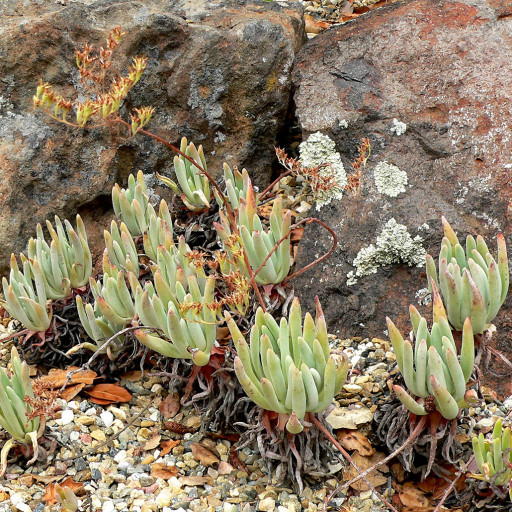
Often called the Green Live-Forever, Dudleya virens is a hardy, salt-tolerant succulent native to the rugged cliffs of the Channel Islands and coastal Southern California. It looks like a cluster of emerald stars clinging to sea-sprayed rocks, personifying the "Live-Forever" nickname due to its incredible longevity. In the wild, these plants anchor themselves into vertical crevices, watching the Pacific Ocean for decades.
🔍 How to Identify
- 🍃 The Rosette: Features fleshy, strap-shaped leaves that are bright green to a waxy grey-green. Unlike some of its "chalky" cousins, it has a smoother, glossier appearance.
- 🌼 The Blooms: In late spring, it sends up striking reddish-tinted stalks that hold clusters of small, star-shaped yellow or pale cream flowers.
- 🪵 The Habit: This species is a "clumper." Instead of staying as a single rosette, it branches out at the base to form dense, low-growing mats that spill beautifully over edges.
🏡 In Your Garden
- 🌊 The "Cliff" Trick: Because it evolved on vertical rock faces, it hates "wet feet." In a garden or pot, try planting it at a slight angle. This allows rainwater to drain out of the center of the rosette rather than sitting there and causing rot.
- 💤 Summer Slumber: This plant is summer-dormant. In the hottest months, it prefers to be left completely dry. Overwatering during a summer heatwave is the fastest way to kill a Dudleya, as it essentially "shuts down" to conserve energy.
⚠️ Safety & Toxicity
- ✅ Status: Generally Non-Toxic.
- 🐾 Details: Dudleya virens is safe for homes with curious cats or dogs. However, the leaves are quite brittle and can snap off easily if bumped, so it is best kept in a decorative pot out of the main "splash zone" of high-traffic areas.
✨ Fun Fact
- 🕵️ Island Exclusivity: Some subspecies of Dudleya virens are incredibly rare and grow nowhere else on Earth except for tiny patches on San Clemente or Santa Catalina Island. Because they are so rare and beautiful, they are protected by law to prevent "succulent poaching."

Detailed Care Instructions
To grow Dudleya virens, also known as the Dudleya chalk lettuce, follow these steps:
- Location: Choose a location that receives full sunlight for at least 6-8 hours a day. Dudleya virens thrives in bright light and warm temperatures.
- Soil: Use well-draining soil with good airflow. Dudleya plants prefer a sandy or rocky substrate, as they are native to arid regions. You can amend the soil with sand or perlite to improve drainage.
- Propagation: Dudleya virens can be propagated from seeds or through leaf cuttings. If starting from seeds, sow them in sandy soil mix and lightly cover with a thin layer of soil. Keep the soil consistently moist until the seeds germinate.
- Watering: During the growing season, water Dudleya virens moderately. Allow the soil to dry out between waterings. Overwatering can cause rotting of the plant, so be cautious not to keep the soil too wet.
- Climate: Dudleya virens is drought-tolerant and can handle high temperatures. However, it is not very frost-tolerant, so protect the plant from freezing temperatures. If you live in a cold climate, consider growing it in a container that you can bring indoors during winter.
- Fertilizer: Dudleya virens does not typically require fertilization. However, you can provide a balanced, diluted liquid fertilizer once or twice during the growing season to give it a boost.
- Pruning: Dudleya virens does not require much pruning. However, you can remove any dead or damaged leaves to maintain the plant's appearance and health.
- Pests and diseases: Dudleya virens is generally resistant to pests and diseases. However, overwatering or poor drainage can lead to root rot. Monitor the plant for any signs of rot or pests and take appropriate action if necessary.
By following these guidelines, you can successfully grow Dudleya virens and enjoy its unique and attractive appearance in your garden or container.

Place in a bright room that is sun drenched almost all day. Or directly in a south-facing window.

Dudleya Virens is a succulent plant that requires minimal watering. When watering, it is essential to water deeply but infrequently. A good rule to follow is to water the plant when the soil is completely dry, usually once a month during the growing season and once every other month during the winter.
To water the plant, you should thoroughly wet the root area, allowing the water to soak in for a few minutes. It is advisable not to water the plant's leaves or stem as this could cause rotting. After watering, allow the soil to drain and return the plant to its normal position.
It is also important to avoid overwatering your Dudleya Virens plant as this could cause root rot and eventually lead to the plant's demise. Ensure the pot has drainage holes that allow for excess water to escape, and never let the plant sit in standing water.
In conclusion, watering your Dudleya Virens plant requires patience, attention, and care. Avoid overwatering, water deeply and infrequently and ensure the pot has drainage holes that allow for excess water to escape. By following these tips, you will be able to keep your plant healthy and thriving.
To fertilize the plant, mix a balanced fertilizer with equal parts of nitrogen, phosphate, and potassium. Use a low dose of this mixture once a month during the growing season, which is typically spring and summer. Avoid over-fertilizing as it can burn the plant's roots. Ensure you water the plant thoroughly before fertilizing and do not fertilize when the plant is dormant.
Dudleya virens is a plant that requires well-draining soil that allows for air circulation around the roots. It is important to use a mixture of porous and lightweight materials such as perlite, pumice, gravel, and sand in the soil mix. The soil should also be rich in organic matter while still allowing adequate drainage. A mixture with high levels of moisture retention such as peat moss or compost should be avoided as it can lead to root rot and other issues. Additionally, the pH level of the soil should be slightly acidic, around 6.0 to 7.0. Overall, the ideal soil for Dudleya virens should provide good drainage, aeration, and nutrition while maintaining a mildly acidic pH level.
There are a few different methods that can be used to propagate this plant species. Here are some general steps and guidelines to follow:
- Start by selecting a healthy and mature plant that you want to propagate. It should have a good-sized rosette of leaves, with no signs of disease or damage.
- Look closely at the plant and find any offsets or “pups” that are growing from the sides of the main rosette. These will eventually grow into new plants, and you can carefully remove them and plant them on their own.
- To remove an offset, use a sharp, clean knife or pair of scissors to cut it away from the parent plant. Try to avoid damaging the roots or the main stem of the offset.
- If the offset has roots already, you can simply plant it in a small pot or container with well-draining soil. Water it lightly and give it some bright, indirect sunlight.
- If the offset does not have roots yet, you can let it dry out for a day or two to encourage the formation of roots. Then, plant it in soil as described above.
- Another method of propagating Dudleya virens is to take leaf cuttings. Choose a healthy leaf from the parent plant and cut it off cleanly with a knife or scissors. Allow the cut end to dry out for a day or two.
- Once the cut end is dry, dip it in rooting hormone powder (optional) and plant it in well-draining soil. Water it lightly and place it in bright, indirect sunlight.
- Keep the soil moist but not soggy, and monitor the cutting for signs of new growth. Once it has established roots and new leaves, you can transplant it to a larger pot or outside in the garden.
Overall, it is important to be gentle and careful when propagating Dudleya virens. This plant is delicate and can be easily damaged, so take your time and handle it with care. With the right conditions and some patience, you should be able to successfully propagate this species and enjoy its unique beauty in your garden.
Common pests of the bright green dudleya include Scale insect, mealybugs, thrips. Make a habit of checking your bright green dudleya frequently for pests so that any infestations can be caught and managed early.








