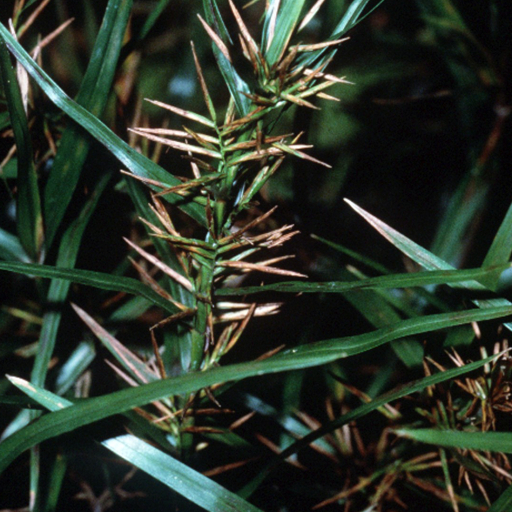
Plant Overview
Commonly known as the Three-way Sedge, this plant is a geometric marvel of the marshlands. Unlike common grasses that grow in chaotic clumps, this sedge is famous for its perfect mathematical alignment and architectural silhouette. Native to North American wetlands, it is a favorite for water gardeners who want to add a touch of structural elegance to pond edges or boggy corners.
🔍 How to Identify
- 📐 Geometric Leaves: The most striking feature is the "three-way" arrangement. Leaves emerge from the stem in three very distinct vertical rows. If you look down from the top, the foliage forms a perfect three-pointed star.
- 🔺 Triangular Stem: Staying true to the botanical rhyme "sedges have edges," the stem is noticeably triangular. However, unlike most sedges, the stem of Dulichium is uniquely hollow.
- 🌾 Hidden Blooms: In late summer, small, brownish, lance-shaped spikelets appear. Rather than waving high above the plant, these flower clusters are tucked neatly into the axils where the leaves meet the stem.
🏡 In Your Garden
- 💧 The "Wet Feet" Rule: This is an obligate wetland plant, meaning it doesn't just like water—it requires it. It is the perfect candidate for rain gardens, the shallow margins of a pond, or any "problem area" in your yard that stays consistently muddy.
- 🌱 Controlled Colonialist: It spreads via horizontal underground stems (rhizomes). While it will gradually fill in an area to create a lush, green screen, it is far less aggressive than many invasive wetland grasses and is easily managed in a garden setting.
⚠️ Safety & Toxicity
- 🛡️ Low Risk: The Three-way Sedge is generally considered non-toxic and safe for both humans and household pets.
- 🐜 Habitat Safety: Because it grows in dense, wet colonies, it can be a hiding spot for moisture-loving insects like mosquitoes or ticks. If you are thinning out a patch, it’s always wise to wear garden gloves and check for "hitchhikers" afterward.
✨ Fun Fact
The specific name arundinaceum means "reed-like," but its leaf arrangement is so precise that botanists use it as the "textbook" example of tristichous phyllotaxy (leaves in three vertical ranks). It’s one of the few plants in the world that looks like it was designed with a ruler and compass!

Detailed Care Instructions
To grow Dulichium arundinaceum, also known as three-way sedge, follow these steps:
- Climate: Determine if your climate is suitable for this plant. Dulichium arundinaceum is native to wetlands, marshes, and boggy areas in northeastern North America, so it thrives in moist to wet soil and prefers full sun to partial shade.
- Soil: Prepare a suitable planting area. The soil should be rich in organic matter, acidic to neutral (pH 5.5-7.0), and well-draining. If your soil doesn't meet these requirements, consider adding compost or peat moss to improve its quality.
- Watering: This plant requires consistently moist soil, so make sure to keep the soil damp but not waterlogged. However, if you're planting it near a natural water source or in a marshy area, you may not need to worry much about watering.
- Propagation: You have several options for propagating Dulichium arundinaceum:
- Nursery-grown plants: Look for nurseries that specialize in wetland or native plants and purchase a starter plant. This is the easiest and most convenient option.
- Seed propagation: Obtain seeds by collecting them from existing plants or purchasing them from a reputable source. Sow the seeds in a seed tray or pots indoors during spring or outdoors in fall. Keep the soil consistently moist, and transplant the seedlings into your prepared planting area once they are strong enough.
- Division: If you have an established Dulichium arundinaceum plant, you can divide it to create new plants. Carefully dig up the plant and separate the rhizomes (underground stems) into sections. Replant each section in your prepared area.
- Planting: If you're using nursery-grown plants, simply dig a hole large enough to accommodate the root ball, place the plant in the hole, and backfill with soil. Gently firm the soil around the plant, ensuring it is at the same level as it was in the pot.
- Maintenance: Provide regular water to ensure the soil remains moist. Mulching around the plant can help retain moisture. Remove any weeds that compete for nutrients. Avoid using chemical herbicides as they can harm wetland ecosystems.
- Growth: With proper care, Dulichium arundinaceum should grow well and spread by rhizomes over time. Be patient, as it may take a couple of years to establish a dense stand.
Note: Depending on your location and local regulations, it may be necessary to obtain proper permits or approvals before growing Dulichium arundinaceum, especially if you are recreating a natural wetland or marsh habitat.

Place in a bright room that is sun drenched almost all day. Or directly in a south-facing window.

Dulichium arundinaceum is a wetland plant that thrives in moist soil conditions. It requires consistent watering to maintain its growth and health. The plant should be watered regularly to ensure that the soil is consistently moist, but not overly saturated. When watering, it is important to avoid getting the leaves wet as this can lead to disease and fungal growth. Instead, water the soil around the base of the plant, making sure that it seeps deeply into the root system. During periods of drought or dry weather, it is important to water more frequently to prevent the soil from drying out completely. It is also advisable to mulch around the base of the plant to help retain moisture in the soil. Overall, the key to watering Dulichium arundinaceum is to maintain a consistently moist but not overly wet soil environment.
To fertilize this plant, apply a well-balanced fertilizer with equal parts of nitrogen, phosphorus, and potassium. Use a slow-release granular fertilizer and scatter it around the root zone. Avoid applying too much fertilizer as it can lead to excessive growth and can damage the plant. Fertilize once every 4-6 weeks during the growing season. Always follow the fertilizer manufacturer's instructions and guidelines.
The ideal soil for Dulichium Arundinaceum plant is a nutrient-rich, moist soil with good drainage. The pH level of the soil should be moderately acidic, around 5.5-6.5. It is important that the soil is not too compact, as it can hamper the growth of the plant. Adding organic matter such as compost or leaf litter to the soil can improve its texture and fertility. The presence of peat moss in the soil can also be beneficial for the plant. This plant is usually found in wetlands and marshy areas, so it can tolerate periodically inundated soil. In containers or pots, it is recommended to use a well-draining soil mix with a combination of peat moss, perlite, and sand. Avoid using soils that are high in salts as it can damage the roots of the plant.
To propagate this plant, you need to first identify mature and healthy rhizomes. These rhizomes are usually thick and have nodes or points where the leaves and roots emerge.
Take a sharp and clean knife and cut the rhizomes into sections, making sure there are at least 2 to 3 nodes in each section.
Take a tray or a pot filled with nutrient-rich soil and create small holes in it. Place the rhizome section in each hole, making sure that the nodes are facing upwards.
Cover the rhizome sections with soil and water them gently. Place the tray or pot in a sunny location that gets partial shade.
Keep the soil moist but not waterlogged. Within a few weeks, you should see new growth emerging from the nodes.
Once the new plant has established roots and leaves, you can transplant it to a permanent location. This plant prefers wet soil and partial shade, so make sure you select a suitable location for it.








