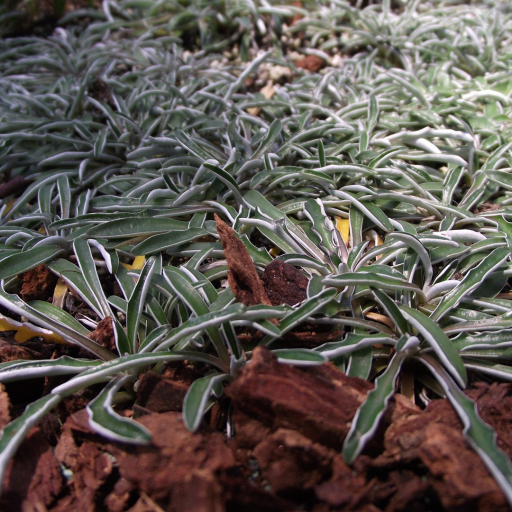
Plant Overview
Often called the Silver Carpet, this South African native is a master of minimalism and a darling of water-wise landscaping. It creates a dense, velvety mat that looks like a shimmering pool of green and silver, making it the ultimate alternative for those looking to replace thirsty lawns with something more architectural. In folklore, groundcovers like these were often seen as "earth-hugging" protectors of the soil's moisture.
🔍 How to Identify
- 🍃 The Leaf Contrast: Slender, leathery leaves that are deep grayish-green on top but feature a brilliant, fuzzy silver-white underside.
- 🌼 Hidden Blooms: Small, bright yellow daisy-like flowers that sit flush against the foliage, appearing mostly in mid-summer.
- 📏 Growth Habit: A prostrate, mat-forming perennial that rarely grows taller than 1 to 2 inches, spreading slowly to fill every available crack.
🏡 In Your Garden
- 👣 Foot Traffic Hero: This is one of the few groundcovers that can handle light foot traffic. It’s perfect for planting between flagstones or pavers where it will "hug" the stone edges.
- ⚓ Deep Roots: It develops a deep taproot system, which is the secret to its incredible drought tolerance. However, this means it hates being transplanted once it has settled in—choose its home wisely!
- ☀️ Sun Seeker: To keep that dense, carpet-like look, it needs plenty of sun. In the shade, it can become "leggy" or sparse, losing its iconic silver shimmer.
⚠️ Safety & Toxicity
- ✅ Pet & Child Friendly: Dymondia margaretae is considered non-toxic to dogs, cats, and humans.
- 🧤 Skin Safety: The foliage is soft and non-irritating, making it a safe choice for sensory gardens or play areas.
✨ Fun Fact
The "Silver Carpet" gets its name from a clever survival trick: when the plant is thirsty or the wind blows, the leaves curl upward to reveal their white, hairy undersides. This reflects sunlight and reduces moisture loss, effectively showing you its "silver lining" when times get tough!

Detailed Care Instructions
To successfully grow Dymondia Margaretae, follow these steps:
- Select a suitable location: Dymondia Margaretae thrives in full sun to partial shade, so choose a spot that receives at least 4-6 hours of direct sunlight. It prefers well-draining soil.
- Prepare the soil: Dymondia Margaretae grows best in sandy or loamy soil, so amend the soil if necessary by adding organic matter to improve drainage. Avoid heavy clay soils as they can lead to root rot.
- Planting: Dig a hole that is slightly larger than the root ball of the Dymondia Margaretae plant. Place the plant in the hole, ensuring that the top of the root ball is level with the surrounding soil. Backfill the hole and gently firm the soil around the plant.
- Watering: Initially, water the plant deeply to ensure proper establishment. Afterward, water deeply but infrequently to encourage deep root growth. Dymondia Margaretae is drought-tolerant, so allow the top few inches of soil to dry out before watering again.
- Mulching: Apply a layer of organic mulch around the plant to help conserve moisture, suppress weeds, and protect the shallow root system from extreme temperatures.
- Fertilizing: Dymondia Margaretae does not require much fertilization. If desired, a slow-release, balanced fertilizer can be applied in spring to promote healthy growth.
- Pruning: Trim back any overhanging or encroaching vegetation to allow sunlight to reach the Dymondia Margaretae plant. This will encourage it to spread and fill in bare areas.
- Weed control: Remove any weeds that may compete with the Dymondia Margaretae plant for nutrients and space. Regularly inspect the area and hand-pull any weeds that appear.
- Maintenance: To keep the plant dense and low-growing, occasionally mow or trim Dymondia Margaretae to a height of 2-3 inches.
- Propagation: Dymondia Margaretae can be propagated using seeds or by dividing established plants. However, division is usually the most successful method.
With proper care and maintenance, Dymondia Margaretae should gradually spread and form a dense, low-growing ground cover.

Place in a bright room that is sun drenched almost all day. Or directly in a south-facing window.

To water this specific plant, you should first check the soil moisture level by touching it with your fingers. If it feels dry to the touch, then it's time to water it. Make sure to pour the water directly onto the soil and not on the leaves. Allow the water to soak into the soil until it becomes moist but not soggy. Overwatering can harm the plant, so be mindful to not let it sit in standing water. In general, water regularly but moderately, allowing the top layer of soil to dry out before watering again.
To fertilize this plant, use a balanced fertilizer with equal parts nitrogen, phosphorus, and potassium. Apply the fertilizer in the early spring, just as new growth begins to appear. Avoid fertilizing during the hot summer months or in the fall, as this can promote growth that will not survive the winter. Water the plant well before and after fertilizing to ensure that the nutrients are properly absorbed.
Dymondia Margaretae prefers a well-draining soil that has good moisture retention. The ideal soil mix for this plant should contain a combination of sand, grit, perlite, and a little bit of organic matter such as compost or peat moss. The soil should be slightly acidic with a pH range of 6.0 to 7.0. It is important to avoid using heavy clay soil or soil that retains too much moisture as it can cause root rot and other fungal diseases. Additionally, it is best to avoid fertilizers high in nitrogen as they can cause excessive leaf growth at the expense of flowers.
Propagation of a certain trailing plant can be done through dividing the plant. Firstly, carefully remove the plant from its pot or garden bed. Then, use a sterilized sharp knife to cut the plant into several sections, with each section consisting of some roots and foliage. These sections should be planted in a well-draining soil mix, keeping the soil moist but not overly wet. In addition to division, the plant can also be propagated by taking stem cuttings. Choose a healthy stem, make a clean cut with a sterilized knife, and remove the lower leaves. Then, place the cutting into a well-draining soil mix, making sure it is buried deep enough and watered regularly until roots have formed. Optimal conditions for propagation are a warm, humid environment with bright, indirect light.








