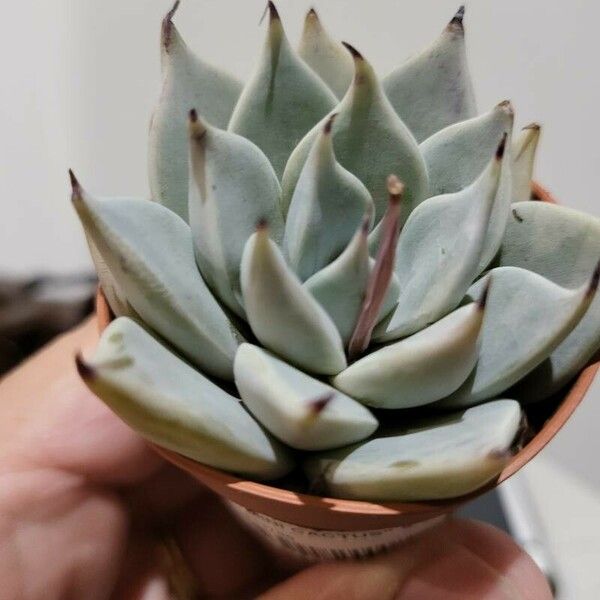
Plant Overview
Known for its remarkably sharp, geometric precision, Echeveria cuspidata is often called the "Pointed Echeveria" or simply the "Cuspidata." Hailing from the rugged, rocky terrains of Mexico, this succulent is a master of structural elegance, forming tight rosettes that look almost as if they were sculpted from frosted stone. It is a favorite among collectors who appreciate a plant that balances a delicate, powdery appearance with a "don’t touch" attitude.
🔍 How to Identify
- 🌵 The Rosette: It forms a compact, symmetrical starburst shape. The leaves are thick, fleshy, and spoon-shaped, but they narrow significantly toward the end.
- 🖋️ The "Cusp": The most defining feature is the sharp, dark reddish or brown point (the mucro) at the very tip of each leaf, giving the plant its name.
- ❄️ The Farina: The leaves are coated in a thick layer of epicuticular wax (farina), giving the plant a ghostly blue, silvery, or pale green matte finish.
- 🔔 The Blooms: In spring or early summer, it sends up a tall, arching stalk bearing bell-shaped flowers that transition from a coral-pink base to a yellow interior.
🏡 In Your Garden
- ☀️ The Sun-Blush: To keep its tight, rose-like shape, this plant craves high-intensity light. If it doesn't get enough, the rosette will "stretch" (etiolate), losing its geometric beauty. In bright sun, the tips turn a deep, dramatic burgundy.
- 💧 Drought Mimicry: Because it grows in rocky crevices in the wild, its roots are incredibly sensitive to standing water. It prefers a "soak and dry" method; the thick leaves act as water reservoirs, so it is far better to underwater than to overwater.
- 🤲 The "No-Touch" Rule: The powdery wax on the leaves is the plant's natural sunscreen and raincoat. Touching the leaves leaves permanent fingerprints and smudge marks that never grow back, so handle it only by the root ball or the very bottom leaves.
⚠️ Safety & Toxicity
- ✅ Status: Generally considered non-toxic to humans and common household pets.
- 🐱 Details: While it is safe for cats and dogs, the sharp tips of the leaves can cause minor mechanical injury if a curious pet tries to chew on them. It is always best to keep succulents out of reach to prevent the plant from being crushed or the pet from choking on thick leaves.
✨ Fun Fact
The powdery coating (farina) on Echeveria cuspidata doesn't just protect it from the sun; it's also hydrophobic! If you drop water on the leaves, it will bead up and roll off instantly like a marble, ensuring the plant doesn't rot in its center during rare mountain rainstorms.

Detailed Care Instructions
To grow Echeveria cuspidata (also known as "Echeveria agavoides" or "Succulent Agave"), follow these steps:
- Choose the right conditions: Echeverias thrive in full sun to partial shade, so make sure to place your plant in a location that receives at least 4-6 hours of bright sunlight each day. If you live in a very hot climate, it's best to provide some protection from the intense afternoon sun.
- Provide well-draining soil: Echeverias prefer sandy or rocky soil that drains well. You can create a suitable mix by combining regular potting soil with perlite or coarse sand to help improve drainage.
- Use a proper container: Echeverias can be grown in pots or containers. Select a container with drainage holes to prevent water from pooling and causing root rot. A shallow pot works well for this type of plant, as it has a shallow root system.
- Watering: Echeverias are succulents and have a low water requirement. Allow the soil to dry out completely between waterings, and then thoroughly water the plant until water flows out of the drainage holes. Avoid overwatering to prevent root rot. In winter, reduce watering as the plant goes into a dormant period.
- Fertilizing: Echeverias are not heavy feeders but can benefit from occasional fertilization. Use a balanced, diluted liquid fertilizer specifically formulated for succulents, following the instructions on the packaging. Apply the fertilizer during the plant's active growing season (spring and summer) about once a month.
- Propagation: Echeveria cuspidata can be propagated easily through stem or leaf cuttings. Simply allow the cuttings to dry and callus over for a few days, then plant them in well-draining soil, keeping them slightly moist until new roots develop. Avoid overwatering during the propagation process.
- Pruning: If your Echeveria cuspidata starts to lose its rosette shape or becomes leggy, you can prune it back to encourage new growth and maintain its compact form. Use clean, sharp scissors or pruners to trim back any leggy or damaged stems.
- Protection from frost: Echeverias are not frost-tolerant, so if you live in a region with cold winters, the plant should be protected indoors or in a greenhouse during frosty periods. Alternatively, you can cover or bring the plant indoors during chilly nights.
By following these steps, you can successfully grow and care for your Echeveria cuspidata plant. Enjoy the unique beauty of this succulent!

Place in a bright room that is sun drenched almost all day. Or directly in a south-facing window.

To properly water the Echeveria Cuspidata plant, you should follow these tips:
1. Understand the watering needs: Echeveria Cuspidata plants are succulents, which means they have unique watering requirements. They are adapted to arid environments and store water in their leaves. Hence, they prefer infrequent but deep watering rather than frequent, shallow watering.
2. Check the soil: Before watering, it is important to check the moisture level of the soil. Stick your finger about an inch into the soil. If it feels dry, it's time to water. However, if the soil feels moist, it is better to wait a few more days.
3. Watering technique: When watering, use a gentle and direct stream of water to ensure that the water reaches the root zone. Watering directly on the leaves or on other parts of the plant can lead to rot and harm the Echeveria Cuspidata.
4. Adequate drainage: Echeveria Cuspidata requires well-draining soil to prevent root rot. Make sure the pot has drainage holes to allow excess water to escape. This helps prevent water from sitting in the container.
5. Watering frequency: During the growing season (typically spring and summer), water the Echeveria Cuspidata when the soil has completely dried out. This usually occurs once every 7-10 days, depending on the environment. In winter, reduce watering to once every few weeks as the plant goes into a dormant state.
6. Observe the plant: Pay attention to the signs of overwatering or underwatering. Overwatering can cause leaves to become mushy or translucent, while underwatering may make them shriveled and wrinkled. Adjust your watering schedule accordingly to maintain optimal plant health.
By following these watering guidelines, you can help your Echeveria Cuspidata thrive and maintain its overall health and appearance.
To fertilize your plant, mix a balanced liquid fertilizer with water according to the package instructions. Use a watering can to apply the diluted fertilizer directly to the soil around the base of the plant. Make sure not to pour fertilizer directly onto the leaves as it may cause damage. Fertilize the Echeveria Cuspidata plant once a month during the growing season, which is typically spring and summer. In the winter months, reduce the frequency of fertilization to every two to three months or suspend it entirely. Remember to always follow the instructions specific to the fertilizer you are using for the best results.
Echeveria Cuspidata plants thrive best in well-draining soil that allows excess moisture to flow through easily. The ideal soil composition for Echeveria Cuspidata consists of a blend of organic and inorganic matter. It is recommended to use a succulent or cactus mix as the base soil, which typically contains ingredients like coarse sand, perlite, pumice, and/or volcanic rock fragments. These components aid in ensuring proper drainage and prevent waterlogging, which can cause root rot.
Additionally, incorporating some organic matter such as compost or well-rotted manure into the soil can provide essential nutrients for the plant's growth. This organic matter can improve the soil's moisture retention while still allowing excess water to drain away.
When selecting the soil for Echeveria Cuspidata, it is important to avoid heavy or compact soils, as these can retain excessive moisture and lead to root rot. Such soils can suffocate the roots and hinder optimal growth. Additionally, soils with high clay content are not suitable, as they tend to become waterlogged and restrict oxygen availability to the roots.
Overall, the key considerations for the soil used with Echeveria Cuspidata are good drainage, aeration, and avoidance of excessive moisture retention. A well-draining succulent or cactus mix enriched with organic matter can provide the ideal growing medium for this plant, ensuring healthy root development and overall plant vigor.
Here are steps to propagate Echeveria Cuspidata plant:
- Start by selecting a healthy, mature Echeveria Cuspidata plant for propagation. Look for a plant that has several rosettes with firm, fleshy leaves.
- Gently remove the plant from its pot, being careful not to damage the roots or the base of the rosettes.
- Inspect the plant for any offsets or "pups" that have grown near the base of the rosettes. These are smaller plants that can be separated and propagated.
- Using a clean, sharp knife or gardening shears, carefully remove the offsets from the main plant. Make sure to include a small portion of the root system with each pup.
- Allow the cuts to callous over for a few days. This helps prevent rotting when the offsets are planted.
- Prepare a well-draining potting mix for the new plants. A mixture of cactus or succulent soil and perlite works well.
- Plant the offsets in the prepared soil, ensuring that the roots are covered, but the rosettes remain above the soil surface. Gently firm the soil around each plant to provide support.
- Place the newly propagated Echeveria Cuspidata plants in a location with bright, indirect light. Avoid direct sunlight, as it may scorch the leaves.
- Water the plants sparingly, allowing the soil to dry out between waterings. Overwatering can cause root rot, so it's essential to maintain a well-draining soil and watering schedule.
- After a few weeks, the new Echeveria Cuspidata plants should establish roots and start growing. At this point, you can treat them like mature plants, providing regular care and maintenance.
Remember to be patient during the propagation process, as it may take several weeks for the new plants to take root and start showing signs of growth. With proper care and attention, you can successfully propagate Echeveria Cuspidata and expand your succulent collection.
Common pests of the white mexican rose include Mealybugs, aphids, thrips. Make a habit of checking your white mexican rose frequently for pests so that any infestations can be caught and managed early.








