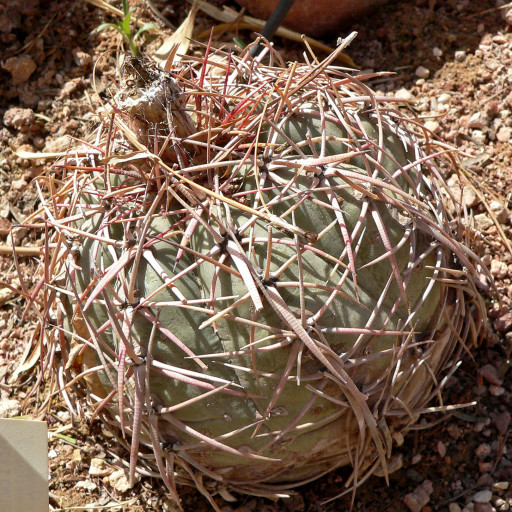
Plant Overview
Known as the "Eagle’s Claw" or "Blue Barrel Cactus," this desert survivor looks more like a weathered piece of turquoise stone than a typical plant. Native to the harsh limestone ridges of the Chihuahuan and Sonoran deserts, it is highly prized by collectors for its geometric precision and ethereal, dusty-blue skin. It is a true specialist of the arid Southwest, designed to withstand the most intense sun and driest soils on Earth.
🔍 How to Identify
- 🌵 The Body: A solitary, slow-growing cactus that starts as a flattened disk and matures into a short, stout cylinder. It typically features 8 to 13 wide, spiraling ribs that give it a "twisted" appearance.
- 🦅 The "Claws": It is armed with thick, heavy, and flattened spines that curve back toward the plant body like an eagle’s talons. These spines are often a striking reddish-pink when wet or young, aging to a slate gray.
- 🌸 Woolly Blooms: Large, funnel-shaped flowers emerge from a dense patch of white "wool" at the very top (the apex). The petals are a shimmering rose-pink or magenta with a delicate, papery texture.
🏡 In Your Garden
- 🪨 The Limestone Lover: This cactus is a "calciphile," meaning it naturally thrives in calcium-rich, rocky environments. When kept in a container, it requires an extremely gritty mineral mix (pumice, lava rock, and limestone) with very little organic soil to prevent rot.
- ☀️ Sun Worshiper: It requires intense, direct sunlight to maintain its signature blue-gray "glaucous" coating. This waxy layer acts as a natural sunscreen; without enough light, the plant will turn a dull green and become prone to pests.
- 🏺 Taproot Sensitivity: Unlike many succulents with shallow roots, this species develops a thick, sensitive taproot. It hates being moved or repotted frequently, so it’s best to choose a deep, breathable terracotta pot and leave it undisturbed for several years.
⚠️ Safety & Toxicity
- 🗡️ Mechanical Hazard: While the plant is not chemically toxic, the spines are incredibly strong and hooked. They can easily pierce thick gardening gloves and are notoriously difficult to remove from skin or clothing.
- 🐾 Pet & Child Safety: It is generally considered non-toxic if accidentally tasted, but the physical barrier of the "claws" is its primary defense. Keep it on a high shelf or in a protected area to avoid accidental stabs.
✨ Fun Fact
⏳ Slow and Steady: Echinocactus horizonthalonius is one of the slowest-growing cacti in North America. Because it grows so incrementally, a specimen the size of a grapefruit could easily be over 30 to 50 years old!

Detailed Care Instructions
| Humidity | High |
| Difficulty | Medium |
| Hibernation | Cold Period |
| Temperature | 22°C - 32°C |
| Hardiness Zones | 10 - 11 |
To grow an Echinocactus Horizonthalonius plant, also known as the eagle's claw cactus, you can follow these steps:
- Decide if you want to grow the plant from seeds or purchase a young plant from a nursery. Growing from seeds is a longer process, but can be rewarding.
- Select a suitable container with good drainage. The container should be slightly larger than the plant's root ball.
- Prepare the potting mix. Use a well-draining cactus or succulent potting mix. You can also create your own mix by combining regular potting soil with perlite or coarse sand.
- Fill the container with the potting mix, leaving some space at the top for watering.
- If you are planting from seeds, scatter the seeds on top of the potting mix and lightly press them into the soil. If you are using a young plant, gently remove it from its pot, loosen the roots, and place it in the container, adding more potting mix around it.
- Place the container in a location that receives bright, indirect sunlight. Echinocactus Horizonthalonius plants require at least 4-6 hours of sunlight per day.
- Water the plant sparingly. Allow the soil to dry out completely between waterings. Overwatering can cause root rot.
- During the growing season (spring and summer), you can fertilize the plant with a cactus-specific fertilizer. Follow the instructions on the fertilizer package for application and frequency.
- Monitor the plant for any signs of pests or diseases. Common pests include mealybugs and scale insects. If you notice any insect activity or damage, treat the plant with an appropriate pesticide or try natural remedies like rubbing alcohol or neem oil.
- Repot the plant every few years into a slightly larger container to provide ample space for growth.
Remember, Echinocactus Horizonthalonius plants are slow-growing, so be patient and give it time to establish and thrive.

Place in a bright room that is sun drenched almost all day. Or directly in a south-facing window.

When watering this particular plant, it is important to take into consideration the type of soil it is planted in and the moisture levels of the environment it is placed in. Ideally, this plant should be grown in well-draining soil that has good air circulation. When watering, it is recommended to use a watering can or hose with a gentle spray nozzle to avoid disturbing the plant's roots. It is important to only water the plant when the soil has become completely dry and to never overwater as this can lead to root rot. Additionally, this plant is known to prefer drier conditions and therefore requires less frequent watering than other succulents. Finally, it is important to take into consideration the temperature and humidity levels of the surrounding environment as these can affect the plant's ability to absorb water.
To fertilize the Echinocactus Horizonthalonius plant, start by selecting a balanced, slow-release fertilizer. Dilute the fertilizer according to the package instructions.
During the growing season, typically from spring to summer, apply the fertilizer once every 4-6 weeks. Make sure the soil is moist before fertilizing.
Pour the diluted fertilizer evenly over the soil, taking care not to let it touch the plant's spines as they may cause skin irritation.
Avoid fertilizing during the dormant period in winter. Additionally, be cautious not to overfertilize, as it can lead to plant burn or damage. Monitor the plant's response and adjust the fertilizing schedule accordingly.
The ideal soil for this type of plant should be well-draining, with a pH level between 6.0 and 7.0. It should consist of a mixture of coarse sand, perlite, and gritty materials such as pumice or lava rock to improve drainage. The soil should not be overly rich in nutrients as this can lead to excessive growth and weakness in the plant. When planting, it is important to ensure that the soil is firmly packed around the roots to provide support as this plant does not have a deep root system. Water sparingly, allowing the soil to dry out slightly between watering, but be careful not to let the plant become too dry as this can cause stress and damage. Regular fertilization is not necessary for this plant, but a balanced, low-nitrogen fertilizer can be applied once every 3-4 months during the growing season.
To propagate Echinocactus Horizonthalonius, also known as its scientific name, you will need to follow a specific process. Here are the detailed steps:
- Start by selecting a healthy and mature Echinocactus Horizonthalonius plant. This will ensure a higher success rate for propagation.
- Prepare the necessary tools, including sharp and sterilized pruning shears or a sharp knife, a clean and well-draining propagation container, suitable potting mix, and a watering can.
- Choose a suitable offset or pup from the mother plant to propagate. Offsets are smaller plants that grow around the base of the main plant.
- Carefully remove the selected offset from the mother plant by cutting it off close to the base. Make sure to avoid damaging the parent plant or the roots of the offset during this process.
- Allow the cut surface of the offset to dry and callous over for a few days. This step is crucial to prevent rotting and infections during the propagation process.
- Prepare a well-draining potting mix suitable for cacti and succulents. You can use a mixture of perlite, sand, and peat moss to create a suitable medium.
- Fill the propagation container with the potting mix, leaving some space at the top for watering.
- Create a shallow hole or trench in the potting mix using your finger or a small tool. Gently place the offset in the hole so that it remains upright and stable.
- Lightly press the potting mix around the base of the offset to provide support and ensure good soil-to-root contact.
- Water the newly planted offset until the excess water drains out from the bottom of the container. Avoid overwatering, as this can lead to root rot.
- Place the propagation container in a warm and bright location, but avoid direct sunlight, especially during the hottest part of the day.
- Keep the soil slightly moist but not overly saturated. Water only when the top inch of soil feels dry to the touch.
- It may take several weeks or even months for the offset to develop roots and establish itself as an independent plant. During this time, be patient and avoid disturbing the plant unnecessarily.
- Once the new Echinocactus Horizonthalonius plant has established roots and shows signs of healthy growth, you can start treating it as a mature plant by gradually reducing watering frequency and providing appropriate care.
Following these detailed instructions should help you successfully propagate and grow Echinocactus Horizonthalonius from an offset without using its common names.
Common pests of the eagle-claw cactus include Scale insect, mealybugs, spider mites, thrips. Make a habit of checking your eagle-claw cactus frequently for pests so that any infestations can be caught and managed early.








