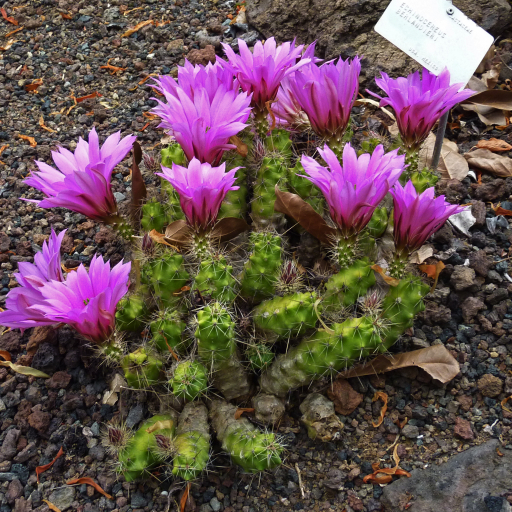
Plant Overview
The Berlandier’s Hedgehog Cactus is a low-slung desert gem that trades height for horizontal charm. Native to the brushlands of South Texas and Northern Mexico, this cactus is often called the "Alice-cactus" or simply "Berlandier's Hedgehog." While it may look like a tangled cluster of spiny fingers for most of the year, it transforms into a showstopper in spring with blossoms so bright they seem to glow against the dusty earth.
🔍 How to Identify
- 🌵 Growth Habit: Unlike upright columnar cacti, this species is decumbent, meaning its stems sprawl along the ground, often forming dense, messy mats or "clumps."
- 🌸 Brilliant Blooms: It produces large, funnel-shaped flowers in shades of deep magenta or neon pink. Look for the distinct green stigma in the center of the flower—a classic trait of the Echinocereus family.
- 🦴 Spine Structure: The stems are covered in small clusters of spines. The radial spines are usually white or grayish, while the central spines are slightly longer and darker, giving the plant a textured, "bristly" appearance.
🏡 In Your Garden
- 🏜️ Drainage is Non-Negotiable: Because of its prostrate (creeping) nature, the stems often touch the soil. If the ground stays damp, the plant will rot quickly. It thrives best in gritty, mineral-heavy soil or tucked into the crevices of a rock garden.
- 🌞 Sun & Stress: It loves full sun, which encourages tighter spine growth and more prolific flowering. If it’s grown in too much shade, the stems will stretch out (etiolate) and lose their characteristic "hedgehog" fullness.
- ❄️ Cold Nuance: This cactus is surprisingly hardy compared to tropical succulents, but it must be kept bone-dry during winter months to survive freezing temperatures.
⚠️ Safety & Toxicity
- ✅ Non-Toxic: This cactus is not known to be poisonous to cats, dogs, or humans.
- 🌵 Physical Hazard: While not "deadly," the spines are sharp and can easily puncture the skin or get stuck in a curious pet's paw. It is best handled with thick leather gloves or tongs.
✨ Fun Fact
This species was named after Jean-Louis Berlandier, a French-Swiss naturalist who explored the American Southwest in the 1820s. He was one of the first Europeans to document the incredible biodiversity of the Texas-Mexico borderlands!

Detailed Care Instructions

Place in a bright room that is sun drenched almost all day. Or directly in a south-facing window.

When the top few inches of soil dry out, water your plants. If the top few inches of soil are still moist, do not water your plant. Wait a few days, then poke your finger into the soil to see if anything has changed. Overwatering poses a disease risk, such as the development of fungal diseases in the roots. These plants have adaptations in there leaves that allow them to survive in low water supply.








