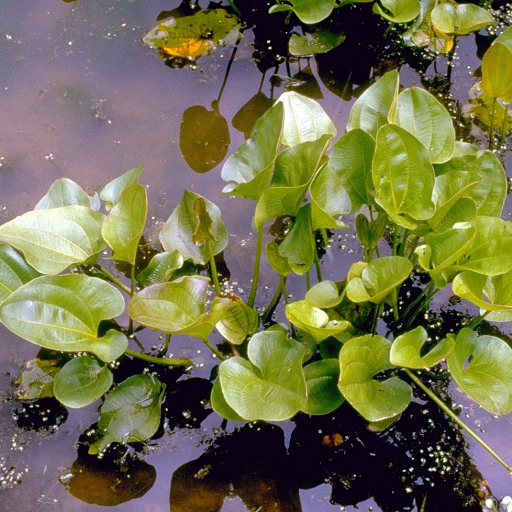
Plant Overview
Known as the "Creeping Burhead" or "Heartleaf Sword," this aquatic giant is a staple of North American wetlands and home aquariums. Unlike many delicate water plants, it is a robust survivor that loves to "climb" out of the water to show off its delicate white blooms. It’s the perfect choice for someone looking to add a lush, tropical jungle vibe to a pond or a large aquarium.
🔍 How to Identify
- 🍃 The Leaves: Large, deep green, and distinctly heart-shaped (cordate). When grown underwater, the leaves are often thinner and more translucent; when grown above water, they become thick, waxy, and tough.
- 🌸 The Blooms: It produces long, arching flower stalks that bear clusters of small, snowy-white flowers with three delicate petals and a yellow center.
- 📏 Growth Habit: It grows in a dense rosette. In high light, it may stay compact, but it typically aims for the surface, spreading its leaves wide and tall.
🏡 In Your Garden or Aquarium
- 🍴 The Iron Hog: This plant is a "heavy feeder." Because it develops a massive, hungry root system, it requires a nutrient-rich substrate or frequent root tabs. It often shows signs of yellowing if it doesn’t get enough iron.
- 🌊 The Great Escape: If kept in a fish tank, it will eventually try to grow leaves right out of the top of the water. While this looks stunning in "open-top" aquariums, it can quickly shade out smaller plants below if not pruned.
- 🌱 Natural Propagation: It earns the name "Creeping Burhead" because its long flower stalks often develop baby plantlets (adventitious plants). In the wild, these stalks eventually touch the mud, allowing the new plants to take root and "creep" across the shoreline.
⚠️ Safety & Toxicity
- ✅ Safe Status: Non-toxic and completely safe for living environments.
- 🐾 Pet & Fish Friendly: It poses no threat to cats, dogs, or curious fish. In fact, many aquarium fish, like Discus or Angelfish, prefer to use the broad, sturdy leaves of the Heartleaf Sword as a "nursery" to glue their eggs during spawning.
✨ Fun Fact
The Echinodorus Cordifolius is a master of transformation. It is "amphibious," meaning it can transition its entire biology from living completely submerged under a lake to living on dry land during a drought, changing its leaf shape and texture to survive the change in humidity!

Detailed Care Instructions
To grow Echinodorus Cordifolius or sword plant, here are some steps you can follow:
- Select a suitable aquarium or tank: Choose a tank that can accommodate the height of the plant when fully grown. Make sure to provide enough space for the plant's spreading leaves.
- Substrate: Use a nutrient-rich substrate in the tank, such as aquarium soil or aquatic plant-specific substrate. This will provide essential nutrients for the plant's growth.
- Lighting: Echinodorus Cordifolius requires moderate to high lighting levels to grow well. Install a suitable aquarium light that provides a spectrum of light suitable for plant growth. Ensure the light is on for 10-12 hours per day.
- Water conditions: Maintain good water quality in the tank. Echinodorus Cordifolius prefers slightly acidic to neutral water with a pH between 6.5 to 7.5. Keep the water temperature between 72-82°F (22-28°C).
- Fertilization: Regularly fertilize the plant to ensure it receives all essential nutrients. Use a liquid or root fertilizer specifically designed for aquatic plants. Follow the instructions on the fertilizer package for proper dosage and frequency.
- Water changes: Perform regular water changes to prevent the accumulation of toxins and maintain optimal water conditions for the plant's growth.
- Pruning: Trim and remove any dead or decaying leaves to promote new growth. Pruning can also help maintain the desired shape and size of the plant.
- CO2 supplementation (optional): Echinodorus Cordifolius can benefit from CO2 supplementation, especially in high-light setups. Carbon dioxide injection can enhance the plant's growth and coloration.
Remember that Echinodorus Cordifolius can grow relatively large, so ensure you have enough space in your aquarium for its mature size. Additionally, be patient, as this plant can take time to establish and grow to its full potential.

Place in a bright room that is sun drenched almost all day. Or directly in a south-facing window.

To water this plant, ensure that the soil is moist by testing it with your finger before watering. If the soil feels dry, carefully pour water around the base of the plant until the soil is wet. Avoid watering directly on the leaves as this can cause damage and disease. This plant requires moderate watering and should not be overwatered as it can lead to root rot. Watering once a week or whenever the soil feels dry is sufficient. Ensure that the pot has proper drainage to avoid waterlogging.
To fertilize this plant, you can add a balanced liquid fertilizer to the water every two weeks. Additionally, you can add a root tab fertilizer to the substrate every few months to provide additional nutrients. It is important not to over-fertilize and to regularly monitor the plant's health to adjust the fertilization regimen as needed.
Echinodorus Cordifolius plant grows best in a nutrient-rich substrate that is well-draining and contains a mixture of organic matter and minerals. It prefers a soil pH that is neutral to slightly acidic, with a range of 6.5-7.0.
To create the ideal soil for Echinodorus Cordifolius plant, start with a base of high-quality aquarium soil or a mixture of peat moss, vermiculite, and perlite. Add in some small amounts of clay, sand, and gravel to improve drainage and provide minerals.
It is also important to provide adequate lighting and CO2 supplementation to help promote healthy growth. Regular fertilization with a balanced liquid fertilizer can also help to keep the soil nutrient-rich and support the plant's growth and development.
Propagation of this plant can be done by either dividing the plant or by using the runners that are produced by the parent plant. The parent plant should be gently removed from the substrate and root system carefully separated to get the new plants. The new plants should be placed in a separate tank since they may not tolerate the same water conditions as the parent plant. The new plants' substrate should have enough nutrients to assist their growth. With appropriate care, these new plants will thrive and produce more plantlets.








