Plant Overview
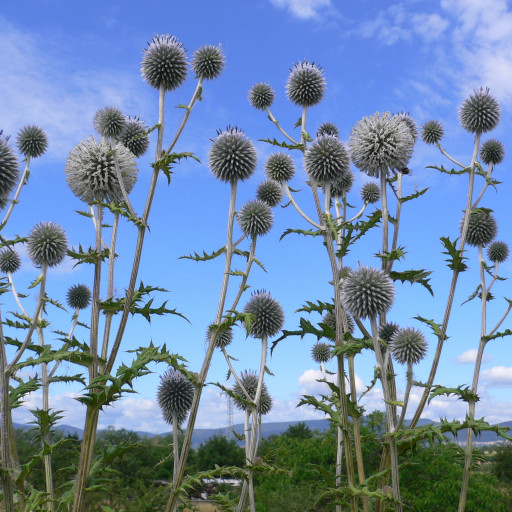
Often called the Glandular Globe Thistle, this plant looks like it was plucked straight from a medieval armory. Its perfectly spherical, icy-blue or white flower heads sit atop tall, silvery stems, creating a striking "architectural" silhouette in a landscape. Originally hailing from Eurasia, it has become a favorite for gardeners who want a touch of drama and a lot of bees.
🔍 How to Identify
- 🌿 The Foliage: The leaves are large, deeply lobed (pinnatifid), and armed with small spines. While the tops are dark green, the undersides are covered in a soft, silvery-white fuzz.
- 🏐 The Bloom: Look for perfectly round, golf-ball-sized spheres. Unlike many flowers that open in sequence, these globes look like spiky "maces" before hundreds of tiny individual flowers bloom outward from the center.
- 🧴 Sticky Stems: The stems are unique because they are covered in "glandular" hairs—tiny, sticky filaments that give the plant a slightly tacky feel and its scientific name, sphaerocephalus.
🏡 In Your Garden
- 🏗️ The Taproot Rule: This thistle develops a massive, deep taproot. This makes it incredibly resilient against drought and poor soil, but it also means it hates being moved. Once you plant it, it’s best to let it stay there forever.
- 🐝 A Pollinator Party: If you want to support local wildlife, this is your plant. It is a high-ranking nectar producer; don't be surprised to see three or four bees sharing a single flower head at once.
⚠️ Safety & Toxicity
- 🌵 Physical Spines: Echinops is generally non-toxic to humans and pets. However, it is "mechanically" dangerous. The sharp spines on the leaves and flower heads can easily puncture skin or irritate the mouths of curious dogs.
- 🧤 Handle with Care: Always wear thick gardening gloves when pruning or deadheading to avoid "hedgehog" pricks.
✨ Fun Fact
The genus name Echinops is derived from the Greek words echinos (meaning hedgehog) and ops (meaning appearance). It literally translates to "looking like a hedgehog," a nod to its prickly, spherical flowers!

Detailed Care Instructions
| Humidity | Normal |
| Lighting | Full Sun |
| Difficulty | Medium |
| Hibernation | Cold Period |
| Temperature | 20°C - 26°C |
| Hardiness Zones | 3 - 9 |
To grow Echinops sphaerocephalus, also known as globe thistle, you can follow these steps:
- Choose the right location: Echinops sphaerocephalus prefers full sun to partial shade, so find a spot in your garden that receives at least 6 hours of direct sunlight.
- Prepare the soil: The plant prefers well-draining soil. If your soil is heavy or clay-like, amend it with organic matter like compost to improve drainage. Globe thistle can tolerate a range of soil types but prefers slightly alkaline conditions.
- Sow seeds or plant seedlings: You can start echinops sphaerocephalus from seeds or purchase young plants from a nursery. Sow seeds indoors about 6-8 weeks before the last frost date or directly in the garden after the danger of frost has passed. Bury the seeds ¼ inch deep in the soil and keep them moist until germination. Transplant seedlings to their final location once they have developed several sets of leaves.
- Watering: Globe thistle is relatively drought-tolerant, but it is important to keep the soil consistently moist during the plant's establishment period. Afterward, water regularly, especially during dry spells.
- Mulching: Apply a layer of organic mulch around the base of the plant to help retain soil moisture and suppress weed growth. Avoid piling the mulch against the stem.
- Provide support: Echinops sphaerocephalus can grow tall and may require staking to prevent the stem from bending or breaking under the weight of the flower heads. Place stakes or a plant cage around the growing plant to provide support.
- Pruning: After the plant has finished flowering, you can trim back the spent flower heads to encourage new growth and prevent self-seeding. You can also cut the plant down to the ground in late winter or early spring to allow for fresh growth in the following season.
- Division: Every few years, you can divide mature echinops sphaerocephalus plants to maintain their health and vigor. Dig up the plant in early spring before new growth begins, carefully separate the clumps into smaller sections, and replant them in prepared soil.
With proper care and maintenance, your Echinops sphaerocephalus plants should thrive and produce beautiful globe-shaped flower heads.

Place in a bright room that is sun drenched almost all day. Or directly in a south-facing window.

To water this plant, you should always be mindful of its soil conditions. The Echinops Sphaerocephalus plant prefers well-draining soil that is kept consistently moist, but not waterlogged.
When watering, use room temperature water and aim to water the soil directly around the base of the plant rather than getting water on the foliage. This will help to prevent moisture-related issues such as fungal diseases.
It is also important to note that this plant can tolerate some dry conditions, so be sure to check the soil moisture level before watering to ensure that it really needs it. Additionally, it is best to avoid wetting the foliage during the late afternoon or evening hours, as this can increase the risk of disease.
In general, a good rule of thumb for watering the Echinops Sphaerocephalus plant is to water deeply and thoroughly once a week during periods of normal rainfall, and more frequently during hot, dry weather.
To fertilize this plant, it is recommended to use a balanced fertilizer with equal amounts of nitrogen, phosphorus, and potassium. The fertilizer can be applied either in granular or liquid form, and it should be applied to the soil around the base of the plant. It is important to follow the instructions on the fertilizer package regarding how much to apply and how frequently to apply it. Over-fertilization can harm the plant, so it is important to use caution and not apply too much. Additionally, it is recommended to fertilize this plant in the early spring when new growth is just starting to appear.
Echinops Sphaerocephalus is a plant that prefers a well-draining soil mix that is slightly acidic. It does well in soils that have a pH level of 6.0 to 7.0. The soil should be enriched with organic matter, such as compost or well-aged manure, to ensure that the plant receives the nutrients it needs to thrive. It is recommended to use a mixture of sand, perlite, and peat moss in equal parts to create a suitable soil mix. The plant requires regular watering, but care should be taken not to overwater as this can cause root rot. Adequate drainage is crucial to prevent waterlogging.
To propagate this plant, you can take stem cuttings during the growing season. Choose healthy stems that are at least several inches long and cut them at a 45-degree angle. Remove any leaves from the bottom of the stem, leaving only a few leaves at the top. Dip the cut end of the stem in rooting hormone and plant it in moist potting soil. Place the cutting in a bright location but out of direct sunlight, and keep the soil moist. After a few weeks, new roots should start growing and the cutting can be transplanted to its final location.
Common pests of the great globe-thistle include Aphids, larvae, snails. Make a habit of checking your great globe-thistle frequently for pests so that any infestations can be caught and managed early.








