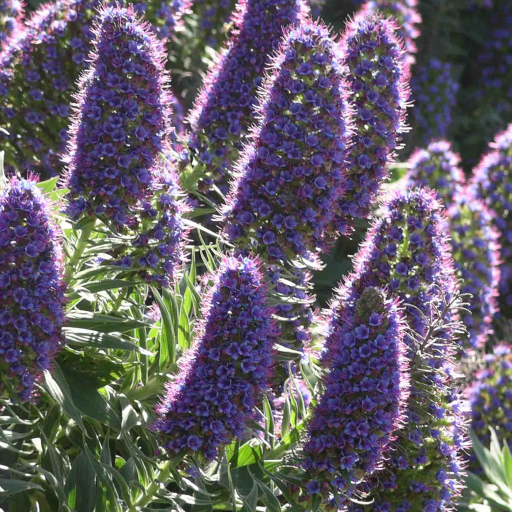
Plant Overview
Known as the Pride of Madeira, this Mediterranean-style beauty looks like something plucked straight from a fantasy novel. With its towering purple spires and dramatic, silvery-green foliage, it is a favorite for coastal gardens and drought-tolerant landscapes where visual "wow-factor" is required. While it originates from the rocky cliffs of the Madeira islands, it has traveled the world as a symbol of architectural elegance and pollinator support.
🔍 How to Identify
- 🌊 The Flower Spikes: Its most striking feature is the massive, cone-shaped clusters of flowers (thyrses) that can reach up to 20 inches in length, blooming in vibrant shades of bluish-purple with reddish stamens.
- 🗡️ The Foliage: The leaves are lance-shaped, silvery-gray-green, and grow in dense, attractive rosettes at the ends of woody branches.
- 🌵 The Texture: Both the stems and leaves are covered in fine, stiff hairs, giving the plant a fuzzy, almost sandpaper-like feel when touched.
🏡 In Your Garden
- ☀️ Sun and Salt: This plant is a true coastal warrior. It thrives in poor, rocky soil and salt spray, making it perfect for seaside cliffs or Mediterranean-style "dry" gardens.
- 🌊 Drainage is Non-Negotiable: Pride of Madeira hates "wet feet." If the soil stays soggy, the roots will rot quickly. It is better to underwater than overwater once established.
- ⏳ Short but Sweet: Treat this as a short-lived perennial. It usually lives for about 5 to 6 years, but it often leaves behind "volunteers" (seedlings) to take its place.
⚠️ Safety & Toxicity
- 🚫 Status: Toxic to ingest and a skin irritant.
- 🧤 Touch Warning: The tiny hairs on the leaves and stems can cause significant skin irritation or a prickly rash. Always wear gloves and long sleeves when pruning.
- 🐾 Pet Safety: If eaten, the plant contains pyrrolizidine alkaloids which can cause liver damage in cats, dogs, and horses. Keep it away from curious nibblers.
✨ Fun Fact
The Pride of Madeira is often called a "living magnet" for nature. When in full bloom, the plant hums with life, as it is one of the most prolific nectar producers for honeybees, bumblebees, and butterflies, making it a cornerstone species for pollinator-friendly gardens.

Detailed Care Instructions
To promote fast growth of the Echium fastuosum plant, you can follow these steps:
- Select a suitable location: Choose a spot in your garden that receives full sun or partial shade, as Echium fastuosum prefers bright light to thrive.
- Soil preparation: Ensure the soil is well-draining and rich in organic matter. If needed, amend the soil with compost or well-rotted manure to improve fertility and drainage.
- Planting: Dig a hole slightly larger than the plant's root ball. Gently remove the plant from its container and place it in the hole at the same depth as it was in the pot. Fill in with soil and firm it gently around the base of the plant.
- Watering: Echium fastuosum prefers moderate watering. Water the plant deeply but infrequently, allowing the top inch of the soil to dry out between waterings. Avoid overwatering, as it can lead to root rot.
- Mulching: Apply a layer of organic mulch around the base of the plant to help conserve moisture, prevent weed growth, and maintain a more stable temperature.
- Fertilizing: Apply a balanced, slow-release fertilizer in early spring to provide necessary nutrients. Repeat the feeding every 6-8 weeks during the growing season.
- Pruning: Echium fastuosum can become quite large and bushy. To promote faster growth and maintain a more compact shape, prune back the plant in late winter or early spring before new growth begins.
- Protecting from frost: Echium fastuosum is not frost-tolerant, so if you live in an area with colder winters, consider growing it in a container that can be brought indoors or providing a frost cover during winter.
- Support: Echium fastuosum produces tall flower spikes, so it may benefit from staking or support to prevent bending or breaking under strong winds or when in bloom.
With proper care and attention, your Echium fastuosum plant should grow quickly and provide a beautiful display of colorful flowers.
To water this particular plant, it is important to remember a few key points. Firstly, it is imperative that the soil is kept moist but not waterlogged. This plant requires moderate watering, so aim to water it once a week, or perhaps more often during hot, dry spells. It is also important not to let the soil dry out completely, as this can cause stress to the plant.
When watering the plant, it is best to do so at the base of the stem. Avoid getting water on the leaves or flowers, as this can cause damage to them. Use a watering can or hose with a gentle sprayer to ensure even watering.
It is important to monitor the plant carefully and adjust watering as needed. If the plant starts to droop or wilt, it may need more water. However, overwatering can lead to root rot, so be careful not to go overboard.
Overall, the key to watering this plant is to keep the soil moist but not waterlogged, and to avoid getting water on the leaves or flowers. With proper care, this plant should thrive and produce beautiful blooms.
To fertilize this plant, use a balanced fertilizer once a month during the growing season. Mix the fertilizer according to package instructions, and apply it to the soil around the plant. Water the plant after fertilizing to ensure that the nutrients are distributed properly. Avoid fertilizing during the dormant season, as this can damage the plant.
Echium Fastuosum plant requires well-drained soil that is rich in nutrients and have a neutral pH level. The soil should be fertile, loamy, and have good aeration. It is important to avoid using heavy clay soil as it does not allow for good drainage and can cause root rot. Adding organic matter such as compost or peat moss to the soil can improve its texture and nutrient content. It is also recommended to mix in some sand to improve drainage. The plant prefers full sun exposure and should be watered regularly but not overwatered. Fertilizing the soil with a balanced fertilizer once every few months can help promote healthy growth and flowering.
Echium fastuosum is a plant that can be propagated through seeds or cuttings.
To propagate through seeds, collect ripe seeds from the plant and store them in a cool, dry place until ready to plant. Sow the seeds in a well-draining soil mix, covering them lightly with soil, and water gently. Keep the soil moist and warm, and the seedlings should appear in 2-3 weeks.
To propagate through cuttings, take stem cuttings in the spring or early summer. Cut healthy stems with a sharp, sterilized knife, and remove the leaves from the lower half of the stem. Dip the cut end of the stem into rooting hormone powder and insert it into a well-draining soil mix. Keep the soil moist and the cutting in a warm, bright location. The cutting should root within a few weeks.
Propagation through division is also possible, but it is less common for this plant. Divide the plant in spring before new growth starts, being careful to separate sections with healthy roots. Replant the sections in well-draining soil and water well.








