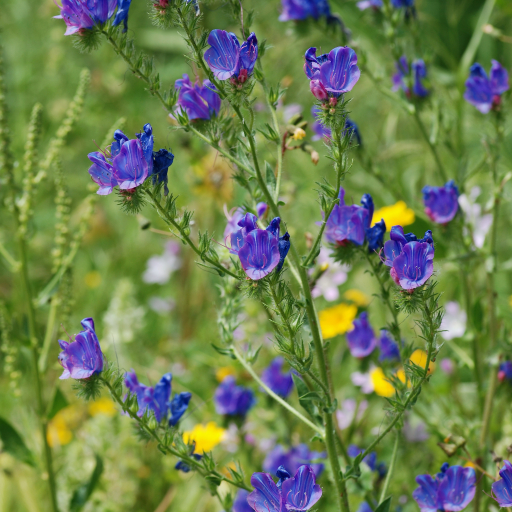
Plant Overview
Often referred to as the "Paterson’s Curse" or "Salvation Jane," this Mediterranean native is a plant of many faces. Depending on who you ask, it is either a devastating invasive weed or a drought-defying lifesaver for honeybees. Its stunning waves of purple blooms can transform a dry field into a violet sea, but beneath its beauty lies a resilient survivor that is tough to eradicate once it takes hold.
🔍 How to Identify
- 🌸 Vibrant Blooms: Funnel-shaped flowers that transition from a rosy pink to a deep, electric purple. Look closely and you will see two long stamens poking out like a snake's tongue.
- 🗡️ Bristly Texture: The entire plant—from the stem to the leaves—is covered in stiff, white hairs. These give the plant a rough, sandpaper-like feel that can be quite prickly to the touch.
- 🌿 The Rosette Phase: In its first year, it sits low to the ground in a flat, star-shaped cluster of wide, oval leaves before shooting up its tall flowering spikes in the second year.
🏡 In Your Garden
- 🏜️ The Taproot Factor: This plant develops a massive, deep taproot that allows it to survive in bone-dry soils where other flowers wither. However, this means it hates being moved; transplanting often leads to a quick decline.
- 🐝 Pollinator Magnet: If you are a beekeeper, this is often called "Salvation Jane" because it provides a reliable source of nectar when other plants have died off. The honey produced from its nectar is light, floral, and highly prized.
- 🌱 Aggressive Spreading: In a garden setting, it is a prolific self-seeder. If you don't deadhead the flowers before they drop seeds, you may find your entire yard overtaken by a purple carpet the following spring.
⚠️ Safety & Toxicity
- 🐾 Toxic to Livestock: It contains pyrrolizidine alkaloids, which are cumulative poisons. While sheep can graze on it for short periods, it is highly toxic and often fatal to horses, cattle, and pigs.
- 🧤 Skin Irritation: The stiff hairs on the stems can cause "contact dermatitis" (an itchy, red rash) for those with sensitive skin. It is always best to wear gloves when handling or pulling this plant.
✨ Fun Fact
The dual name "Paterson’s Curse" and "Salvation Jane" comes from Australian history. It was named a "Curse" by farmers whose livestock died after eating it, but called "Salvation" by others who were grateful it was the only plant that stayed green during the brutal droughts of the 1800s.

Detailed Care Instructions
| Humidity | Dry |
| Lighting | Full Sun |
| Difficulty | Easy |
| Hibernation | Cold Period |
| Hardiness Zones | 9A - 11A |
To grow Echium plantagineum, also known as Paterson's curse or purple viper's-bugloss, follow these steps:
- Choosing the right location: Echium plantagineum prefers full sun and well-draining soil. Choose a sunny spot in your garden where the plant will receive at least 6-8 hours of direct sunlight.
- Preparing the soil: Echium plantagineum thrives in moderately fertile soil. Prepare the soil by removing any weeds and loosening it with a garden fork. Add some compost or well-rotted manure to improve soil fertility.
- Planting from seed: Echium plantagineum can be grown from seed. Sow the seeds directly into the prepared soil, scattering them evenly. Lightly press them into the soil, ensuring they are not buried too deep. Water gently after sowing.
- Watering: Keep the soil consistently moist but not waterlogged. Water the plants regularly, especially during dry spells. Avoid overwatering, as echium plants can be prone to root rot.
- Thin out the seedlings: Once the seedlings emerge, thin them out to allow enough space for each plant to grow properly. Space the plants about 12-18 inches apart.
- Mulching: Apply a layer of organic mulch around the base of the plants to help retain moisture and suppress weed growth. This will also help keep the roots cool during hot weather.
- Fertilizing: Echium plantagineum generally doesn't require regular fertilization, as it can grow well in moderately fertile soil. However, you can apply a balanced, slow-release fertilizer once or twice during the growing season if desired.
- Support for taller varieties: Some taller varieties of Echium plantagineum may require support as they grow. Stake or place plant supports around the plants to prevent them from toppling over during strong winds.
- Deadheading: To encourage continuous blooming, remove faded and spent flowers regularly. Cut off the flower stalks just above a pair of healthy leaves.
- Pests and diseases: Echium plantagineum is relatively resistant to pests and diseases. However, keep an eye out for common garden pests such as aphids and slugs, and take appropriate measures to control them if necessary.
By following these steps, you can successfully grow Echium plantagineum in your garden. Enjoy the vibrant flowers and the attraction they bring to bees and other pollinators.

Place in a bright room that is sun drenched almost all day. Or directly in a south-facing window.

To water this plant, ensure that the soil is dry to touch before watering. When watering, pour water onto the soil around the base of the plant, making sure not to wet the foliage or flowers. Water deeply and thoroughly, allowing the water to soak into the soil. Avoid overwatering, as this plant is sensitive to standing water and poorly drained soil. It is important to maintain consistent moisture levels, especially during the plant's active growth phase. In periods of drought or high temperatures, more frequent watering may be necessary.
For best results, fertilize this plant with a balanced fertilizer once every four weeks during the growing season. Be sure to follow the package instructions and avoid over-fertilizing, as this can harm the plant. Additionally, it is recommended to amend the soil with organic matter before planting to ensure optimal growth and health.
Echium Plantagineum plant prefers soil that is well-drained and has good moisture retention capacity. A soil mixture consisting of equal parts of loamy soil, sand, and peat moss is considered optimal for the plant to thrive. Additionally, the soil should be slightly acidic with a pH of around 6.0-6.5. It is important to ensure that the soil is not compacted as this can hinder root growth and lead to poor plant development. Adding organic matter to the soil, such as compost or well-rotted manure, can also be helpful in improving soil quality and providing essential nutrients for healthy plant growth.
To propagate this plant, first collect the seeds from mature plants. Plant the seeds indoors in pots or trays filled with moist seed starting mix. Cover the seeds lightly with soil and keep them moist.
Place the pots or trays in a warm, bright location, such as near a south-facing window or under a grow light. Keep the soil moist but not waterlogged.
Once the seedlings have emerged and developed a few true leaves, they can be transplanted into individual pots with potting soil. Continue to keep the soil moist and provide plenty of light.
As the plants grow and mature, they can be transplanted into larger containers or directly into the garden. Provide them with well-draining soil and full sun to partial shade.
To propagate the plant by division, wait until it has matured and developed multiple stems. Carefully dig up the entire plant, being sure to keep the root system intact. Gently divide the plant into smaller sections, each with its own set of roots and stems.
Replant each section in its own container or in the garden. Water the plants well and provide them with plenty of light and nutrients as they establish themselves.








