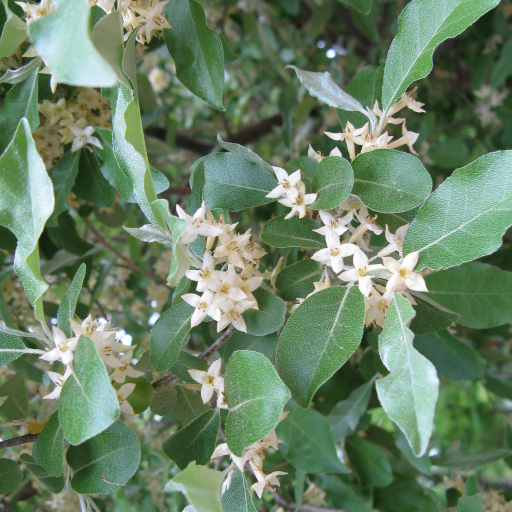
Plant Overview
Known as the Autumn Olive or Japanese Silverberry, this resilient shrub is a master of transformation. In the spring, it perfumes the air with a heavy, sweet scent from its delicate blossoms, while in autumn, it drips with shimmering, speckled red berries. Though it is prized by foragers and wildlife, it is often viewed as a spirited "rebel" in North America due to its ability to spread rapidly and claim new territory.
🔍 How to Identify
- 🍃 The Silver Shimmer: The most striking feature is the underside of the leaves, which are covered in tiny silvery scales that catch the light when the wind blows.
- 🍒 Speckled Berries: The small, round fruits are a deep ruby red but are uniquely "dusted" with silver or gold flecks, giving them a metallic appearance.
- 🌼 Tubular Blooms: Its flowers are creamy white to pale yellow, trumpet-shaped, and grow in clusters along the twigs rather than at the tips.
🏡 In Your Garden
- 🌱 The Soil Builder: This plant is a "nitrogen fixer." It works with special soil bacteria to pull nitrogen from the air and store it in its roots, essentially fertilizing the ground as it grows.
- ✂️ Containment is Key: Because it grows so aggressively and birds spread the seeds far and wide, it is considered invasive in many regions. If you grow it, regular pruning and harvesting of all the fruit are necessary to keep it from "escaping" into nearby woods.
- ☀️ Indestructible Nature: It is incredibly drought-tolerant and thrives in poor, sandy, or salty soil where other plants would wither, making it a favorite for windbreaks or erosion control.
⚠️ Safety & Toxicity
- 😋 Edible Fruit: The berries are safe and quite delicious for humans, offering a tart, berry-like flavor that sweetens significantly as they ripen in late autumn.
- 🐾 Pet Friendly: There are no known toxicities for dogs or cats, though the dense, twiggy growth can sometimes produce sharp, thorn-like spurs that could cause minor scratches.
- 🐦 Wildlife Magnet: Birds absolutely love the berries, which is why the plant spreads so easily.
✨ Fun Fact
Move over, tomatoes! Research has shown that Autumn Olive berries contain up to 17 times more lycopene (a powerful antioxidant) than a typical tomato, making them a secret superfruit of the foraging world.

Detailed Care Instructions
| Color | Creamy |
| Soil Ph | 6-9 |
| Humidity | Normal |
| Lighting | Full Sun |
| Toxicity | Poisonous |
| Soil Type | Moist, Well-Draining Or Loamy Soils |
| Bloom Time | Early, Late And Mid-Spring |
| Difficulty | Medium |
| Plant Type | Deciduous Shrub |
| Mature Size | 10-16' Tall |
| Native Area | Europe And Western Asia |
| Sun Exposure | Partial Shade To Full Sun |
| Hardiness Zones | 4-9 |
To grow an Elaeagnus umbellata plant, also known as autumn olive, you can follow these steps:
- Choose the right location: Select a spot in your garden that receives full sun, as autumn olive plants thrive in sunny conditions.
- Prepare the soil: Autumn olive plants are adaptable to various soil types, but they prefer well-draining soil. Amend the soil by adding organic matter like compost to improve its fertility and drainage.
- Planting: Dig a hole that is slightly larger than the root ball of the plant. Place the plant in the hole and backfill with soil, gently pressing the soil around the roots. Water thoroughly after planting.
- Watering: Water the plant regularly during its first year to establish strong roots. Afterward, water deeply but less frequently to encourage deep root growth.
- Pruning: Regular pruning will help maintain the shape and size of the plant. Prune in early spring to remove any dead or damaged branches and to encourage new growth.
- Fertilizer: Autumn olive plants usually do not require heavy fertilization. However, you can apply a balanced slow-release fertilizer in spring to promote healthy growth.
- Mulching: Apply a layer of organic mulch around the base of the plant to help retain moisture, suppress weed growth, and regulate soil temperature.
- Pest and disease management: Elaeagnus umbellata is relatively resistant to pests and diseases. However, occasional inspection for common garden pests such as aphids and mites is recommended. If necessary, treat them with appropriate insecticides or soapy water.
- Harvesting: Autumn olive plants produce edible fruit. Harvest the ripe fruits in late summer or early fall when they turn red. The fruits can be consumed fresh or used in various culinary preparations like jams, jellies, and sauces.
Remember that Elaeagnus umbellata is considered an invasive species in some regions, so it's important to check whether it is suitable for cultivation in your area and to prevent its spread to natural habitats.

Place in a window with dappled sun or a spot in the middle of a room. Or directly in a window facing west or east.

To water this particular plant, it is important to first check the moisture level of the soil. This can be done by touching the soil surface or using a moisture meter. If the top inch of soil feels dry, it is time to water the plant.
When watering, make sure to apply water slowly and evenly to the base of the plant. Avoid getting water on the leaves, as this can promote disease. Water deeply but infrequently, allowing the soil to dry out slightly between watering sessions.
It is also important to consider the growing conditions of the plant, such as the temperature, humidity, and sunlight exposure. These factors will influence how often and how much water the plant needs.
Overall, regular monitoring and proper watering techniques will help to maintain the health and vigor of this unique plant species.
To fertilize this plant, use a slow-release fertilizer in the early spring when new growth appears. Apply the fertilizer according to the directions on the package, avoiding direct contact with the roots. Alternatively, you can use a balanced fertilizer once a month during the growing season. Be careful not to over-fertilize as it can lead to overgrowth and root damage. Water the plant thoroughly after fertilizing.
The best soil to use with this plant is a well-draining, loamy soil with a pH range of 5.5 to 7.5. The soil should be rich in organic matter and have good water retention properties while also allowing excess water to drain away. A soil mixture that contains sand, perlite, and peat moss can help provide the necessary drainage and nutrient retention. It is important to ensure that the soil is not too compact, as Elaeagnus Umbellata plants require good air circulation for healthy growth. Additionally, the plant prefers a slightly acidic soil, so regular soil testing can help maintain the appropriate pH levels.
To propagate this plant, you will need to collect fresh seeds from the mature fruit during the fall season. After collecting the seeds, you will need to stratify them in order to break their dormancy. You can stratify the seeds by placing them in a plastic bag with some damp sand, then storing them in a refrigerator for up to three months.
After the stratification period is over, you can plant the seeds in a well-draining potting mix in a container with drainage holes. Place the container in a warm, bright location and keep the soil damp but not soaking wet.
Once the seedlings have grown to a height of at least 4 inches, they can be transplanted into larger containers or outdoors into a sunny location with well-draining soil. It is important to keep the soil around the newly transplanted seedling moist until it establishes a strong root system.
You can also propagate this plant by taking cuttings from mature stems during the summer months. Dip the cut end of the stem in rooting hormone and plant it in a well-draining potting mix. Keep the soil damp and place the cutting in a bright location but out of direct sunlight. Once roots have formed and new growth appears, the cutting can be transplanted into a larger container or outdoors into a suitable location.








