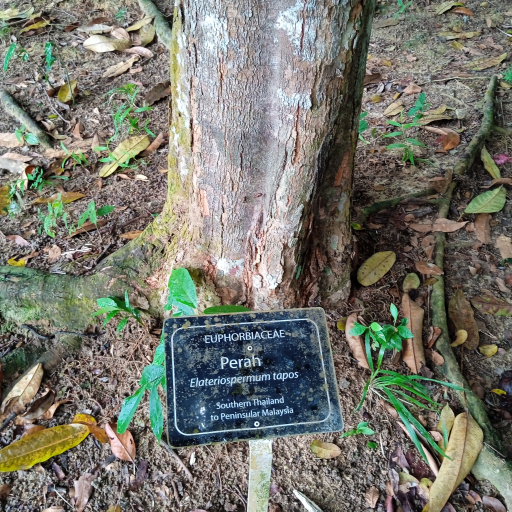
Plant Overview
Known affectionately as the "Buah Perah" in its native Southeast Asia, Elateriospermum tapos is a majestic rainforest giant that acts as a living seasonal clock. It is famous for its dramatic "flushing" periods, where the entire canopy turns a brilliant shade of pinkish-red as new leaves emerge. In jungle folklore, the sound of its seeds exploding like firecrackers signals a time of abundance for both forest creatures and local communities.
🔍 How to Identify
- 🍃 Chameleon Foliage: The most striking feature is the color change; young leaves emerge in a soft, hanging flush of bright red or purple before stiffening into long, glossy green ovals.
- 🌰 Woody Capsules: The tree produces thick, three-lobed seed pods. When mature, these brown, heart-shaped capsules are incredibly hard and woody.
- 💧 Milky Latex: Like many of its cousins in the rubber family, the bark and stems exude a sticky, white milky sap if punctured or broken.
🌲 Habitat & Ecology
- 💥 Ballistic Dispersal: This tree doesn't rely on the wind; it uses "explosive dehiscence." On hot days, the seed pods dry out and burst with a loud "crack," launching seeds up to 30 feet away from the trunk.
- 🦇 Wild Buffet: While the seeds are a favorite for small mammals like squirrels and wild boar, the tree plays a massive role in the rainforest ecosystem by providing a high-energy fat source during the fruiting season.
⚠️ Safety & Toxicity
- 🚫 Dangerous Raw: The seeds are toxic if eaten raw. They contain cyanogenic glycosides (which release cyanide) and must be processed through boiling or fermentation to be rendered safe.
- 🐾 Pet Warning: Keep pets away from fallen seeds or leaking sap. Ingesting raw seeds can cause respiratory distress, while the sap may cause skin irritation or "sap burn" on sensitive paws and noses.
✨ Fun Fact
In Malaysia, the seeds are fermented to create a traditional delicacy known as "Jeruk Perah." Once the toxins are removed, the seeds have a rich, creamy, and nutty flavor that many compare to a cross between a macadamia and a chestnut!

Detailed Care Instructions
To grow Elateriospermum Tapos plant, follow these steps:
- Obtain the seeds of Elateriospermum Tapos plant from a reputable nursery or seed supplier.
- Prepare a well-draining potting mix with a combination of organic matter, sand, and perlite.
- Fill a seed tray or small pots with the prepared potting mix.
- Sow the Elateriospermum Tapos seeds onto the surface of the potting mix, lightly press them down, and cover them with a thin layer of vermiculite or sand.
- Water the seeds gently using a spray bottle or misting nozzle to avoid displacing them.
- Place the seed tray or pots in a warm and well-lit area, preferably near a south-facing window that receives indirect sunlight.
- Maintain consistent moisture levels in the potting mix by watering lightly whenever the top inch of soil feels dry. Avoid overwatering, as it can cause root rot.
- Germination may take anywhere from 10 days to several weeks. Be patient and continue providing the right conditions.
- Once the seedlings have developed a few sets of true leaves, you can transplant them into larger individual pots or a suitable garden bed.
- Choose a location for planting that receives partial shade to avoid direct sunlight, which can scorch the delicate leaves of the young plant.
- Ensure the soil in the planting area is well-draining and amended with organic matter.
- Dig a hole large enough to accommodate the root ball of the Elateriospermum Tapos plant. Place the plant in the hole and backfill it with soil, gently firming it around the roots.
- Water thoroughly after planting to settle the soil and remove any air pockets around the roots.
- Continue watering regularly, ensuring the soil remains consistently moist but not waterlogged.
- As the Elateriospermum Tapos plant grows, provide support or trellis to help it climb and spread.
- Fertilize the plant every two to three months with a balanced slow-release fertilizer, following the manufacturer's instructions.
- Prune any dead or faded leaves, flowers, or vines to maintain a tidy appearance and promote healthy growth.
- Monitor the plant for any signs of pests or diseases and take appropriate measures, such as using organic pest control methods or consulting a professional if necessary.
With proper care and attention, your Elateriospermum Tapos plant should thrive and grow into a beautiful and vigorous vine.
To water this plant, first, check the soil moisture level by inserting your finger into the soil up to the second knuckle. If the soil feels dry, it's time to water. Use a watering can or hose to water the plant thoroughly, making sure that the water reaches the roots. Avoid overwatering, which can cause root rot and other problems. Allow the soil to partially dry out between watering sessions. If the plant is in a container, make sure to empty any excess water that collects in the drainage tray to prevent waterlogged soil. Water the plant more often during hot, dry weather or if it's in a location with bright, direct sunlight.
To properly fertilize the Elateriospermum Tapos plant, you should apply a balanced fertilizer that is high in nitrogen during the growing season. Avoid over-fertilizing as this can lead to decreased plant growth and poor health. Apply the fertilizer every two weeks and ensure that the soil is moist before fertilizing. During the dormant period, reduce fertilizer applications to once a month. Additionally, you can add organic matter, such as well-rotted manure or compost, to the soil to improve its fertility.
Elateriospermum Tapos is a plant that requires well-draining soil that is rich in organic matter. It thrives in loam or sandy loam soil with a pH level between 6.5 and 7.5. The soil should be moist but not waterlogged, as the plant does not tolerate standing water. It is important to avoid using heavy clay soil as it can retain too much moisture and lead to root rot. Before planting, it is recommended to mix in compost or other organic matter to improve soil quality and fertility. Additionally, adding slow-release fertilizer can enhance plant growth and health.
Elateriospermum Tapos is a plant that can be propagated via several methods such as seed propagation and vegetative propagation. Here are some details on propagating this plant without mentioning its common names:
- Seed propagation: Collect mature seeds from the plant when they are dry and brown. Clean the seeds by removing any debris or chaff. Soak the seeds overnight in lukewarm water. Sometimes scarification of the seed coat may be needed to increase germination rates. Sow the seeds in pots filled with a well-draining soil mix. Water the pots regularly, and keep them in a warm, bright location but out of direct sunlight. Once the seedlings are established, transplant them into bigger pots or outside in a suitable location.
- Vegetative propagation: This method of propagation involves taking cuttings from the parent plant and rooting them. Select a healthy, disease-free stem from the parent plant and make a clean cut just below a node. Remove any leaves or flowers from the lower part of the stem. Dip the cut end in rooting hormone to aid in the rooting process. Plant the cutting in a well-draining soil mix and keep it moist. Cover the cutting with a plastic bag or place it in a propagator to create a humid environment to help with rooting. Keep the cutting in a warm, bright location but out of direct sunlight. Once the cutting has rooted, it can be transplanted to a larger pot or a suitable location outside.
Overall, propagation of Elateriospermum Tapos requires attention to detail, patience and a good understanding of the plant's growth habits. By following the above steps, you can successfully propagate the plant and enjoy its beauty in your garden.








