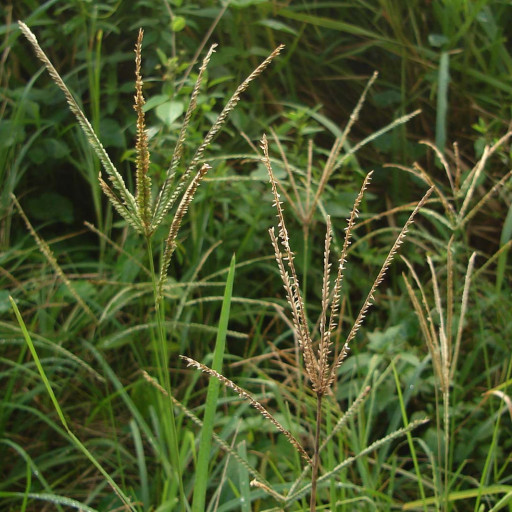
Plant Overview
Often called "Goosegrass," "Wiregrass," or the "Toughest Weed in the Yard," Eleusine indica is the ultimate survivor. Originally hailing from the tropics and subtropics, this grass has conquered gardens worldwide by thriving exactly where other plants give up. Its flattened, radiating stems look like a green star pressed firmly into the earth, refusing to be moved.
🔍 How to Identify
- 🌿 Flattened Stems: The base of the plant is distinctly silver-white and compressed, radiating outward in a low-profile "tufted" or "rosette" shape.
- 🌾 Zipper-Like Seed Heads: The flowers consist of 2–7 spiky "fingers" radiating from the top of the stem, featuring a unique double-row of seeds that look like tiny green zippers.
- 💪 Wire-Like Texture: True to its nickname "Wiregrass," the stems are incredibly tough and fibrous, making them almost impossible to break or pull by hand without a tool.
🏡 In Your Garden
- 🚜 Compaction King: This plant thrives in "problem areas"—specifically in hard, compacted soil or sidewalk cracks where heavy foot traffic or machinery prevents other grass from growing.
- 🌱 The "Survivor" Strategy: It produces thousands of seeds that can remain dormant in the soil for years. Because it grows so flat to the ground, it often escapes the blades of a lawnmower, allowing it to go to seed even in well-kept lawns.
⚠️ Safety & Toxicity
- ✅ Safe Profile: Eleusine indica is generally considered non-toxic to humans, dogs, and cats. It does not possess thorns or stinging hairs.
- 🚜 Physical Risk: While not poisonous, its stems are so strong they can actually tangle in lawnmower undercarriages or pose a minor tripping hazard in thin lawns due to their grip on the soil.
✨ Fun Fact
In the Philippines, this "weed" is known as Paragis and is highly respected in traditional medicine; it is often brewed into a tea believed to treat everything from fever to kidney issues!

Detailed Care Instructions
To grow Eleusine indica, also known as goosegrass or crowfootgrass, you can follow these steps:
- Obtain seeds: You can find Eleusine indica seeds at local nurseries or purchase them online.
- Choose a suitable location: Eleusine indica can tolerate a wide range of soil types but prefers well-draining soil. It also requires full sun for optimal growth.
- Prepare the soil: Clear any weeds or debris from the planting area. Loosen the soil with a garden fork or tiller to a depth of about 6-8 inches.
- Sow the seeds: Sprinkle the Eleusine indica seeds evenly over the prepared soil. Press them lightly into the soil, but do not bury them too deeply. A shallow covering of soil or mulch will help retain moisture.
- Watering: Keep the soil consistently moist until the seeds germinate. Water regularly, but avoid overwatering, as this can lead to rotting.
- Maintain proper moisture: Once the plants establish themselves, water them deeply but infrequently to encourage deep root growth. Eleusine indica is fairly drought-tolerant but still requires regular watering.
- Fertilizing: Apply a balanced slow-release fertilizer according to the package instructions. This will provide necessary nutrients for healthy growth.
- Weed control: It is important to control weeds around Eleusine indica, as they can compete for resources. Regularly remove any weeds by hand or use mulch to suppress their growth.
- Pest and disease control: Eleusine indica is generally resistant to pests and diseases. However, keep an eye out for signs of damage or infestation and take appropriate measures if necessary.
- Harvesting: Once the plants reach maturity, you can harvest the seeds by carefully cutting the seed heads and allowing them to dry. Store the seeds in a cool, dark place for future use or replanting.
Remember that Eleusine indica is classified as a weed in many regions, so ensure it is legal to grow in your area and take necessary precautions to prevent it from spreading beyond your intended planting area.

Place in a bright room that is sun drenched almost all day. Or directly in a south-facing window.

The watering requirement for this plant depends on a few factors such as the season, location, and soil type. Before watering, it is important to check the top soil level to see if it is dry or not. If the top soil is dry, it's an indication that the plant needs water.
To water the plant, use a watering can or hose with a gentle flow of water. Avoid using a high-pressure spray as it can damage the plant. Water the plant thoroughly, making sure that the water reaches the roots.
It is advisable to water the plant early in the morning or in the evening when the temperature is cooler to avoid evaporation. Additionally, it is beneficial to water the plant deeply but less frequently, rather than shallow watering frequently. This encourages deep root growth, which helps the plant to withstand dry periods.
Overwatering can be harmful to the plant, as it may lead to root rot and fungal diseases. Ensure that the soil has adequate drainage to avoid waterlogging.
In conclusion, it's essential to water this plant adequately, checking for dryness before watering and providing deep but infrequent watering.
- Choose a slow-release, balanced fertilizer with a ratio of N-P-K (nitrogen, phosphorus, and potassium) of 1:1:1.
- Apply the fertilizer once every three months during the growing season.
- Use a spreader to evenly distribute the fertilizer across the soil surface around the plant.
- Water the plant immediately after fertilizing to help the nutrients absorb into the soil.
- Avoid fertilizing when the soil is dry or if the plant is stressed.
- Monitor the plant for signs of over-fertilization, such as yellowing leaves or stunted growth, and adjust the fertilization schedule as needed.
The soil recommended for Eleusine Indica plant is well-draining and sandy loam soil with a pH range of 6-7.5. It should have good organic matter content and be rich in minerals and nutrients, such as nitrogen, phosphorous, and potassium. The soil should be regularly fertilized with balanced fertilizer for optimal growth and development of the plant. It is advisable to avoid using heavy clay soils or soils with poor drainage, as these can cause waterlogging and root rot, which can be detrimental to the plant's health. Additionally, it is recommended to plant the Eleusine Indica in a sunny location with adequate water supply.
To propagate this plant, you will need to take stem cuttings from a mature plant. Choose a healthy stem with at least 2-3 nodes. Cut the stem at a 45-degree angle using a sterile pair of scissors. Remove the leaves from the lower half of the stem. Place the cutting in a container of water, making sure that at least one node is submerged. Change the water every 2-3 days to prevent the growth of bacteria and fungi. Once roots have formed and are at least an inch long, you can transplant the cutting into a pot filled with a well-draining potting mix. Keep the soil moist and the plant in a bright, indirect light. After a few weeks, the plant should establish itself and begin to grow.








