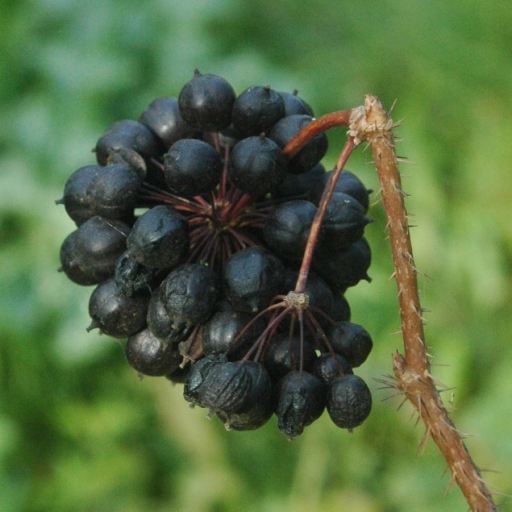
Plant Overview
Often called "Siberian Ginseng," Eleutherococcus senticosus is the rugged, cold-hardy cousin of the more famous Asian Ginseng. While it isn’t a "true" ginseng, it has been prized for centuries in Eastern medicine as a powerful adaptogen meant to help the body resist stress. In the wild, it forms dense, defensive thickets in the chilling, frost-bitten forests of East Asia and Russia.
🔍 How to Identify
- 🌿 Palmate Leaves: The plant features compound leaves, usually with five elliptical leaflets spreading out from a single point like the fingers of a hand.
- 🌵 Bristly Stems: The woody branches are covered in fine, needle-like prickles that often point downward, giving the stalks a "hairy" but sharp texture.
- 🔮 Dark Berries: In late summer, small clusters of pale-purple flowers transform into globe-shaped umbels of glossy, blue-black berries.
🌲 Habitat & Ecology
- 🏔️ Extreme Resilience: This shrub is famous for its "toughness." It thrives in USDA zones 3 through 7, meaning it can survive Siberian-level winters that would kill most other medicinal plants.
- 🍄 Forest Floor Preferences: In its natural habitat, it grows under the canopy of conifers and oaks. In a garden setting, it prefers "dappled" shade and rich, moist soil that mimics the decaying leaf litter of an ancient forest.
- 🐢 Slow Establishment: This is not a plant for the impatient gardener. It focuses its energy on developing a complex, woody root system before putting on significant height, often taking several years to reach its full 6-10 foot stature.
⚠️ Safety & Toxicity
- 🛡️ Physical Caution: While the plant is generally non-toxic to humans and animals, the stems are deceptively sharp. The fine bristles can easily lodge in the skin, so always wear thick gardening gloves when pruning.
- 🐾 Pet Safety: There are no documented toxic effects for cats or dogs; however, the prickly stems make it a "look but don't touch" plant for curious pets who might try to chew on the woody stalks.
✨ Fun Fact
🚀 Space Herb: During the height of the Space Race, Soviet scientists gave Eleuthero extract to their cosmonauts to help them adapt to the extreme physical and psychological stress of long-duration space missions!

Detailed Care Instructions
To grow Eleutherococcus Senticosus, commonly known as Siberian ginseng or Eleuthero, you can follow these steps:
- Climate: Ensure you live in a suitable climate for Siberian ginseng. It prefers cooler or colder regions and can tolerate temperatures between -40 to 40 degrees Celsius (-40 to 104 degrees Fahrenheit). It thrives in zones 3 to 7.
- Soil: Siberian ginseng prefers well-draining, acidic soil with a pH of around 4.5 to 6.5. Amend the soil with organic matter like compost or leaf mold to improve fertility and moisture retention.
- Sunlight: Find a location that receives partial sun or light shade throughout the day. Avoid strong, direct sunlight as it may scorch the plant.
- Planting: Obtain Siberian ginseng seeds or seedlings from a nursery or reputable supplier. If using seeds, stratify them by cold-moist stratification. Place the seeds in a damp paper towel, seal them in a plastic bag, and refrigerate for about 90-120 days.
- Start indoors: Start the seeds indoors in separate pots 6-8 weeks before the last frost date. Plant the seeds 1/4 inch deep in a well-draining seed-starting mix. Keep the soil moist and warm, around 20-25 degrees Celsius (68-77 degrees Fahrenheit). Seedlings should emerge in 2-3 weeks.
- Transplanting: Once the seedlings are 4-6 inches tall, transplant them outdoors in your prepared garden. Space each plant at least 2-3 feet apart to allow for their mature size, which can reach up to 6 feet in height.
- Watering: Keep the soil consistently moist but not waterlogged. Siberian ginseng prefers slightly moist soil, so water deeply when the top inch of soil feels dry. A layer of mulch can help retain moisture and control weeds.
- Maintenance: Remove any weeds that compete with the young plants for resources. Apply an organic, balanced fertilizer in early spring and midsummer to promote healthy growth.
- Pruning: Prune branches back in early spring to encourage bushier growth and maintain its desired shape.
- Harvesting: Wait until the plant is at least three years old before harvesting the roots. Dig up the roots carefully, wash them, and air-dry them before storage or further processing.
Remember that Eleutherococcus Senticosus is a slow-growing perennial plant, and it requires patience and care to establish and cultivate properly.

Place in a bright room that is sun drenched almost all day. Or directly in a south-facing window.

To water this plant, it is important to first identify its specific watering needs based on its growth stage, soil type, and environmental conditions such as temperature and humidity. Generally, this plant requires moderate watering, meaning that the soil should be kept consistently moist but not overly saturated. It is recommended to water the plant deeply but infrequently, allowing the water to penetrate the root zone and avoid shallow root growth.
When watering, it is important to use room temperature or tepid water, as cold water can shock the roots and cause damage. Additionally, it is recommended to water in the morning or early evening to avoid water evaporation and allow the plant to absorb the moisture before the heat of the day.
Before watering, it is important to check the soil moisture level by sticking your finger into the soil. If the top inch of soil feels dry to the touch, it is time to water. However, if the soil feels moist or damp, wait a few days to avoid overwatering.
To water the plant, pour water slowly and evenly over the soil, avoiding getting water on the foliage as this can lead to disease. Allow the water to drain out of the bottom of the pot to prevent waterlogging. It is recommended to fertilize the plant during the growing season, as this can help it thrive and produce healthy foliage.
- Choose a well-draining soil mixture that is rich in organic matter.
- Plant in a location that receives partial to full sunlight.
- Fertilize the plant in early spring and mid-summer using a balanced 10-10-10 or 20-20-20 fertilizer.
- Apply the fertilizer at a rate of 1 tablespoon per 1 gallon of water.
- Water the plant thoroughly before and after fertilizing to avoid root burn.
- Avoid over-fertilizing, as this can lead to excessive growth and weak plants.
- Monitor the plant for any signs of stress or nutrient deficiencies, such as yellowing leaves or stunted growth.
- Adjust fertilizing frequency and amount based on the plant's needs and growth patterns.
Eleutherococcus Senticosus plant prefers well-draining soil that is enriched with organic matter. It does well in slightly acidic to neutral soils with a pH range of 6 to 7.5. It requires fertile soil that retains moisture but does not become waterlogged. Additionally, the plant requires an environment that is rich in nutrients, specifically minerals such as phosphorus and potassium. A soil mix containing peat moss, perlite, and vermiculite can provide ideal growing conditions for Eleutherococcus Senticosus plant. It is also important to ensure that the soil is not compacted as it can restrict the root growth of the plant.
To propagate this plant, start by gathering mature healthy stems with at least two leaf nodes. Using clean shears, trim the stems to a length of around six inches. Remove any lower leaves and keep only two or three at the top of the stem. Dip the cut end of the stem in rooting hormone powder and place it in a well-draining potting mix. Water the newly potted stem and place it in a warm, bright location but not in direct sunlight. Mist the leaves regularly to keep them from drying out. Over the course of several weeks, roots will begin to emerge from the stem. Once you see new growth, you can carefully transplant the young plant into a larger container or into the ground, making sure it is still in a warm and bright location, and keeping it watered as needed.








