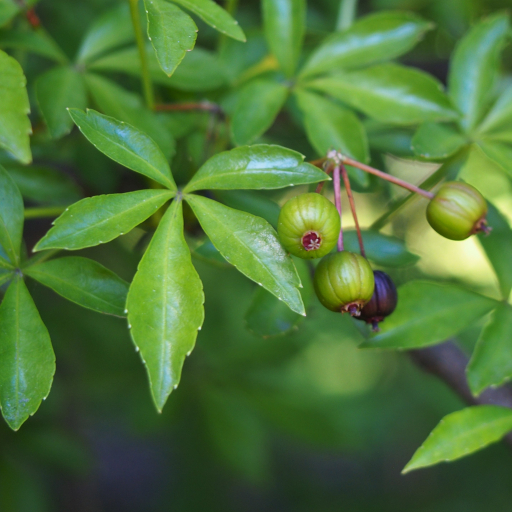
Plant Overview
Meet the ultimate "tough guy" of the shade garden, the Five-Leaf Aralia. Native to the mountainous regions of China and Japan, this resilient shrub is the secret weapon for gardeners who struggle with difficult corners. Often nicknamed the "Survivalist Shrub," it thrives in conditions that would make other plants wilt, from heavy city pollution to the deepest, driest shade.
🔍 How to Identify
- 🖐️ The Five-Leaf Fan: The most distinctive feature is its palmate foliage, where usually five (sometimes seven) bright green leaflets radiate from a single point, resembling a small, elegant hand or a starburst.
- 🏹 Arching Thorns: Look closely at the base of the leaf stalks; you will find small, sharp, curved prickles. These woody stems grow in long, graceful arches that give the shrub a fountain-like silhouette.
- 🌿 Texture and Color: The leaves have a slightly serrated edge and a crisp, matte texture. While it produces tiny, greenish-white flowers in summer, they are quite inconspicuous and often hidden by the dense foliage.
🏡 In Your Garden
- 🏙️ Urban Champion: This plant is legendary for its ability to handle "hell strips"—those narrow areas between sidewalks and roads. It shrugs off road salt, soot, and compacted soil without losing its vibrant green color.
- ✂️ The Living Fence: Because it is so tolerant of pruning and possesses those sneaky thorns, it makes an excellent security hedge. It can be tucked into dark corners under large trees where grass refuses to grow, providing a lush, green backdrop.
⚠️ Safety & Toxicity
- 🧤 Handle with Care: While not typically considered poisonous to touch, the small thorns can be quite sharp and may cause skin irritation or physical injury if you brush against them bare-handed.
- 🐾 Pet & Child Safety: The plant is generally considered non-toxic to cats and dogs. However, due to its prickly nature, it’s best planted away from play areas or high-traffic paths where children or curious pets might accidentally stumble into its "barbed" branches.
✨ Fun Fact
In many landscape circles, the Five-Leaf Aralia is known as "Living Barbed Wire." Before modern fencing was common, it was frequently planted around properties in East Asia as a beautiful but formidable deterrent to keep unwanted animals—and intruders—at bay!

Detailed Care Instructions
To grow Eleutherococcus sieboldianus (fiveleaf aralia), follow these steps:
- Choose the right location: Eleutherococcus sieboldianus prefers partial shade to full sun. Ensure that the location receives at least 4-6 hours of indirect sunlight per day.
- Soil preparation: Provide well-draining soil that is rich in organic matter. Amend the soil with compost or well-rotted manure to improve fertility and drainage.
- Plant selection: Obtain healthy, disease-free plants from a reputable nursery or garden center. Choose plants that are well-branched and have no signs of damage.
- Planting: Dig a hole slightly larger than the root ball of the plant. Place the plant in the hole, ensuring that the top of the root ball is level with the soil surface. Backfill the hole and gently firm the soil around the plant. Water thoroughly.
- Watering: Keep the soil consistently moist but not waterlogged. Water deeply once a week, or adjust the frequency based on the weather conditions. During hot summer months, the plant may need more frequent watering.
- Mulching: Apply a layer of organic mulch around the base of the plant. This helps retain moisture, suppresses weeds, and regulates soil temperature.
- Fertilization: In early spring, before new growth appears, apply a balanced slow-release fertilizer according to the manufacturer's instructions. Repeat the application every 6-8 weeks during the growing season.
- Pruning: Prune your Eleutherococcus sieboldianus in early spring to maintain its shape and control its size. Remove dead or damaged branches, as well as any crossing or crowded branches.
- Winter care: Eleutherococcus sieboldianus is hardy in USDA zones 4-9. However, providing some winter protection, such as mulching the base of the plant or covering it with burlap, can be beneficial in colder regions.
- Monitoring: Regularly check for signs of pests or diseases, such as aphids, scale insects, or leaf spot. Treat any issues promptly to prevent them from spreading.
By following these guidelines, you can successfully grow Eleutherococcus sieboldianus and enjoy its attractive foliage and ornamental berries.

Place in a bright room that is sun drenched almost all day. Or directly in a south-facing window.

To effectively water Eleutherococcus Sieboldianus plants, it is essential to consider their specific needs. Here are some guidelines to follow:
1. Understanding moisture requirements: Eleutherococcus Sieboldianus generally prefer well-drained soil. They thrive in moist, but not waterlogged conditions. Proper watering ensures the plant receives sufficient hydration while preventing root rot.
2. Soil type and composition: The plant prefers slightly acidic to neutral soil. Use high-quality, well-draining soil that retains some moisture but mainly allows excess water to drain away easily. A mix of organic matter like compost or peat moss can be added to improve soil structure.
3. Establishing a watering routine: Water the plant deeply and thoroughly during the growing season, ensuring the water reaches the plant's root system. However, avoid overwatering as it can lead to waterlogging and root suffocation.
4. Watering frequency: The frequency of watering depends on various factors such as climate, temperature, and soil moisture retention. Typically, watering every 7-10 days is sufficient during the active growth period. Adjust this frequency based on specific conditions, such as rainfall or excessive heat.
5. Checking soil moisture: Before watering, assess the soil moisture level by inserting your finger or a moisture meter into the soil to check if it feels dry. If the top inch of soil is dry, it is an indication that the plant requires watering.
6. Watering techniques: Avoid overhead watering as it can encourage the development of fungal diseases. Instead, use methods like drip irrigation or water directly at the base of the plant to ensure the water reaches the root system efficiently.
7. Mulching: Apply a layer of organic mulch around the base of the plant, leaving some space around the stem to prevent rot. Mulching helps to conserve soil moisture, regulate soil temperature, and suppress weed growth.
8. Seasonal adjustments: During winter, Eleutherococcus Sieboldianus plants will require less frequent watering as they enter a dormant phase. However, ensure that the soil does not completely dry out during this period.
9. Monitoring plant response: Pay attention to the plant's appearance and behavior. If the leaves start to droop or wilt, it may be a sign of underwatering. On the other hand, yellowing leaves may indicate overwatering. Regularly inspect the plant for any signs of stress or inadequate watering.
By following these watering guidelines, you can provide optimal conditions for your Eleutherococcus Sieboldianus plant to thrive and maintain its health and beauty.
To fertilize the Eleutherococcus Sieboldianus plant, follow these instructions:
- Choose a balanced, water-soluble fertilizer specifically formulated for shrubs or evergreen plants.
- Dilute the fertilizer according to the package instructions. Typically, a ratio of 1 tablespoon of fertilizer per 1 gallon of water is suitable.
- Ensure the plant's soil is moist before applying fertilizer.
- Gently pour the diluted fertilizer around the base of the plant, avoiding direct contact with leaves or stems.
- Use enough fertilizer solution to thoroughly wet the soil in the plant's root zone.
- Avoid over-fertilizing, as it can cause harm. Stick to the recommended dosage and frequency as mentioned on the fertilizer packaging.
- After applying fertilizer, water the plant lightly to help the nutrients reach the roots.
- Repeat the fertilization process in spring, during the growing season. You may choose to fertilize again in early summer if desired.
- Monitor the plant's health and growth. If the leaves start to yellow or if growth appears stunted, consider adjusting the fertilization routine.
Eleutherococcus sieboldianus is a hardy deciduous shrub that belongs to the Araliaceae family. When it comes to selecting the ideal soil for this plant, it is important to consider its natural habitat and growth preferences.
In its native regions of Japan and Korea, Eleutherococcus sieboldianus is commonly found growing in woodlands, thickets, and forest edges. To mimic its natural environment, it is best to provide a soil mix that is well-draining yet moisture-retentive.
The soil should be loamy and have good fertility, allowing for proper root development and nutrient uptake. It should also be slightly acidic to neutral in pH, ideally ranging from 5.5 to 7.0. This pH range ensures optimal nutrient availability to facilitate healthy growth.
While Eleutherococcus sieboldianus can tolerate a wide range of soil types, including sandy and clay soils, it thrives in soils that are rich in organic matter. Incorporating organic compost, leaf mold, or well-rotted manure into the soil before planting will support the growth of the plant by enhancing soil fertility and structure.
The soil should offer good drainage to prevent waterlogging, which could lead to root rot. However, it is important to ensure that the soil retains moisture adequately to meet the plant's water needs. Adding organic materials, such as compost, also aids in improving both drainage and moisture retention.
Eleutherococcus sieboldianus prefers growing in a partially shaded location but can tolerate full sun as well. Therefore, the soil should also provide a stable environment for the plant's roots, protecting them from extreme temperature fluctuations and providing ample airflow.
By providing a well-draining, moisture-retentive soil with good fertility and organic matter, you can create an ideal growing environment for Eleutherococcus sieboldianus, promoting healthy growth and overall plant vigor.
Eleutherococcus sieboldianus, commonly referred to as five-leaf aralia or Siebold's aralia, is a versatile and resilient plant that can be propagated through various methods. Here's a detailed guide on how to propagate this plant:
- Propagation by Seeds:
- Collect ripe berries from a mature Eleutherococcus sieboldianus plant.
- Remove the seeds from the berries by gently crushing or rubbing them.
- Soak the seeds in water for 24 hours to help with germination.
- Fill small nursery pots or trays with a well-draining seed-starting mix.
- Sow the soaked seeds evenly on the surface of the soil.
- Lightly cover the seeds with a thin layer of soil or vermiculite.
- Mist the soil surface with water to ensure it is evenly moist.
- Place the trays or pots in a warm location with bright, indirect light.
- Maintain a consistent temperature around 70-80°F (21-27°C) for optimal germination.
- Mist the soil whenever it starts to dry out during the germination process.
- Germination usually takes 2-4 weeks.
- Once seedlings have grown a couple of inches tall, transplant them into individual pots or desired planting locations.
- Collect ripe berries from a mature Eleutherococcus sieboldianus plant.
- Propagation by Stem Cuttings:
- Select a healthy, mature stem from an existing Eleutherococcus sieboldianus plant.
- Using clean, sharp pruning shears, cut a 4-6 inch (10-15 cm) section from the tip of the stem.
- Remove any leaves from the bottom half of the cutting.
- Dip the cut end of the stem into a rooting hormone powder to enhance rooting.
- Fill a small pot or container with a well-draining potting mix.
- Make a hole in the soil using a pencil or stick.
- Insert the cut end of the stem into the hole, ensuring that at least 1-2 inches (2.5-5 cm) of the stem is buried in the soil.
- Firmly press the soil around the base of the cutting to hold it in place.
- Mist the cutting and soil lightly with water to moisten it.
- Place the pot in a warm location with indirect light or use a plastic bag to create a mini greenhouse effect, which helps retain humidity.
- Maintain a consistently moist but not waterlogged soil during the rooting process.
- After 4-8 weeks or when you notice new growth, it indicates that the cutting has developed roots.
- Transplant the rooted cutting into a larger pot or the desired planting location.
- Select a healthy, mature stem from an existing Eleutherococcus sieboldianus plant.
- Propagation by Division:
- Select a healthy, mature Eleutherococcus sieboldianus plant that has multiple stems and a well-developed root system.
- Dig up the plant gently using a garden fork, being careful not to damage the roots.
- Shake off excess soil to expose the root system.
- Carefully divide the root ball into smaller sections using a sharp, sterilized knife or garden shears.
- Ensure that each divided section has several stems and a sufficient amount of roots.
- Replant each divided section into a pre-dug hole in well-prepared soil.
- Water the newly divided plants thoroughly to settle the soil and encourage root establishment.
- Provide adequate moisture and shade to the divided plants until they become established.
Remember to label the propagated plants, monitor their progress, and offer appropriate care and maintenance to ensure their successful growth.
- Select a healthy, mature Eleutherococcus sieboldianus plant that has multiple stems and a well-developed root system.








