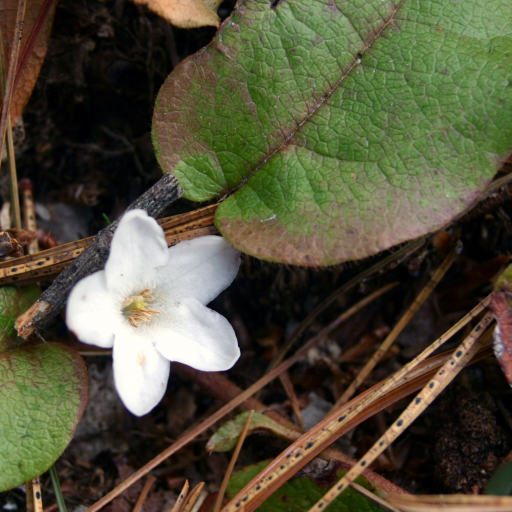
Plant Overview
Known affectionately as the Trailing Arbutus or the Mayflower, this resilient little groundcover is steeped in American lore. Legend has it that this was the first wildflower the Pilgrims discovered after their first brutal winter at Plymouth, earning it a permanent place in history as the state flower of Massachusetts. It is a shy, woodland beauty that stays low to the earth, often hiding its fragrant blossoms beneath a layer of fallen pine needles.
🔍 How to Identify
- 🌸 The Flowers: Small, waxy, tubular blossoms that transition from pure white to a delicate "blush" pink. They grow in small clusters and emit a surprisingly powerful, spicy-sweet fragrance reminiscent of cloves.
- 🍃 The Foliage: Tough, leathery, evergreen leaves that are oval-shaped. They often have a rough, "rusty" appearance and are covered in fine, bristly hairs.
- 🌱 Growth Habit: A prostrate, woody sub-shrub. It doesn't grow upward but instead "trails" along the ground, rarely rising more than a few inches high.
🏡 In Your Garden
- 🍄 The Fungal Connection: This plant is notoriously difficult to grow or transplant because it lives in a strict symbiotic relationship with specific soil fungi (mycorrhizae). If the soil isn't "just right," the plant will refuse to thrive.
- 🌲 Acidic Desires: In the wild, it is almost always found under the canopy of pine or oak trees. It craves highly acidic, sandy, or peaty soil and absolutely hates being disturbed or moved once it has settled in.
⚠️ Safety & Toxicity
- ✅ Status: Non-toxic and safe to touch.
- 🐾 Pets & Kids: There are no known toxic effects for cats, dogs, or humans. However, because it is a sensitive wild species, it should never be foraged for consumption.
- 🛡️ Conservation Warning: In many regions, the Trailing Arbutus is protected by law or listed as "Special Concern." Because it grows so slowly and is so sensitive to environmental changes, you should never pick the flowers or attempt to dig it up from the wild.
✨ Fun Fact
The Trailing Arbutus is often the very first flower to bloom in the spring, sometimes even pushing its way through a lingering crust of melting snow to signal the end of winter.

Detailed Care Instructions
| Color | Green Leaves With Copper Stems And Pale Pink To Red Blooms |
| Soil Ph | 4.6-6.0 |
| Lighting | Part Sun |
| Soil Type | Sandy Or Loamy, Moderately Moist |
| Bloom Time | Mid To Late Spring |
| Plant Type | Woodland Sub-Shrub |
| Mature Size | 2 Inches To 8 Inches High And Up To 1.4 Feet Wide |
| Native Area | Eastern United States And Canada |
| Sun Exposure | Dappled Sun To Partial Shade |
| Hardiness Zones | 2-8 |
To grow Epigaea Repens, also known as Trailing Arbutus or Mayflower, you can follow these steps:
- Planting: Select a suitable location that receives partial shade, such as under deciduous trees or along woodland edges. The soil should be well-draining, slightly acidic to neutral (pH 4.5-7), and rich in organic matter.
- Propagation: Epigaea Repens can be propagated from seeds or stem cuttings. Seeds should ideally be stratified (cold-treated) to simulate winter conditions before planting in early spring. Stem cuttings can be taken in late spring or early summer and should be treated with rooting hormone before being planted in a pot with a well-draining rooting medium.
- Soil preparation: Remove any weeds or grass from the planting area and loosen the soil with a garden fork or tiller. Mix in compost or aged manure to improve soil fertility and drainage.
- Planting: Dig holes that are slightly wider and deeper than the plant's root ball. Carefully place the plant in the hole, making sure that the top of the root ball is level with the soil surface. Fill the hole with soil mixture, gently pressing down to eliminate air pockets. Water thoroughly after planting.
- Watering: Keep the soil consistently moist but not overly saturated. Avoid allowing the soil to dry out completely, especially during the plant's establishment period. Regular watering will vary depending on local climate conditions.
- Mulching: Apply a layer of organic mulch, such as shredded leaves or wood chips, around the plant to retain moisture, suppress weeds, and regulate soil temperature. Leave a small space around the stem to prevent rot.
- Fertilizing: Epigaea Repens generally does not require heavy fertilization. However, you can apply a balanced slow-release fertilizer in early spring to provide necessary nutrients. Be sure to follow the product instructions for proper application rates.
- Pruning: Minimal pruning is required for Epigaea Repens. However, you can lightly trim back any dead or damaged foliage in early spring before new growth emerges.
- Protection: Shelter the plant from extreme weather conditions, such as strong winds, heavy frosts, or excessive heat, during its early stages of growth.
- Monitoring: Regularly check for pests, diseases, or any signs of stress. Treat any issues promptly using appropriate organic or chemical controls.
By following these steps, you can successfully grow Epigaea Repens, a beautiful and delicate plant known for its lovely flowers and fragrance.

Place in a dark room with little light, like a dark bedroom or a spot far away from a window or directly in a north-facing window.

Epigaea Repens is a ground-covering plant that belongs to the Ericaceae family. It is a perennial plant that produces lovely flowers. It generally grows best in acidic soil that is well-draining and is shaded by trees.
When watering Epigaea Repens, it is best to do so in the early morning or late evening so that the plant can absorb the water without losing it to evaporation. Overwatering can lead to the growth of fungus and diseases, so it is essential to water the plant only when necessary.
Before watering, ensure that the top layer of soil is dry to the touch. This helps prevent rot and fungal growth. When watering, it is recommended to use a watering can or a hose with a diffuser to avoid damaging the delicate foliage.
It is important to water the plant deeply so that the water can reach the roots. However, avoid watering too much, as this can lead to waterlogging and root rot. A good rule of thumb is to water the plant about once a week, depending on weather conditions.
Overall, it is crucial to strike a balance when watering Epigaea Repens. It needs adequate moisture to thrive, but too much or too little water can harm the plant.
For best results, fertilize this plant in the early spring before new growth appears. Use a slow-release fertilizer with a balanced ratio of nitrogen, phosphorus, and potassium. Avoid over-fertilization, as this can lead to leaf burn and other issues. Water the plant thoroughly before and after fertilization, and apply the fertilizer according to the manufacturer's instructions. Repeat this process every 6-8 weeks throughout the growing season to promote healthy growth and flowering.
Epigaea Repens plant requires a well-draining and nutrient-rich soil that is slightly acidic. Soil with a pH range of 5.5 to 6.5 is suitable for its healthy growth. The soil must be a mixture of peat moss or sphagnum moss, sand or perlite, and some organic matter like compost or leaf mold. The plant thrives well in a slightly moist soil, so it is necessary to maintain adequate soil moisture level by regular watering. However, the soil must not be waterlogged. The plant prefers a loamy soil type with good texture and aeration. It is better to add some slow-release granulated fertilizer to the soil before planting the plant in it.
Epigaea Repens is a perennial plant that can be propagated by several methods, including seed propagation, division, and stem cuttings.
Seed propagation involves collecting seeds from the plant and sowing them in a tray or pot filled with seed-starting mix. The seeds should be covered with a thin layer of soil and kept moist until they germinate. Once the seeds have germinated, they can be transplanted into individual pots or directly into the garden.
Division is another method of propagating Epigaea Repens. This involves carefully digging up the plant and separating the root system into smaller sections. Each section should have several stems and roots attached to it and can be planted in a new location.
Stem cuttings are another effective way to propagate Epigaea Repens. Cut a 4-6 inch section of stem from a healthy plant and remove the lower leaves. Dip the cut end of the stem into rooting hormone and plant it in a pot filled with well-draining soil. Keep the soil moist and place the pot in a warm, bright location.
Regardless of the method of propagation used, it is important to keep the newly propagated plants moist and protected from direct sunlight until they are established.








