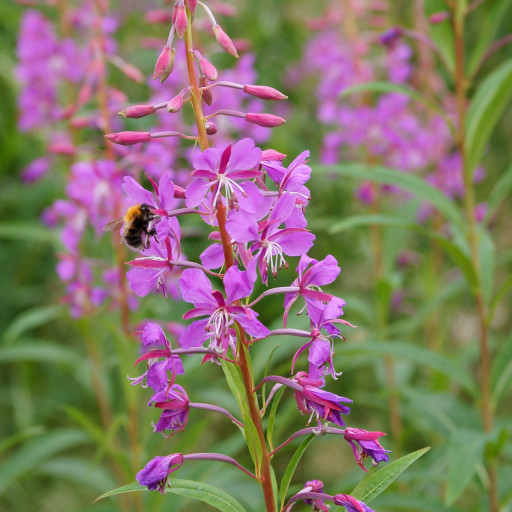
Plant Overview
Known widely as Fireweed or Rosebay Willowherb, this striking perennial is nature’s first responder, famously painting charred landscapes with a sea of vibrant magenta. In London after the Blitz, it earned the nickname "Bombweed" for its ability to bloom amidst the rubble and ruins. It is a powerful symbol of resilience and rebirth, signaling to the world that life returns even after the most devastating fires.
🔍 How to Identify
- 🌸 The Blooms: Features tall, elegant spikes of four-petaled flowers that range from soft pink to deep magenta. Uniquely, they bloom from the bottom of the stalk upward.
- 🌿 The Foliage: Long, narrow, lance-shaped leaves that closely resemble those of a willow tree, which are arranged spirally around a sturdy, often reddish stem.
- 💨 The Seeds: In late summer, the flowers transform into long, thin pods that split open to release hundreds of tiny seeds attached to silky, white fluff that carries them miles on the wind.
🏡 In Your Garden
- 🐝 A Nectar Factory: Fireweed is a high-value "pollinator magnet." If you have a large property, it will draw in honeybees, bumblebees, and butterflies in droves, making it an essential addition to a wild meadow or habitat garden.
- 🌱 The Spreading Habit: It is a pioneer species that spreads aggressively via underground runners (rhizomes). While beautiful, it can quickly crowd out smaller perennials, so it is best kept in large, open areas or containers to prevent it from "traveling" through your flower beds.
⚠️ Safety & Toxicity
- ✅ Non-Toxic: Fireweed is considered safe and non-toxic for humans, dogs, cats, and horses. It has a long history of being used in traditional herbalism.
- 🍽️ Edibility Context: The young shoots are often eaten like asparagus, and the leaves can be fermented to create a popular herbal tea known as "Ivan Chai." However, always ensure the area hasn't been treated with roadside pesticides before foraging.
✨ Fun Fact
During World War II, the silky "fluff" attached to Fireweed seeds was seriously considered as a potential substitute for cotton or down in stuffing life jackets and pillows because it is incredibly lightweight and buoyant!

Detailed Care Instructions
| Lighting | Full Sun |
| Hardiness Zones | Max 9A |
To grow Epilobium angustifolium, also known as fireweed, follow these steps:
- Choose a suitable location: Fireweed thrives in well-drained soil and full sun, although it can also tolerate partial shade. Make sure the chosen area has enough space for the plant to grow to its full height, which can range from 3 to 8 feet (1 to 2.5 meters) depending on the variety.
- Prepare the soil: Fireweed grows best in soil with a pH range of 6.0 to 7.5. If your soil's pH is outside this range, you may need to amend it accordingly. Add organic matter, such as compost or aged manure, to improve soil fertility and drainage.
- Sow seeds directly outdoors: Fireweed is typically propagated by seeds, which can be sown directly in the garden. Wait until the last frost has passed before planting. Scatter the seeds lightly over the soil and lightly press them down. Do not cover the seeds with soil, as they require sunlight for germination.
- Water properly: Fireweed prefers consistently moist soil but does not tolerate waterlogging. Water the area thoroughly after planting and continue to keep the soil evenly moist until the seeds germinate. After that, water regularly but avoid overwatering.
- Control weeds: Fireweed can compete with weeds, but initially, it may be beneficial to keep the area relatively weed-free to give the young plants a better chance to establish. Mulching can help suppress weed growth.
- Provide support: As fireweed grows tall, it may require support to prevent it from bending or falling over in windy conditions. Staking or using plant supports can help keep the plants upright.
- Prune if necessary: Fireweed generally does not require pruning. However, if you want to control its spread or manage its height, you can trim the plants back after flowering. Pruning can also help promote bushier growth.
- Harvesting and propagation: Fireweed produces beautiful pink to purple flowers in summer. Once the flowers have faded, you can harvest the seeds for propagation or let them self-sow. Be aware that fireweed can spread rapidly through its seeds, so pruning or harvesting can prevent excessive spreading if desired.
Remember to check your local regulations and verify if Epilobium angustifolium is a native or invasive species in your area. It's important to ensure that you are not introducing an unwanted plant into the ecosystem.

Place in a bright room that is sun drenched almost all day. Or directly in a south-facing window.

1. First, assess the soil moisture level. Stick your finger or a moisture meter about an inch into the soil to determine if it's dry or moist.
2. Water the plant deeply and thoroughly when the soil feels dry to the touch.
3. Consider the surrounding weather conditions, such as heat or wind, which can cause the soil to dry out faster and require more frequent watering.
4. Avoid watering too frequently, as Epilobium Angustifolium prefers well-draining soil and can suffer from root rot if left sitting in standing water.
5. Water in the morning or evening when it's cooler to reduce evaporation and give the plant time to absorb water before any possible heat stress during the day.
6. Use a watering can or hose with a gentle spray nozzle to avoid damaging the plant or disturbing the soil.
7. Monitor the plant's growth and adjust watering as needed to ensure it receives adequate moisture to thrive.
- Identify the plant's growth stage: Before fertilizing, it is important to determine the stage of growth of the plant to ensure that you use the appropriate fertilizer.
- Choose the right fertilizer: Select a balanced fertilizer that contains equal amounts of nitrogen, phosphorus, and potassium. You can also use a slow-release fertilizer.
- Determine the amount of fertilizer needed: The amount of fertilizer to be applied to the Epilobium Angustifolium plant should be based on the size of the plant and the fertilizer's concentration. Refer to the manufacturer's instructions for proper application rates.
- Apply the fertilizer: Spread the fertilizer evenly around the base of the plant, taking care not to get any on the leaves or foliage. Water the plant adequately after fertilizing.
- Repeat fertilization: Repeat the fertilization process every six to eight weeks during the active growing season, which is usually from early spring to late summer. Avoid fertilizing during the winter months.
Epilobium angustifolium thrives in soils that are well-drained, moist, and fertile. The ideal soil pH for this plant is slightly acidic, between 5.5 to 7.0. It also prefers soils that are rich in organic matter and high in nitrogen.
A good soil mix for Epilobium angustifolium would consist of equal parts of high-quality potting soil, peat moss, and perlite. It is important to ensure proper drainage, as this plant does not tolerate waterlogged soil. If the soil is heavy or clayey, adding coarse sand or vermiculite can improve drainage.
Before planting, it is recommended to work in a slow-release fertilizer or well-rotted compost into the soil to provide a nutrient-rich environment for the plant. Epilobium angustifolium also benefits from a top dressing of compost or mulch in the spring to retain moisture and regulate temperature.
Overall, a well-draining, nutrient-rich, and slightly acidic soil mix with plenty of organic matter is key to growing healthy Epilobium angustifolium.
Epilobium angustifolium is a perennial plant that belongs to the family Onagraceae. It grows in a variety of habitats, including wetlands, meadows, and forests. It can be easily propagated by dividing the rhizomes.
To propagate Epilobium angustifolium, first, select a healthy mature plant. Dig it up carefully, taking care not to damage the roots. Separate the plant into smaller clumps by gently pulling the rhizomes apart. Each clump should have several healthy roots and some leaves.
Plant the clumps in a moist, well-draining soil mixture. Keep the soil moist by watering regularly, but do not let it become waterlogged. The best time to propagate Epilobium angustifolium is in the spring when new growth is emerging.
After planting, provide the plant with enough sunlight and nutrients. The plant will establish new roots and begin to grow new shoots and leaves. In a few weeks, the plant will be ready to transplant into its permanent location.
Propagation by seed is also possible but less reliable. Seeds should be collected in the fall and planted immediately in a well-prepared seed bed. The seed bed should be kept consistently moist until the seeds germinate, which can take several weeks. Once the seedlings are established, they can be transplanted into their permanent location.
Common pests of the fireweed include Spider mites, larvae. Make a habit of checking your fireweed frequently for pests so that any infestations can be caught and managed early.








