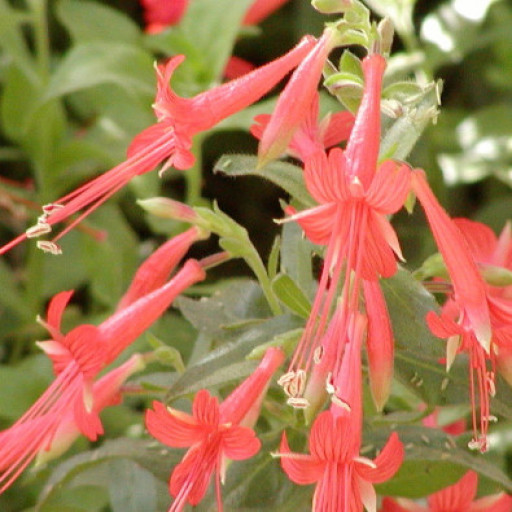
Plant Overview
Often called the "Hummingbird Trumpet," the California Fuchsia is a vibrant splash of fire-engine red that ignites the landscape in late summer. While most native plants go dormant during the heat of August, this hardy perennial is just getting started, acting as a vital "gas station" for migrating hummingbirds. Its striking contrast between silver-grey foliage and neon flowers makes it a showstopper for rock gardens, slopes, and drought-tolerant borders.
🔍 How to Identify
- 🌺 Flaming Blooms: Features long, tubular, trumpet-shaped flowers in shades of brilliant orange-red to scarlet that dangle from the stems.
- 🌫️ Velvety Leaves: Small, narrow, lance-shaped leaves that are often covered in fine grey or silvery hairs, which help the plant reflect intense sunlight.
- 🌿 Growth Form: Depending on the variety, it can appear as a low, spreading groundcover or an upright, slightly woody subshrub that reaches about 2 feet tall.
🏡 In Your Garden
- 🏜️ Drainage is Key: This plant is a "dry-footed" specialist; it thrives in rocky or sandy soil and may suffer from root rot if left in heavy, standing water during the winter months.
- ✂️ The "Winter Haircut": To prevent the plant from becoming messy and "leggy," it should be cut back nearly to the ground in late fall after the flowering has finished. This encourages fresh, lush growth in the spring.
- ☀️ Sun Seeker: While it can handle light shade, the foliage turns its most beautiful silver-blue color when exposed to full, direct sun.
⚠️ Safety & Toxicity
- ✅ Non-Toxic: Epilobium canum is generally considered safe and non-toxic for humans, dogs, and cats.
- 🐾 Pet-Friendly: Because it lacks thorns and toxic saps, it is an excellent choice for "wildlife gardens" where pets and children play.
- 🧤 Texture Sensitivity: The fine hairs on the leaves are harmless, but sensitive gardeners might find the texture slightly scratchy during heavy pruning and may prefer wearing gloves.
✨ Fun Fact
For over a century, this plant was known by the name Zauschneria. When botanists used DNA testing to reclassify it into the Epilobium genus, many gardeners and nurseries staged a "botanical rebellion," refusing to change their labels because they found the original name much more fun to say!

Detailed Care Instructions
| Humidity | Normal |
| Lighting | Full Sun |
| Difficulty | Medium |
| Temperature | 21°C - 35°C |
To grow Epilobium Canum, also known as California fuchsia, follow these steps:
- Choose the right location: Select a sunny spot in your garden or yard where the plant will receive at least 6-8 hours of direct sunlight daily. Epilobium Canum prefers well-draining soil.
- Prepare the soil: Ensure that the soil is fertile and well-draining. You can improve drainage by adding organic matter such as compost or well-rotted manure to the soil.
- Propagation: Epilobium Canum can be propagated through seeds or cuttings. If starting from seeds, sow them in early spring by lightly pressing them into the soil's surface. Keep the soil moist until the seeds germinate.
- Watering: Water the plant regularly, especially during the growing season. Epilobium Canum prefers evenly moist soil but does not tolerate waterlogging. Avoid overwatering.
- Mulching: Apply a layer of organic mulch around the plant to conserve moisture, suppress weed growth, and add nutrients to the soil. Use materials like wood chips, straw, or dried leaves.
- Pruning: Prune the plant regularly to maintain its shape and promote bushier growth. Cut back the plant in late winter or early spring before new growth begins.
- Fertilization: Epilobium Canum generally does not require heavy fertilization. However, you can apply a balanced, slow-release fertilizer in early spring to provide essential nutrients.
- Pests and diseases: California fuchsia is generally resistant to pests and diseases. However, keep an eye out for common garden pests like aphids or spider mites. If necessary, apply organic insecticides or use non-toxic pest control methods.
- Winter care: Epilobium Canum is a hardy perennial that can tolerate some frost. However, providing some winter protection like covering the plant with mulch or burlap can help it survive colder temperatures.
By following these guidelines, you should be able to successfully grow Epilobium Canum in your garden or yard.

Place in a bright room that is sun drenched almost all day. Or directly in a south-facing window.

Epilobium Canum is a plant that requires regular watering. The plant should be watered deeply once a week during the growing season. It is important not to overwater the plant as it can lead to root rot. Watering should be reduced during the dormant season. As the plant becomes established, it may require less frequent watering. It is recommended to water the plant at the base rather than from above to avoid wetting the foliage. It is also important to avoid letting the plant sit in standing water as this can also lead to root rot.
To fertilize this plant, it is recommended to use a balanced fertilizer, with equal proportions of nitrogen, phosphorus, and potassium. Apply the fertilizer once every 2-3 weeks during the growing season, which typically begins in the spring and ends in the fall. Avoid overfertilizing, as this can lead to excessive growth and reduced flowering. Water the plant thoroughly after applying fertilizer to help distribute the nutrients evenly throughout the soil.
The soil that is appropriate for the Epilobium Canum plant is moist and well-draining. It should be rich in organic matter and have a slightly acidic pH level. A soil mixture that contains perlite, peat moss, and sand is ideal for this plant. The soil should also be airy and loose to allow for proper root development. It is essential to ensure that the soil does not become waterlogged as this can lead to root rot. It is best to avoid using heavy clay or compacted soil, which can impede root growth and cause water to pool around the plant. Overall, a soil that is loose, well-draining, and rich in organic matter is the best choice for the Epilobium Canum plant.
There are several ways to propagate this plant. One method is by taking stem cuttings in the late spring or early summer when the plant is actively growing. Cut a stem that is approximately 4-6 inches long, remove the lower leaves, and dip the cut end in rooting hormone. Plant the cutting in a pot filled with a well-draining soil mix and keep it moist. It should root in a few weeks.
Another method is by division. This can be done in the spring or fall when the plant is dormant. Dig up the plant and carefully separate the root clumps into smaller sections, making sure each section has some roots and shoots. Replant the sections in a well-draining soil mix and keep them moist until they establish.
Finally, you can propagate this plant by collecting and sowing its seeds. In the fall, collect the seed pods when they turn brown and open. Remove the seeds and sow them in a pot filled with a well-draining soil mix. Keep the soil moist and the pot in a warm and sunny spot. The seeds should germinate in a few weeks.








