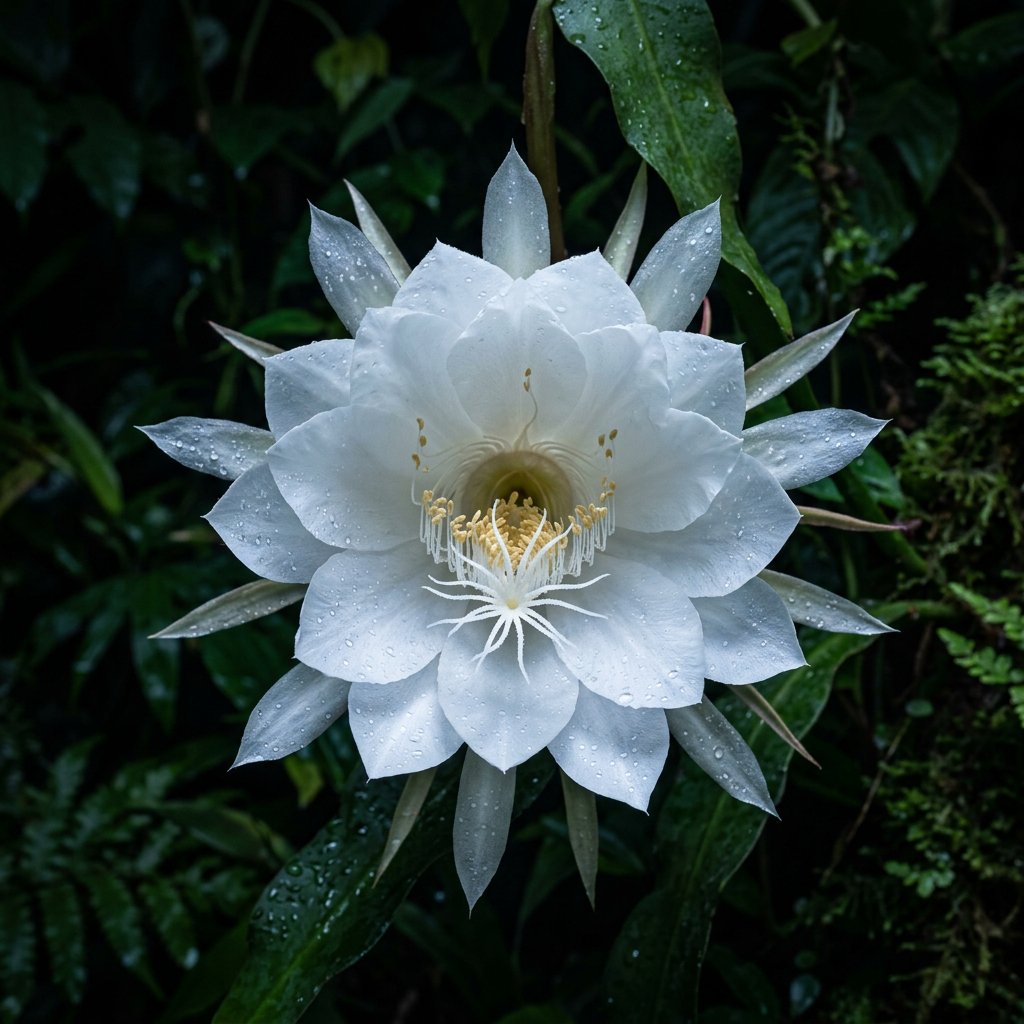
Plant Overview
The "Queen of the Night" is a botanical legend, famous for its theatrical and fleeting midnight performance. Unlike typical desert cacti, this elegant epiphyte hails from the tropical rainforests of Mexico and Central America, where it drapes itself over tree branches. It is most celebrated for its massive, waxy white flowers that open only after sunset and wither before the first light of dawn.
🔍 How to Identify
- 🌿 The "Leaves": What look like long, wavy leaves are actually flattened, succulent stems called cladodes. They are smooth, spineless, and can grow several feet long.
- 🌸 The Bloom: Large, funnel-shaped white flowers (up to 7 inches wide) emerge from the notches of the stems. They feature a crown of thin, spindly outer petals that frame a lush, snowy center.
- 👃 The Scent: When in bloom, the plant emits an intoxicatingly heavy, sweet fragrance designed to attract nocturnal pollinators like bats and hawkmoths from miles away.
🏡 In Your Garden
- ☁️ The "Airy" Requirement: Because it is an epiphyte, its roots crave oxygen. Avoid heavy potting soil; instead, use a chunky mix of orchid bark, perlite, and peat to mimic its natural home on a tree trunk.
- 🧗 Support Systems: As the plant matures, it becomes heavy and sprawling. It requires a sturdy trellis or a hanging basket where its long, arching stems can gracefully trail downward without snapping.
- 💧 The Humidity Balance: Unlike a prickly pear, the Queen of the Night enjoys consistent moisture and high humidity. However, it "breathes" through its roots, so standing water is its greatest enemy.
⚠️ Safety & Toxicity
- ✅ Pet & Human Safe: Epiphyllum oxypetalum is generally considered non-toxic to cats, dogs, and humans. It is a popular choice for indoor enthusiasts with curious pets.
- 🧤 Handle with Care: While it lacks the vicious spines of desert cacti, the long stems can be brittle. Moving a large specimen often requires two people to prevent the "limbs" from breaking under their own weight.
✨ Fun Fact
In many Asian cultures, witnessing the "Queen of the Night" bloom is considered a sign of immense good luck and spiritual protection. The bloom is so culturally significant that it was featured in a pivotal scene in the movie Crazy Rich Asians, where the characters gather specifically to watch the flowers open.

Detailed Care Instructions
| Color | White |
| Humidity | Dry |
| Lighting | Full Sun |
| Soil Type | Standard Potting Soil Amended With Peat And Sand |
| Bloom Time | Mainly Late Spring And Summer |
| Difficulty | Easy |
| Native Area | Central And South America |
| Temperature | 18°C - 24°C |
| Sun Exposure | Full Sun |
| Hardiness Zones | 10-12 |
To grow an Epiphyllum oxypetalum, also known as the Queen of the Night or Night-blooming Cereus, follow these steps:
- Choose a suitable location: Epiphyllum oxypetalum is an epiphytic plant, meaning it naturally grows on tree branches or in crevices rather than in the ground. You can either grow it indoors in a hanging basket or place it in a location with partial shade outdoors. It needs protection from direct sunlight and extreme temperatures.
- Prepare the soil: Use a well-draining soil mix specifically meant for epiphytic cacti or orchids. You can also create a mix by combining equal parts of regular potting soil, peat moss, and perlite. Make sure the soil is loose enough to allow excess water to drain away.
- Planting: Place the plant in a container with drainage holes, ensuring that the roots have enough space to spread. You can also mount it on a suitable tree trunk or hang it in a basket. Avoid planting it too deep, as the plant's roots should be exposed to air.
- Watering: Allow the soil to slightly dry between waterings. Water thoroughly, making sure excess water drains away. Epiphyllum oxypetalum prefers to be slightly dry rather than overwatered. Reduce watering during the winter months.
- Humidity: Increase humidity around the plant by misting it with water occasionally. This helps mimic its natural environment.
- Fertilizing: Fertilize the plant once a month during the growing season (spring and summer). Use a balanced, water-soluble fertilizer specifically formulated for epiphytic plants or cacti. Follow the instructions on the fertilizer package for the correct dilution and application method.
- Pruning: Prune the plant to remove any dead or damaged stems. You can also shape the plant to encourage more compact growth. Pruning is best done after blooming in the spring.
- Propagation: Epiphyllum oxypetalum can be propagated by taking stem cuttings. Allow the cut ends to dry for a few days before planting them in a well-draining soil mix. Keep the soil slightly moist but not overly wet until the cuttings root.
- Flowering: Epiphyllum oxypetalum blooms at night and has large, fragrant white or cream-colored flowers. It usually blooms in late spring or early summer. Provide the plant with a cool period (around 50-55°F or 10-13°C) for 4-6 weeks in the winter to encourage blooming.
- Protect from extreme conditions: Avoid exposing the plant to temperatures below 40°F (4.4°C) or above 90°F (32.2°C). Provide shelter or bring it indoors if necessary during extreme weather conditions.
With proper care and attention, your Epiphyllum oxypetalum will reward you with beautiful night-blooming flowers.

Place in a window with dappled sun or a spot in the middle of a room. Or directly in a window facing west or east.

Epiphyllum Oxypetalum is a plant that belongs to the cactus family and is native to Central America. It is an epiphytic plant that grows on trees and other plants. As such, it has adapted to get its nutrients and water from the air and rain. Therefore, it does not require much water.
When watering Epiphyllum Oxypetalum, it is important to remember that it prefers moist soil, but not wet soil. Overwatering can lead to root rot and subsequent death of the plant. It is best to wait until the soil has dried out before watering. You can test the soil moisture by sticking your finger into the soil to the depth of about an inch. If the soil feels dry, it is time to water.
When watering, use room temperature water and make sure to water evenly around the plant. Do not water excessively, and avoid getting water on the leaves or flowers as this can cause the plant to rot. Allow any excess water to drain out of the pot.
It is recommended to water Epiphyllum Oxypetalum once a week during the growing season and reduce watering to once every two weeks during the winter months when the plant is dormant. Additionally, misting the plant with a sprayer every few days can help increase humidity around the plant.
In summary, Epiphyllum Oxypetalum should be watered when the soil is dry, avoiding overwatering and getting water on the leaves or flowers. Weekly watering during the growing season and reduced watering during dormancy is recommended.
To fertilize this plant, use a balanced fertilizer with an N-P-K ratio of 10-10-10. Apply the fertilizer once a month during the growing season, which is from spring to fall. Dilute the fertilizer to half the recommended strength and apply it to moist soil. Do not fertilize during the winter months when the plant is dormant. Additionally, remember to water the plant regularly and provide it with bright, indirect light.
Epiphyllum Oxypetalum is a type of succulent plant that requires well-drained soil that is not too water retaining. This plant thrives in soil that is rich in organic matter, with a slightly acidic pH level of 5.5 to 6.5. Additionally, the soil should be porous and airy, allowing good movement of air and water.
The best soil for Epiphyllum Oxypetalum should be a mixture of peat, perlite, and sand. Peat is essential for retaining moisture and providing a nutrition-rich environment for the plant's roots, while perlite adds the essential aeration the soil requires. Sand, on the other hand, ensures proper drainage and prevents waterlogging, which can lead to root rot.
It is imperative to note that Epiphyllum Oxypetalum is a shallow-rooted plant, meaning it will benefit from a wide and shallow pot, which provides ample room for its roots to spread out. Regular repotting is recommended to ensure that the plant has adequate space for root development.
Overall, the combination of peat, perlite, and sand creates an ideal soil environment, ensuring optimal growth and health of Epiphyllum Oxypetalum.
Epiphyllum Oxypetalum is a type of plant that can be propagated through various methods. One of the most common ways is through stem cuttings. To propagate this plant through stem cuttings, you will need a stem of about 4-6 inches long. Cut the stem along with a few leaves from the parent plant, ensuring that the cut is made at a node. Remove the lower leaves from the cutting and allow it to dry for a few hours. Once the cutting is dry, plant it in a well-draining soil mix and water it thoroughly. You can also propagate the Epiphyllum Oxypetalum through seeds. To do this, collect the seeds from the parent plant and dry them for a few days. Sow the seeds in a seed-starting mix, cover them lightly with soil, and keep them in a warm and humid environment. With time, the seeds will germinate and grow into new plants.
Common pests of the dutchman's pipe cactus include Scale insect, mealybugs, thrips. Make a habit of checking your dutchman's pipe cactus frequently for pests so that any infestations can be caught and managed early.








