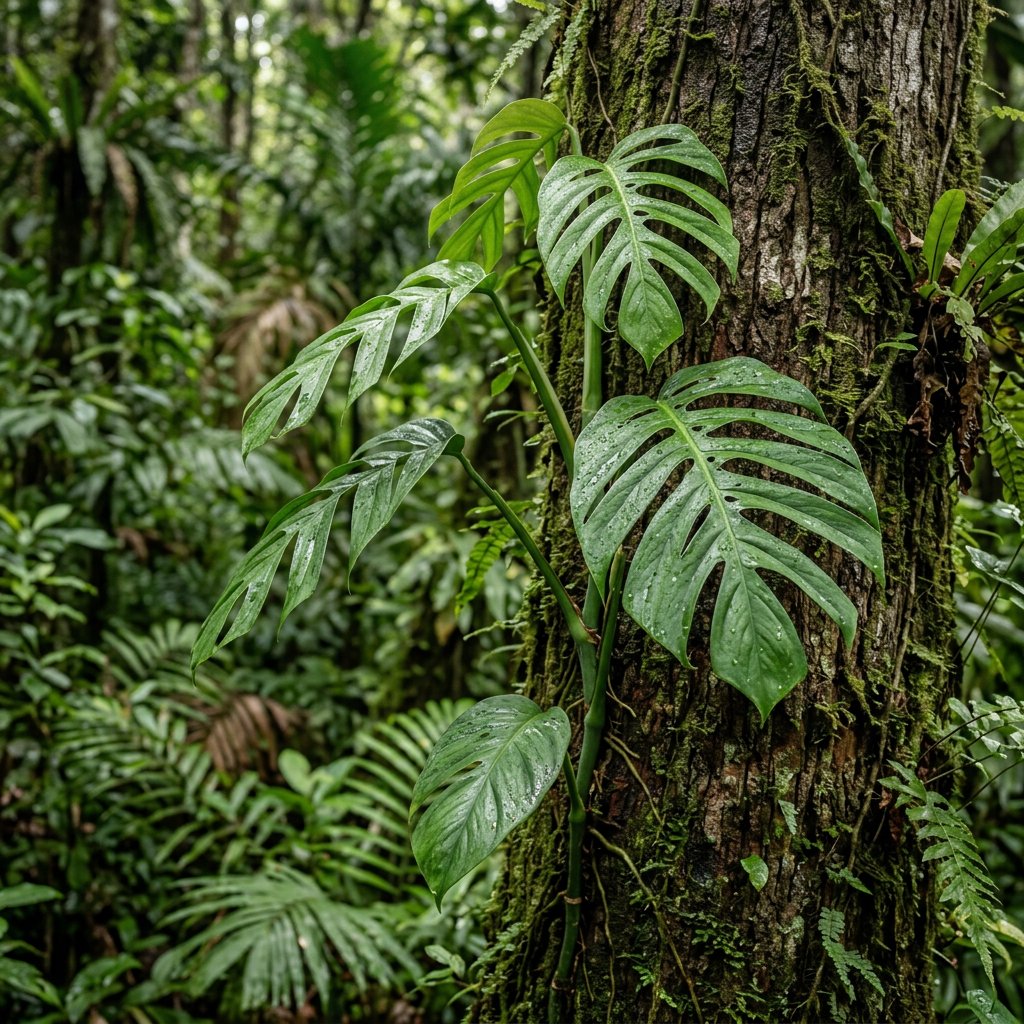
Plant Overview
Often called the Dragon Tail Plant or Centipede Tongavine, Epipremnum pinnatum is the sophisticated, wilder cousin of the common Golden Pothos. While it starts its life with modest, lance-shaped leaves, it possesses a dramatic secret: as it climbs, the foliage transforms into deeply lobed "dragon tails." In many cultures, these vigorous vines are seen as symbols of perseverance and growth, capable of swallowing a moss pole or a garden trellis in just a few seasons.
🔍 How to Identify
- 🍃 Leaf Silhouette: Unlike the heart-shaped leaves of a standard Pothos, these leaves are naturally more elongated and elliptical (lance-shaped) when young.
- ✂️ The Split: As the plant matures and receives adequate light, the leaves develop deep, finger-like slits (fenestrations) that reach almost to the midrib, mimicking a Monstera or a dragon’s tail.
- 🛤️ Aerial Roots: You will notice thick, brown adventitious roots sprouting from the nodes, which the plant uses like "hooks" to anchor itself to trees or walls.
🏡 In Your Garden
- 🧗 The Vertical Advantage: While it can trail from a hanging basket, this plant only reaches its full potential (and produces those iconic splits) if it is allowed to climb. Providing a moss pole or cedar plank mimics its natural environment and encourages larger leaf growth.
- 🌞 Light Logic: It thrives in bright, indirect light. In the wild, it lives under the jungle canopy; too much direct sun will scorch the leaves, but too little light will cause the plant to "revert" to its juvenile, unsplit form.
- 💧 Thirst Cues: It is quite forgiving of a missed watering, but it dislikes "wet feet." Wait until the top two inches of soil feel dry before giving it a deep soak.
⚠️ Safety & Toxicity
- 🐾 Toxic to Pets: Like most members of the Araceae family, this plant contains insoluble calcium oxalate crystals.
- 👄 The Reaction: If chewed or swallowed by cats, dogs, or curious children, it can cause immediate mouth irritation, swelling of the throat, and digestive upset. It is best kept on high shelves or mounted securely on a wall.
✨ Fun Fact
Epipremnum pinnatum is a master of "heteroblasty"—a scientific term for a plant that drastically changes its leaf shape as it ages. A juvenile plant and a 20-foot-tall mature specimen look so different that early botanists often mistakenly categorized them as two entirely different species!

Detailed Care Instructions
| Color | Does Not Flower |
| Soil Ph | 6.1-6.5 |
| Humidity | High |
| Lighting | Part Sun |
| Toxicity | Poisonous |
| Soil Type | Well-Drained Potting Soil |
| Bloom Time | Does Not Flower Unless Treated With A Special Hormone Supplement |
| Difficulty | Easy |
| Plant Type | Trailing Vine |
| Hibernation | Cold Period |
| Mature Size | 6 To 10 Feet (As Much As 30 Feet) |
| Temperature | 18°C - 24°C |
| Sun Exposure | Shade To Part Shade Outdoors, Bright Indirect Light Indoors |
| Hardiness Zones | 10-12 |
Here are some steps to help you grow an Epipremnum Pinnatum plant:
- Select a healthy plant: Find a well-established Epipremnum Pinnatum plant from a reputable nursery or garden center.
- Choose the right pot and soil: Select a pot that has drainage holes to prevent waterlogging. Fill it with a well-draining potting mix rich in organic matter.
- Planting: Gently remove the plant from its container and loosen the root ball. Place it into the prepared pot, ensuring the top of the root ball is level with the soil surface. Backfill with soil and gently firm it around the roots.
- Light requirements: Epipremnum Pinnatum prefers bright, indirect sunlight. Place the plant near a window with filtered light or provide artificial fluorescent lighting if natural light is limited.
- Temperature and humidity: These plants thrive in temperatures between 60-85°F (15-29°C). Maintain a humidity level of 50-60% by misting the foliage regularly, placing a tray of water nearby, or using a humidifier.
- Watering: Water the plant thoroughly when the top inch of soil feels dry to the touch. Avoid overwatering, as Epipremnum Pinnatum prefers slightly drier conditions.
- Fertilizing: Feed the plant with a balanced, liquid houseplant fertilizer every 4-6 weeks during the growing season (spring and summer). Follow the package instructions for the proper amount and frequency.
- Pruning: Pinch back or trim the plant to encourage bushier growth and remove any dead or yellowing leaves. This will also help control the plant's size.
- Repotting: As the plant grows, it may outgrow its pot. Repot every 1-2 years into a larger container using fresh potting mix. This allows the roots to have more room to grow.
- Propagation: Epipremnum Pinnatum can be propagated through stem cuttings. Take a cutting with several leaves and place it in water or moist soil until roots develop. Then transfer it to a pot.
Remember to regularly check your plant for pests, such as spider mites or mealybugs, and take appropriate measures to control them if necessary. Overall, with proper care and attention, your Epipremnum Pinnatum plant should thrive and grow well.

Place in a window with dappled sun or a spot in the middle of a room. Or directly in a window facing west or east.

Epipremnum Pinnatum is a tropical plant that requires regular watering to maintain optimum health and growth. It is important to note that overwatering can be detrimental to the plant, so it is essential to strike a balance.
When watering this plant, it is necessary to ensure that the soil is moist but not waterlogged. The frequency of watering will depend on the type of soil used, climate, and humidity levels. Generally, it is best to water once a week during the growing season and once every two weeks during the colder months.
Before watering, check the soil moisture level by inserting your finger into the soil. If the soil feels dry up to your first knuckle, it is time to water the plant. If the soil feels moist, there is no need to water.
When watering, use room temperature water and pour it slowly onto the soil. Ensure that the water reaches the roots, and excess water drains through the bottom of the pot. It is essential to avoid overwatering as this can cause root rot and other problems.
In summary, water Epipremnum Pinnatum regularly, but only when the soil is dry, and avoid overwatering.
To fertilize your plant, use a balanced liquid fertilizer with equal parts nitrogen, phosphorus, and potassium. Dilute the fertilizer to half strength and apply every two weeks during the growing season. During the dormant season, reduce fertilization to once a month. Be sure to thoroughly water the plant before fertilizing to avoid root burn.
Epipremnum Pinnatum plant is best grown in well-draining soil with a pH range between 6.0 and 7.5. The soil should be moist but not soggy, as overly wet soil can cause root rot. A mix of peat moss, perlite, and vermiculite can provide a good growing medium. Additionally, adding organic matter, such as leaf mold or compost, can improve soil structure and nutrient availability. It is important to ensure that the soil is not compacted, as this can limit root growth and nutrient uptake. Regular fertilization with a balanced, water-soluble fertilizer can also improve plant growth and health.
Epipremnum Pinnatum can be propagated through stem cuttings. First, select a healthy stem that is at least 6 inches long and has several leaves. Using a clean and sharp pair of scissors or pruners, cut the stem just below a node (where a leaf is attached). Remove the bottom leaves to expose 1-2 nodes.
Next, dip the cut end of the stem in rooting hormone powder to encourage root growth. Place the stem cutting in a small vase or jar filled with water, making sure that the cut end is submerged in the water. Place the vase or jar in a bright, but not direct, sunlight and change the water every few days to prevent bacteria growth.
After 2-4 weeks, roots will start to form from the nodes. Once the roots are at least 2 inches long, the stem cutting can be planted in a small pot with well-draining soil. Water the soil well and keep the plant in a bright location, but out of direct sunlight.
Over time, the plant will grow and can be repotted into a larger container. It can also be propagated again using the same method.
Common pests of the pothos include Scale insect, mealybugs, spider mites, fungus gnats, thrips, springtails. Make a habit of checking your pothos frequently for pests so that any infestations can be caught and managed early.








