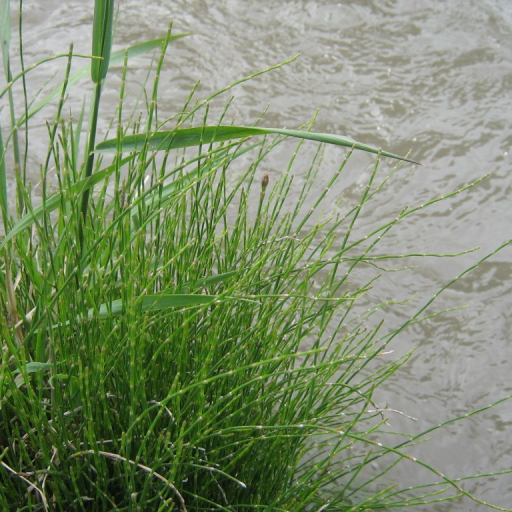
Plant Overview
Often called the Andean Horsetail or Cola de Caballo, this ancient survivor is a true "living fossil." While most modern plants evolved flowers and complex seeds, Equisetum bogotense remains largely unchanged from its ancestors that thrived during the dinosaur era. Native to the high-altitude wetlands of Central and South America, it brings a prehistoric, architectural elegance to any water feature or damp garden corner.
🔍 How to Identify
- 🌿 The Stems: Look for slender, lime-green, reed-like stems that are hollow and conspicuously jointed. They lack traditional leaves, instead featuring tiny black-tipped sheaths at each node.
- 🎋 The Branches: This species is known for its delicate, needle-like branches that emerge in whorls from the joints, giving it a soft, feathery appearance compared to its stiffer relatives.
- 🖐️ The Texture: If you run your fingers along the stem, it feels surprisingly rough or gritty. This is due to the high concentration of silica (essentially glass) embedded in its cell walls.
🏡 In Your Garden
- 💧 The "Wet Feet" Rule: Unlike most garden plants that fear root rot, the Andean Horsetail thrives in saturated conditions. It is the perfect choice for the edge of a pond or a "bog garden" where other plants might drown.
- 🧱 Containment is Key: This plant spreads via aggressive underground rhizomes. To prevent it from taking over your entire yard, it is best grown in submerged pots or within heavy-duty liners that act as a root barrier.
- ⛰️ Soil Preferences: It prefers slightly acidic, sandy, or loamy soils. While it loves water, it is remarkably hardy and can handle the lower oxygen levels found in stagnant mud.
⚠️ Safety & Toxicity
- 🐾 Moderate Risk: While not usually fatal in small "nibbles," it contains an enzyme called thiaminase. If ingested in large quantities, it can cause Vitamin B1 deficiency in pets and livestock (especially horses).
- 👶 Child Safety: The plant is not considered skin-irritant, but its high silica content can make the stems scratchy. It is best kept as an ornamental rather than a play-plant.
✨ Fun Fact
Before the invention of synthetic sponges, many Equisetum species were used as "scouring rushes." Because their stems are naturally coated in abrasive silica, hikers and settlers used bundles of the plant to scrub grime off metal cooking pots and polish wood!

Detailed Care Instructions
To grow Equisetum bogotense, also known as Horsetail Rush or Equisetum hyemale, follow these steps:
- Choose the right location: Equisetum bogotense prefers partial shade to full sun. It thrives in moist soil, so consider planting it near a water source or in a bog garden.
- Prepare the soil: Horsetail Rush prefers rich, loamy soil. Amend the soil with organic matter like compost to improve its moisture retention capacity.
- Propagation: Equisetum bogotense can be propagated using nursery-bought rhizomes or by dividing an established plant. The best time to propagate is during early spring.
- Planting: Dig a hole slightly larger than the rhizome or divided plant, and place it in the hole at the same level it was previously planted. Firmly pack the soil around the base of the plant.
- Watering: Equisetum bogotense requires moist soil, so water it regularly. Avoid overwatering, as excessive standing water can lead to root rot. However, make sure the soil does not dry out completely.
- Maintenance: To keep the plant growing well, remove dead or yellowing stems regularly. Trim back any invasive growth to prevent it from spreading to unwanted areas.
- Fertilizer: In most cases, Equisetum bogotense doesn't require much fertilization. If desired, you can feed it with a balanced, slow-release fertilizer during the growing season. Alternatively, supplement with organic matter like compost or compost tea.
- Pests and diseases: Equisetum bogotense is relatively resistant to pests and diseases. However, occasionally it can suffer from aphids, spider mites, or fungal issues. Treat pest or disease issues promptly using organic insecticides or fungicides.
By following these steps, you should be able to successfully grow Equisetum bogotense in your garden. Remember to check the specific care requirements for your region, as climate and soil conditions may vary.

To properly water this plant, you should thoroughly wet the soil until water begins to drain out of the bottom of the pot. This plant prefers consistently moist soil, so it is important to keep the soil evenly moist without allowing it to become waterlogged. It is best to water it regularly rather than allowing the soil to completely dry out between waterings. Additionally, this plant is very sensitive to the quality of water it receives, so it is recommended to use distilled or rainwater rather than tap water if possible.
To fertilize this plant, mix a balanced liquid fertilizer with water according to instructions on the label. Apply the solution to the soil around the base of the plant every two to four weeks during the growing season. Avoid over-fertilizing, as this can lead to burning of the plant's roots. Additionally, make sure to water the plant thoroughly before and after fertilizing to prevent any burnt roots.
The soil that is best suited for this plant should have good drainage and aeration properties, with a slightly acidic to neutral pH level. It should also contain a high percentage of organic matter, such as peat moss or compost, to provide the necessary nutrients for the plant's growth and development. Additionally, adding sand or perlite to the soil mixture can further enhance its drainage capabilities. It is important to avoid using heavy clay soils or soils that have a high salt content, as these can be detrimental to the health of the plant.
Propagation of this plant can be done through spore propagation or by division of the plant. For spore propagation, the spores can be collected from the underside of the fronds once they have reached maturity. These spores can be sown in a mixture of peat moss and sand and kept in a warm, humid environment. Once the spores have germinated, they can be transplanted into pots.
For division, the plant can be carefully lifted from the soil and the rhizome can be divided into sections, each containing at least one healthy shoot and root system. These sections can be replanted in new pots or directly into the ground. It is important to ensure that each section of the plant has its own root system to ensure its survival.
Propagation of this plant can be challenging, and it is recommended to seek advice from an experienced gardener or horticulturist before attempting to propagate it.








