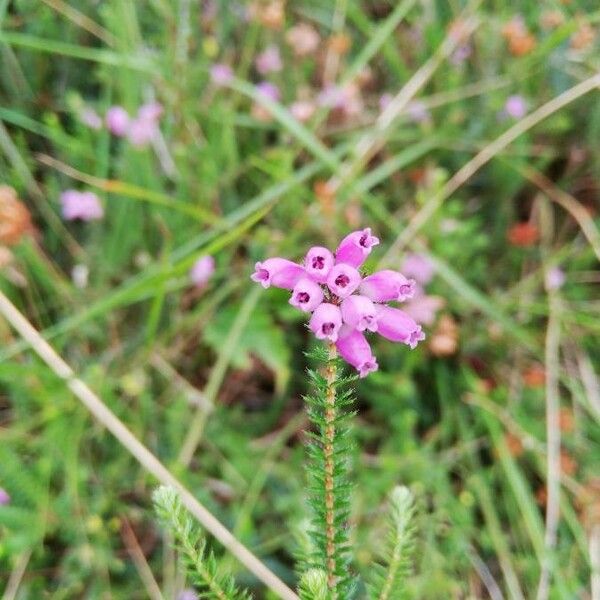
Plant Overview
Known as Mackay's Heath, this resilient little evergreen is a botanical gem with a mysterious history. It is a star of the "Lusitanian flora," meaning it is found only in the wild bogs of Western Ireland and Northern Spain, leaving scientists to wonder how it skipped the rest of Europe. With its deep pink, wax-like bells and dark, glossy foliage, it adds a touch of wild Atlantic charm to any acidic rockery or garden border.
🔍 How to Identify
- 🌸 The Blooms: Clusters of deep rose-pink, urn-shaped flowers appear at the tips of the stems. They are typically more vibrant and broader than those of its close relative, the Cross-leaved Heath.
- 🌿 The Foliage: Small, needle-like leaves are arranged in neat whorls of four. They are a rich, dark green and lack the grayish, hairy coating found on many other heathers, giving them a polished appearance.
- 🌱 Growth Habit: This is a low-growing, spreading shrub that rarely exceeds 30 cm (12 inches) in height. It forms dense, carpet-like mats that are excellent for suppressing weeds.
🏡 In Your Garden
- 🧪 Acidic Ambitions: Like most heathers, Mackay's Heath is strictly "calcifuge," meaning it will struggle and turn yellow in alkaline or lime-heavy soil. It thrives in peat-rich, acidic environments with plenty of organic matter.
- 💧 The Moisture Balance: While it loves a good soak and naturally grows in boggy areas, it doesn't enjoy sitting in stagnant, heavy clay. In a garden setting, aim for "consistently moist but well-drained" soil to mimic its native Irish moorlands.
- ✂️ Post-Bloom Grooming: To keep the plant from becoming "leggy" or woody in the center, give it a light trim immediately after the flowers fade. This encourages a flush of fresh, bushy growth for the following season.
⚠️ Safety & Toxicity
- 🟢 Status: Non-toxic and safe.
- 🐾 Pet & Child Friendly: Erica mackaiana is not known to be poisonous to cats, dogs, or humans. It is a safe choice for family gardens, though its tough, needle-like leaves aren't particularly palatable anyway.
✨ Fun Fact
James Townsend Mackay, the botanist who discovered the plant in 1835, originally found it in Connemara, Ireland. For decades, it was considered a hybrid until genetic testing confirmed it as a distinct species that survived the last Ice Age in small, sheltered pockets of the Atlantic coast!

Detailed Care Instructions
To grow Erica Mackaiana plant, follow these steps:
- Planting: Choose a well-draining, acidic soil mix for your Erica Mackaiana plant. Dig a hole that is slightly larger than the root ball of the plant. Place the plant in the hole and backfill with the soil mix, gently firming it around the roots. Make sure the plant is at the same depth as it was in the nursery pot.
- Watering: Keep the soil consistently moist but not waterlogged. Erica Mackaiana prefers slightly acidic water, so you may want to use rainwater or distilled water for better results.
- Light and temperature: Place the plant in a location that receives bright, indirect sunlight. Erica Mackaiana thrives in cooler temperatures, ideally between 50-60°F (10-16°C), so avoid placing it in a hot environment or near heat sources.
- Humidity: Erica Mackaiana plants prefer high humidity levels. To increase humidity, you can place a tray filled with water near the plant or use a room humidifier.
- Fertilization: Feed your Erica Mackaiana plant with a balanced, water-soluble fertilizer formulated for acid-loving plants during the growing season. Follow the recommended dosage instructions on the label.
- Pruning: Prune the plant after flowering to promote compact and bushy growth. Remove any dead or diseased branches, as well as spent flowers.
- Pests and diseases: Monitor your plant for pests such as aphids or spider mites. If you notice any infestation, treat it with an appropriate insecticide or consider using natural pest control methods. Watch out for root rot, which can occur if the soil remains too wet. Ensure proper drainage and avoid overwatering.
- Overwintering: Erica Mackaiana is not frost-tolerant, so if you live in a cold climate, it may need protection during winter. Bring the plant indoors or cover it with a thick layer of mulch to insulate the roots.
By following these steps and providing the plant with proper care, you should be able to successfully grow Erica Mackaiana.

Place in a bright room that is sun drenched almost all day. Or directly in a south-facing window.

To water this plant, it is important to first check the soil moisture level to ensure it is not too dry or too wet. Watering should be done gradually and evenly, applying enough water to moisten the soil but not so much that it becomes waterlogged or starts to pool around the plant. It is also important to avoid getting water on the leaves and flowers, as this can cause damage or encourage fungal growth. Depending on the climate and season, watering frequency may vary, but it is generally recommended to water when the top inch of soil feels dry. In addition, using a well-draining soil mix and providing adequate drainage holes in the pot can help prevent overwatering and root rot.
To ensure proper fertilization for Erica Mackaiana plants, follow these instructions:
- Use a well-balanced fertilizer specifically formulated for acid-loving plants. Check the N-P-K ratio on the label to ensure nitrogen (N), phosphorus (P), and potassium (K) are present in equal or balanced amounts.
- Apply the fertilizer during the plant's active growing season, which is typically in spring or early summer. Avoid fertilizing during colder months when the plant is dormant.
- Dilute the fertilizer according to the package instructions. It is generally recommended to use a weaker concentration than what is listed for other plants since Erica Mackaiana prefers more moderate feeding.
- Apply the diluted fertilizer around the base of the plant, keeping it at least a few inches away from the stems to avoid burning them. Gently water the area afterward to help the nutrients seep into the soil.
- Repeat the fertilization process about once every four to six weeks during the active growing season, adjusting the strength and frequency if necessary based on the plant's response.
- Monitor the plant for signs of over-fertilization, such as leaf burn or poor growth. If these symptoms occur, decrease the frequency or concentration of the fertilizer.
Remember, it is important to read and follow the specific instructions provided on the fertilizer packaging, as different products may have varied application rates and guidelines.
Erica Mackaiana requires soil that is well-draining and acidic. It should be a mix of organic matter, such as peat moss, and a coarse material like sand or perlite to ensure good aeration and drainage. The soil pH should be between 4.5 and 6.0. The plant is adapted to grow in nutrient-poor soils, so it is important not to fertilize too much or use a soil that is too rich in nutrients. The soil should also be kept moist but not waterlogged.
Propagation of Erica Mackaiana plants can be achieved through various methods, including seed propagation, cutting propagation, and division. Each method has its own steps and requirements, providing different options for successful propagation.
- Seed Propagation:
- Collect seeds from mature Erica Mackaiana plants.
- Prepare a well-draining planting medium consisting of peat moss, perlite, and sand.
- Moisten the medium slightly to provide a suitable environment for germination.
- Sow the seeds evenly on the surface of the medium, ensuring they are not buried too deeply.
- Cover the tray or container with a clear plastic bag or a propagator lid to create a mini greenhouse effect.
- Place the tray in a warm location with indirect light.
- Keep the medium moist but not waterlogged by misting it regularly.
- Germination usually takes several weeks to several months. Once the seedlings have developed their first true leaves, they can be transplanted into individual pots.
- Cutting Propagation:
- Select healthy, mature stems from the Erica Mackaiana plant.
- Using clean, sharp pruning shears, cut a 4-6 inch (10-15 cm) section of the stem.
- Remove the lower leaves, leaving only a few sets of leaves at the top.
- Dip the cut end of the stem in a rooting hormone powder to encourage root development.
- Prepare a well-draining rooting medium, such as a mixture of perlite and peat moss.
- Insert the cutting into the medium, ensuring that at least one or two sets of leaves are above the surface.
- Place the pot or tray in a warm, partially shaded area with high humidity (a propagator can be used).
- Mist the cutting regularly to keep it hydrated and maintain humidity.
- Roots should start forming within a few weeks to a couple of months.
- Once roots have developed, the cutting can be transplanted into a larger pot or directly into the garden.
- Division:
- Choose a mature Erica Mackaiana plant that has multiple stems or clumps.
- Gently dig up the entire plant, taking care not to damage the roots.
- Separate the clumps or stems using your hands or a clean, sharp knife.
- Each division should have its own set of roots and leaves.
- Replant the divisions immediately into well-draining soil or pots.
- Water the newly divided plants thoroughly to settle the soil around the roots.
- Provide a suitable growing environment with partial shade and moderate humidity.
- Monitor the divisions closely and ensure they receive enough water to establish themselves.
Remember that Erica Mackaiana plants prefer acidic soil, good drainage, and a location with partial shade. Monitor their water needs and protect them from extreme temperatures or excessive sunlight. Regularly check for signs of pests or diseases and take appropriate measures if necessary.








