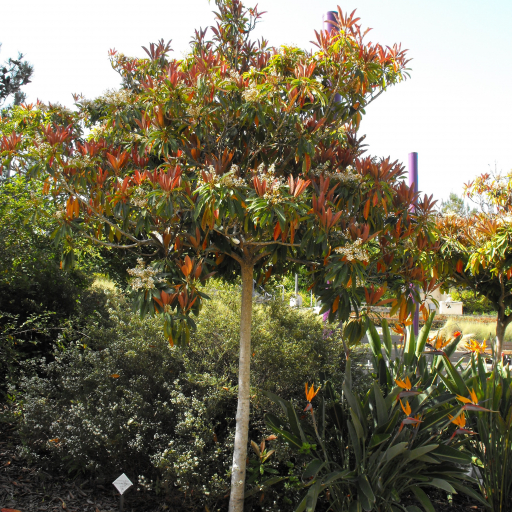
Plant Overview
Meet the Bronze Loquat, a sophisticated and colorful cousin of the common fruiting loquat. Best known for its stunning "chameleon" foliage, this evergreen tree offers a tropical aesthetic without the messy fruit drop of its relatives. It is a staple in Mediterranean-style landscapes and modern gardens where a pop of architectural color is needed.
🔍 How to Identify
- 🍃 The "Bronze" Flush: The most striking feature is the new growth; young leaves emerge in a brilliant coppery-bronze or rusty-red hue before maturing to deep green.
- 🔪 Serrated Edges: Unlike the smooth-edged leaves of many garden trees, these leaves are stiff, leathery, and have prominent "teeth" along the margins.
- 🌸 Spring Clusters: It produces small, fragrant, star-shaped white flowers that grow in large, fuzzy clusters at the ends of the branches.
🏡 In Your Garden
- 🌳 Structural Versatility: Because it responds so well to pruning, it is often trained into a "standard" (a lollipop-shaped tree) or used as a dense, glossy privacy screen.
- 💧 Drainage is Key: While it is surprisingly drought-tolerant once its roots are established, it is prone to root rot if forced to sit in heavy, clay-filled "wet feet" during the winter.
- 🛡️ Disease Resistance: One reason gardeners choose the Bronze Loquat over the common Loquat is its superior resistance to Fire Blight, a bacterial disease that can quickly blacken the branches of other fruit trees.
⚠️ Safety & Toxicity
- ✅ General Safety: The Eriobotrya deflexa is generally considered non-toxic to touch and is safe for planting in high-traffic areas near kids and pets.
- 🍒 The Seeds: While this variety rarely produces significant fruit, any seeds found within the small berries should not be eaten by pets or humans, as they contain low levels of cyanogenic glycosides (common in the rose family).
✨ Fun Fact
🍂 Even though it is an evergreen tree, the Bronze Loquat "molts." It will occasionally drop its oldest, innermost leaves, which turn a bright, fiery orange-red before falling, providing a second splash of color even in the off-season!

Detailed Care Instructions
To grow Eriobotrya deflexa plant, also known as Bronze Loquat or Bronze Loquat Tree, follow these steps:
- Choose a suitable location: Eriobotrya deflexa prefers full sun to partial shade. Make sure the location has well-draining soil.
- Obtain a healthy plant: Purchase a healthy Eriobotrya deflexa plant from a reputable nursery or propagate it from seeds or cuttings.
- Planting: Dig a hole that is slightly wider and deeper than the root ball of your plant. Place the plant in the hole and backfill with soil, gently firming it around the roots. Make sure the soil level is the same as it was in the nursery pot.
- Watering: Water the plant thoroughly after planting to settle the soil. Keep the soil evenly moist, but not waterlogged, during the growing season. Reduce watering in the dormant period.
- Mulching: Apply a layer of organic mulch around the base of the plant, 2-3 inches deep. This will help retain moisture, suppress weeds, and regulate soil temperature.
- Fertilizing: Feed your Eriobotrya deflexa plant with a balanced, slow-release fertilizer in spring. Follow the instructions on the fertilizer packaging for proper application rates.
- Pruning: Prune your plant in late winter or early spring to maintain its shape and remove any dead, diseased, or crossing branches. Pruning can help promote better air circulation and increase fruit production.
- Protecting from extreme cold: Eriobotrya deflexa can tolerate mild frost but may require protection from severe winter temperatures. Cover the plant with a frost blanket or bring it indoors during frosty nights.
- Pests and diseases: Monitor your plant regularly for pests like aphids or mites, and treat them promptly if detected. Also, watch for signs of fungal diseases such as powdery mildew and take appropriate measures if needed.
- Harvesting: Depending on your climate, Eriobotrya deflexa may produce fruit in late fall to early winter. Harvest the ripe fruits gently by hand when they have turned deep orange or yellow.
Remember to research the specific care requirements for Eriobotrya deflexa in your region, as different climates may have varying needs.

Place in a bright room that is sun drenched almost all day. Or directly in a south-facing window.

To properly watering this plant, it is important to first understand its watering needs. This can vary depending on various factors such as the plant's age, size, location, soil type, and weather conditions. Generally speaking, it is important to avoid overwatering this plant as it is susceptible to root rot.
To ensure proper watering, it is best to check the soil moisture level regularly. This can be done by sticking your finger about 2 inches deep into the soil. If the soil feels moist, then it does not need watering. However, if the soil feels dry, it is time to water the plant.
It is recommended to water the plant deeply but infrequently. This means that when watering, allow the water to penetrate deep into the soil, but do not water again until the soil has dried out. This can help promote healthy root growth and reduce the risk of fungal diseases.
Additionally, it is important to water the plant at the base rather than from above. This can help prevent water from accumulating on the leaves, which could increase the risk of fungal diseases.
Overall, watering this plant requires a balance between providing enough moisture without overwatering. Regularly checking the soil moisture level and watering deeply but infrequently can help ensure the plant stays healthy and vibrant.
To fertilize this plant, you can use a balanced fertilizer with a ratio of 10-10-10, applied every six months during the growing season. Use approximately 1 tablespoon of fertilizer per foot of tree height, evenly distributed around the root zone. Be sure to water the plant well before and after fertilizing to avoid burn injury to the roots. Avoid over-fertilizing as this can lead to excessive growth and weak branches.
It is recommended to use a well-draining soil mix with a pH level between 5.5 to 6.5 for this plant. The soil should also be enriched with organic matter and should not be overly compacted or heavy. A mix of peat moss, perlite, and coco coir can be used to create a suitable soil blend for this plant. It is also important to ensure that the soil is kept moist, but not waterlogged, and that adequate drainage is provided to prevent the plant from becoming overly saturated.
The Eriobotrya Deflexa plant can be propagated through both seeds and cuttings.
To propagate through seeds, collect the ripe fruit of the plant and remove the seeds from the pulp. Wash the seeds thoroughly and soak them in water overnight. Sow the seeds in a well-draining potting mix and cover them lightly with soil. Place the pot in a warm and bright area and keep the soil moist. Seedlings should emerge within 2-3 weeks.
To propagate through cuttings, use a sharp and sterilized knife to make a 6-inch cutting from a healthy and mature plant. Remove the lower leaves and dip the cut end in rooting hormone powder. Plant the cutting in a pot filled with a well-draining potting mix and water it thoroughly. Cover the pot with a plastic bag or dome to create a humid environment. Place the pot in a warm and bright area, but out of direct sunlight. Check the cutting for roots after 6-8 weeks, and when they have formed, you can repot the cutting in a larger pot with fresh soil.








