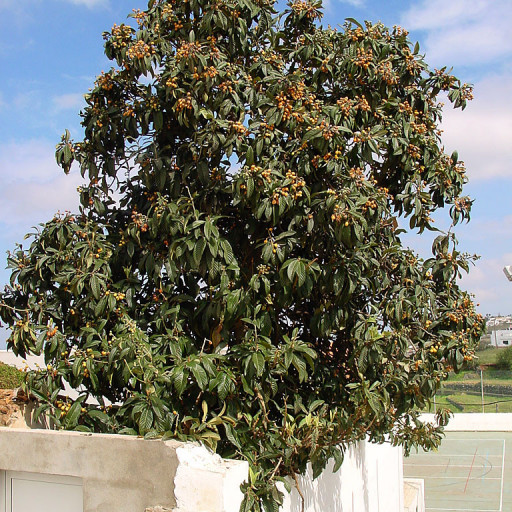
Plant Overview
Known as the Loquat or Japanese Plum, this elegant evergreen is a staple in Mediterranean and subtropical landscapes. Despite its name, it originally hails from the cool hill forests of China before becoming a cultural icon in Japan over a millennium ago. It is beloved by gardeners for its "tropical" look and its unusual habit of flowering in the dead of winter, filling the chilly air with the sweet, nostalgic scent of vanilla and almond.
🔍 How to Identify
- 🍃 The Foliage: The leaves are large, leathery, and deeply "ribbed" with prominent veins. They have a dark, glossy green top and a serrated (toothed) edge.
- ☁️ Rusty Fuzz: Look closely at the underside of the leaves and new stems; they are covered in a distinctive, velvety brown or gray "fuzz" called indumentum.
- 🌸 Winter Blooms: It produces small, creamy-white flowers in fuzzy clusters (panicles) during late autumn and early winter when most other plants are dormant.
- 🟠 Golden Fruit: In late spring, it bears clusters of oval, yellow-to-orange fruits that look like small pears or apricots.
🏡 In Your Garden
- ☀️ The Sunshine Trade-off: While the tree is remarkably cold-hardy for an evergreen, it needs a sheltered, sunny spot to successfully set fruit. Frost can damage the winter flowers even if the tree survives.
- 🪴 Soil Nuance: It is highly adaptable but hates "wet feet." If your soil is heavy clay, plant it on a slight mound to ensure the roots stay oxygenated and dry between waterings.
- 🌳 Growth Habit: It has a naturally rounded, umbrella-like canopy that provides excellent shade, but it can grow quite large—ensure you give it plenty of "elbow room" from your house.
⚠️ Safety & Toxicity
- ✅ Fruit Edibility: The flesh of the ripe loquat fruit is sweet, tangy, and perfectly safe for humans to eat raw or in jams.
- 🚫 The Seeds: Like its cousins the apple and the cherry, the large brown seeds contain cyanogenic glycosides. They should never be chewed or swallowed.
- 🐾 Pets & Kids: Keep an eye on curious pets. While the fruit pulp is generally harmless, ingesting the seeds or large amounts of the leaves can cause respiratory distress or stomach upset in dogs and cats.
✨ Fun Fact
In traditional Chinese medicine, a thick, honey-like syrup made from loquat leaves (known as Pei Pa Koa) has been used for centuries as a world-famous remedy to soothe sore throats and stubborn coughs.

Detailed Care Instructions
| Color | White, Blush |
| Soil Ph | Low Acidity, Neutral, Low Alkalinity |
| Humidity | High |
| Invasive | Weed |
| Lighting | Part Sun |
| Soil Type | Fertile, Loamy, Well Drained |
| Bloom Time | Late Fall, Early Winter |
| Difficulty | Hard |
| Plant Type | Fruit Tree |
| Mature Size | 10 To 25 Ft. In Ht. 10 To 25 Ft. In Width |
| Native Area | China And Japan |
| Temperature | 18°C - 24°C |
| Sun Exposure | Fun Sun To Partial Shade |
| Hardiness Zones | 8-10 |
To grow an Eriobotrya Japonica plant (commonly known as Loquat), you can follow these steps:
- Choose a location: Loquats prefer full sun but can tolerate partial shade. Choose a spot with well-draining soil and protection from strong winds.
- Soil preparation: Prepare the soil by loosening it and adding organic matter to improve drainage and nutrient content.
- Planting: Dig a hole slightly larger than the root ball of the plant. Place the loquat plant in the hole, ensuring the root collar (where the roots meet the trunk) is level with the ground. Fill the hole and gently firm the soil around the base of the plant.
- Watering: Water the plant thoroughly after planting and keep the soil consistently moist but not waterlogged during the growing season. Once established, water deeply but infrequently, allowing the topsoil to dry slightly between watering.
- Mulching: Apply a layer of organic mulch, like wood chips or straw, around the base of the plant. This helps to retain moisture, suppress weeds, and regulate soil temperature.
- Pruning: Prune the plant during late winter or early spring to remove dead or damaged branches, improve air circulation, and maintain a desired shape. Loquat trees tend to grow with multiple trunks, so pruning can help maintain a single trunk structure.
- Fertilizing: Apply a balanced slow-release fertilizer in early spring and midsummer to provide essential nutrients. Follow the package instructions for proper dosage.
- Pests and diseases: Keep an eye out for common pests like aphids, spider mites, and scale insects. Regularly inspect the leaves and apply organic insecticidal soap or neem oil if necessary. Loquats are generally resistant to diseases, but occasional fungal issues like powdery mildew may occur in humid conditions.
- Harvesting: Loquats typically ripen in late winter to early spring. Harvest the fruit when it reaches a yellow-orange color and is slightly soft. Twist or cut the fruit from the stem to harvest.
With proper care and maintenance, your Eriobotrya Japonica plant should thrive and provide you with delicious fruit.

Place in a window with dappled sun or a spot in the middle of a room. Or directly in a window facing west or east.

To properly water this plant, it is important to follow a few guidelines. First, make sure the soil is well-draining and not waterlogged. Second, water deeply and thoroughly, ensuring that the root ball is soaked. Third, allow the soil to dry out slightly before watering again, as overwatering can lead to root rot. Fourth, use room temperature water and avoid getting water on the leaves as this can lead to disease. Lastly, adjust watering frequency based on the plant's needs and environmental conditions, such as humidity and temperature.
To fertilize this plant, select a balanced fertilizer with equal amounts of nitrogen, phosphorus, and potassium. Use a water-soluble fertilizer and dilute it in water according to the instructions on the package. Apply the fertilizer every two weeks starting in the spring and continuing through the summer. Do not fertilize during the fall and winter months. Apply the fertilizer evenly around the plant, avoiding direct contact with the leaves and stems. Water the plant thoroughly after each application to ensure the nutrients reach the roots.
When growing Eriobotrya Japonica, it is important to use a well-draining soil that is rich in organic matter. The ideal pH range is between 5.5 and 6.5. A mixture of peat moss, perlite, and coarse sand works well to improve drainage and aeration. It is also recommended to add some compost or aged manure to the soil to increase the soil's fertility. Eriobotrya Japonica prefers soil that is consistently moist but not waterlogged, so it is important to ensure good drainage and to avoid overwatering. Overall, the soil should be nutrient-rich and well-aerated to promote healthy growth of the plant.
Propagation of this plant can be achieved through several methods including seed propagation, air-layering, hardwood cuttings and grafting.
Seed propagation involves collecting ripe seeds from the fruit of the plant, cleaning and drying them, and then planting them in soil. However, this process can be unpredictable and time-consuming.
Air-layering involves wounding a branch of the plant and then covering the wounded area with moist moss or soil, which will encourage the growth of roots. Once the roots have formed, the branch can be cut off and planted as a new plant.
Hardwood cuttings involves collecting mature stems from the plant, removing the leaves from the bottom two-thirds of the stem and then placing the cuttings in soil or a rooting hormone. The cuttings can then be kept moist until they develop roots and can be transplanted to a new location.
Finally, grafting involves attaching a piece of the plant to a rootstock of a different species or variety that is known for its disease resistance or other desirable traits. This method is commonly used in commercial plant production and can produce consistent results.
Common pests of the loquat include Scale insect, mealybugs, spider mites, aphids. Make a habit of checking your loquat frequently for pests so that any infestations can be caught and managed early.








