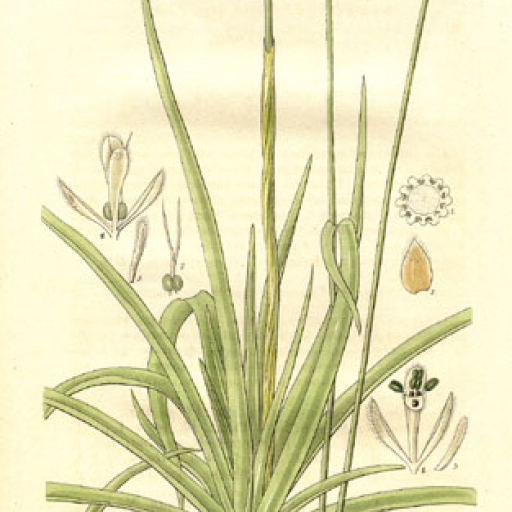
Plant Overview
Commonly known as the Tenangle Pipewort or "Hatpins," this striking wetland native looks like something out of a whimsical storybook. Its perfectly round, snowy-white flower globes sit atop stiff, architectural stems, making it look as though a seamstress left her pins stuck in the bog. It thrives in the soggy, acidic "no-man's-land" of marshes and wet pine flatwoods where few other plants can survive.
🔍 How to Identify
- ⚪ The "Button" Head: The most distinct feature is the terminal flower head—a dense, white, woolly globe about 1/2 to 3/4 inch wide that stays bright throughout the season.
- 📏 The Stiff Scape: The flower stalks (scapes) are remarkably rigid and feature 10 to 12 distinct longitudinal ridges or "angles," which give the plant its "Tenangle" name.
- 🌿 Basal Rosette: At the base, you’ll find a tuft of grassy, translucent, sword-shaped leaves that taper to a sharp point, often submerged or hugging the mud.
🏡 In Your Garden
- 💧 The "Soggy Foot" Rule: This plant is a true obligate wetland species. It doesn't just like water; it requires it. In a home setting, it is best grown in a dedicated bog garden or at the very edge of a pond where its roots can remain constantly saturated.
- ☀️ Sun and Acid: To keep those "hatpins" standing tall and bright, provide full sun and acidic, sandy soil. It struggles in standard potting mix or alkaline garden soil, which can cause the leaves to yellow and the stems to flop.
⚠️ Safety & Toxicity
- ✅ Safe Status: Tenangle Pipewort is generally considered non-toxic to humans and common household pets like cats and dogs.
- 🛑 Environmental Caution: While the plant itself is safe, the boggy environments it loves can harbor bacteria or mold. Always wash your hands after gardening in wet, stagnant soil to avoid skin irritation or accidental ingestion of soil-borne pathogens.
✨ Fun Fact
Despite looking like one solid puffball, each "hatpin" is actually a miniature colony! The head is composed of hundreds of tiny, individual male and female flowers packed tightly together to ensure pollination by passing insects.

Detailed Care Instructions
To grow Eriocaulon decangulare, also known as the Ten-angle Pipewort plant, you can follow these steps:
- Buy or obtain healthy Eriocaulon decangulare plants from a reputable nursery or supplier.
- Choose a suitable aquarium or container for growing the plant. The size of the container depends on the number of plants you want to grow and the available space.
- Fill the container with a suitable substrate. Eriocaulon decangulare prefers nutrient-rich substrates like aquarium soil or specialized plant substrates. Make sure to provide a layer that is thick enough to anchor the plant roots.
- Add water to the container, ensuring that the substrate is saturated. Ideally, use soft water or water with low mineral content. The water temperature should be around 22-26°C (72-79°F).
- Place the plants gently into the substrate, avoiding damage to the roots. Space them according to their growth habit or your desired arrangement. Make sure the roots are adequately covered with substrate.
- Provide adequate lighting as Eriocaulon decangulare prefers high light intensity. You can use full-spectrum LED lights or specialized aquarium plant lights to provide sufficient light for the plants. Aim for a lighting duration of approximately 10-12 hours per day.
- Maintain proper water conditions by regularly monitoring parameters such as pH, nitrate, phosphate, and temperature. Eriocaulon decangulare prefers slightly acidic to neutral pH levels (6.5-7.5) and soft water.
- Regularly fertilize the plants to provide essential nutrients. Eriocaulon decangulare benefits from regular dosing of fertilizers containing macro and micronutrients, particularly iron. Use a high-quality liquid fertilizer or follow a dry fertilization regime.
- Maintain consistent water quality by performing regular partial water changes. This helps remove excess nutrients and maintains a favorable environment for the plant's growth.
- Prune the plant as needed to control its size and remove any dead or decaying parts. Trim the leaves and stems with sharp scissors to avoid damaging the plants.
- Be patient as Eriocaulon decangulare can be slow-growing. With proper care and conditions, the plant should gradually grow and flourish in your aquarium or container.
Remember that Eriocaulon decangulare plants may have specific care requirements, so it's essential to research and adapt their care based on individual needs.

Place in a bright room that is sun drenched almost all day. Or directly in a south-facing window.

Eriocaulon decangulare plants should be watered regularly to keep the soil consistently moist. It is best to water the plant at the base using a watering can or a spray bottle to avoid wetting the leaves excessively. Make sure to water the plant in the morning or evening to prevent evaporation and ensure proper absorption by the roots. Be cautious not to overwater the plant as it may cause root rot. Monitoring the soil moisture level by touching the soil surface can help determine when to water the plant. Additionally, providing good drainage by using a well-draining potting mix and a pot with drainage holes is essential for the plant's overall health.
To fertilize this plant, use a balanced fertilizer with equal amounts of nitrogen, phosphorus, and potassium. Apply the fertilizer once every 2-3 weeks during the growing season, and reduce frequency during winter months. Dilute the fertilizer with water according to the manufacturer's instructions and apply directly to the soil, avoiding the leaves and stems of the plant. Be sure to provide adequate lighting, as this plant requires moderate to high levels of light.
For optimal growth and health of this plant, it is recommended to use a specific type of soil that provides adequate nutrients and drainage. The ideal soil for this plant should be a mixture of organic and inorganic materials, such as a blend of peat moss, perlite, and sand. It should have a slightly acidic pH, in the range of 5.5 to 6.5, as this plant prefers slightly acidic conditions. The soil should be well-draining but also retain moisture to avoid drying out the roots. The plant prefers to grow in a nutrient-rich substrate, so it is important to add fertilizers or supplements to the soil to provide essential nutrients. Overall, the soil used for this plant should be porous, moist, and nutrient-rich to encourage healthy growth.
Eriocaulon Decangulare plant can be propagated through division of the clumps. The process involves gently separating the roots and shoots of the plant to create new individual plants. This can be done during the spring or summer when the plant is actively growing.
To begin, carefully dig up the clump of the plant, taking care not to damage the roots or stems. Once the clump has been removed from the soil, use your hands or a sharp knife to separate the stems and roots into smaller clumps.
Each new clump should have several stems and a healthy root system. If necessary, trim away any damaged or dead roots or stems before replanting.
Before planting, make sure the soil is prepared by adding fertilizer or compost, and ensuring the soil is well-draining. Plant the new clumps at a depth that allows the tops of the stems to be just above the soil surface.
Water the newly planted clumps thoroughly and keep the soil evenly moist until the plants have established new root systems. With proper care, the new Eriocaulon Decangulare plants should grow and thrive, producing new shoots and flowers in the coming growing seasons.








