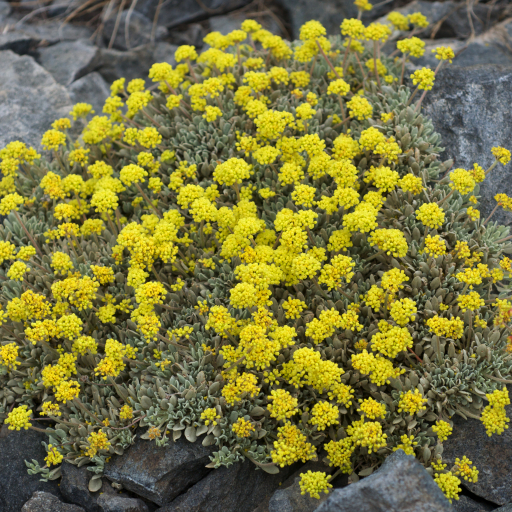
Plant Overview
Often called the Frosted Buckwheat, this hardy alpine survivor looks as if it has been perpetually dusted with a light morning rime. Native to the high-altitude ridges and rocky slopes of the Sierra Nevada, it forms tight, silver-gray cushions that hug the earth to stay warm. It is a favorite among rock garden enthusiasts who want to replicate the rugged beauty of a mountain peak.
🔍 How to Identify
- ❄️ Foliage: The leaves are small, oval, and covered in a dense layer of white, woolly hairs, giving the plant its signature "frosted" or hoary appearance.
- 🌼 Flower Clusters: Tiny blooms emerge in tight, pom-pom-like clusters. They typically start as a bright, cheerful yellow and mature into deep oranges or rusty reds as the season progresses.
- ☁️ Growth Habit: It is a "mat-forming" perennial, growing very low to the ground (rarely exceeding 4-6 inches) to protect itself from harsh mountain winds.
🏡 In Your Garden
- ⛰️ Drainage is King: Because it evolved in granite scree and volcanic soils, this plant will fail in heavy, clay-rich dirt. It requires extremely gritty, fast-draining soil to prevent root rot.
- ☀️ Sun & Stress: The Frosted Buckwheat actually thrives on a bit of neglect. It loves full sun and intense light; the more sun it gets, the more "silvery" and compact the foliage becomes.
⚠️ Safety & Toxicity
- ✅ Safe Status: Eriogonum incanum is generally considered non-toxic to humans, cats, and dogs.
- 🧤 Minor Irritation: While not poisonous, the tiny "wool" hairs on the leaves can occasionally cause mild mechanical irritation to the skin or eyes if handled roughly.
✨ Fun Fact
The Frosted Buckwheat is a vital "neighborhood hub" for high-altitude pollinators. It serves as a critical nectar source and host plant for several rare mountain butterflies, including the Cascades Blue and various species of alpine Copper butterflies.

Detailed Care Instructions

Some plants require more regular watering than others, which should be done every few days. It's critical to maintain the soil moist all of the time. The water requirements of the same plant placed in pots with varying sizes will differ. Because the water in the smaller pot evaporates faster than the water in the larger pot, it will require more watering. Regardless of pot size, the surface should constantly be maintained moist.








