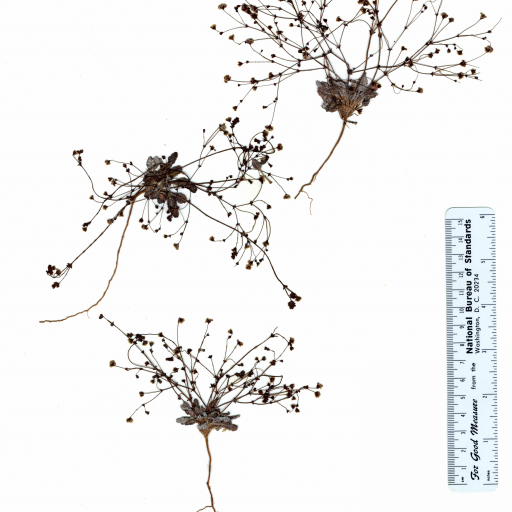
Plant Overview
Known as Thurber’s Buckwheat, this delicate annual is a hidden jewel of the American Southwest. While it may look like a collection of fragile wires for most of the year, it transforms arid landscapes into misty fields of pink and white during its bloom. Named after George Thurber, a 19th-century botanist who explored the Mexican boundary, it is a master of survival in the harshest desert sands.
🔍 How to Identify
- 🍃 The Foundation: Look for a small, flat rosette of leaves hugging the ground. These leaves are oval-shaped, wavy-edged, and covered in a fine, woolly "felt" to trap moisture.
- 🎋 The Skeleton: The plant sends up thin, wiry stems that branch out repeatedly. From a distance, the green or reddish stems create a see-through, airy structure.
- 🌸 The Bloom: Tiny, bell-shaped flowers appear in clusters at the tips of the stems. They are typically white to pale pink, often featuring a distinct dark reddish-brown midvein on each petal.
🏡 In Your Garden
- 🏜️ Desert Logic: Because this is a desert native, it thrives on neglect. It requires exceptionally well-draining soil—think sandy or gravelly mixes. In a standard potting soil, its roots will rot almost instantly because they aren't adapted to hold onto moisture.
- 🌱 The Annual Cycle: Since this is an annual plant, it completes its entire life cycle in one season. If you want it to return, do not "tidy up" the dried flower heads too early; let the seeds fall naturally so they can germinate when the next rains arrive.
⚠️ Safety & Toxicity
- ✅ Safe Status: Thurber’s Buckwheat is considered non-toxic to humans, dogs, cats, and horses.
- 🐜 Ecological Role: While safe for pets, it is a high-traffic area for pollinators. Expect to see a variety of native bees and small butterflies hovering around it, so place it somewhere you can enjoy the "micro-wildlife" without disturbing it.
✨ Fun Fact
Thurber’s Buckwheat is a vital "nursery" plant. It serves as a primary host for the Behr’s Metalmark butterfly, providing the necessary nutrients for their caterpillars to grow and undergo metamorphosis.

Detailed Care Instructions
To grow Eriogonum thurberi, also known as Thurber's buckwheat, follow these steps:
- Choose a suitable location: Eriogonum thurberi prefers full sunlight and well-draining soil. It is native to rocky slopes and desert regions, so it is adapted to warmer and drier conditions.
- Prepare the soil: If your soil doesn't drain well, consider adding some sand or gravel to improve drainage. Eriogonum thurberi is tolerant of poor soil conditions, but it prefers slightly alkaline soils. Adding some lime can help achieve the desired pH.
- Planting seeds: You can sow the seeds directly into the ground in spring or fall after the last frost. Make sure the area is clear of weeds and debris, and lightly scratch the soil surface with a rake or hand tool. Sprinkle the seeds evenly over the area and lightly cover them with a thin layer of soil. Gently water the area to ensure good seed-to-soil contact.
- Watering: During the establishment phase, water the newly planted seeds regularly to keep the soil consistently moist but not waterlogged. After the plants are established, they are drought-tolerant and only need occasional watering during prolonged dry periods.
- Maintenance: Eriogonum thurberi is a low-maintenance plant. It generally does not require pruning or fertilization. However, removing any dead or damaged foliage can improve the plant's appearance. Mulching around the base of the plant can help conserve moisture and suppress weed growth.
- Pests and diseases: This plant is relatively resistant to pests and diseases. However, keep an eye out for common garden pests such as aphids or spider mites. Control measures, such as washing the plant with a strong stream of water or using organic insecticidal soap, can help if infestations occur.
Eriogonum thurberi is a slow-growing plant, so be patient. With proper care and a suitable growing environment, you should be able to enjoy the beautiful blooms of this native buckwheat.

Eriogonum Thurberi is a plant that needs to be watered carefully. This plant requires moderate to low watering, depending on the season and weather conditions. When watering, it is important to make sure that the water reaches the roots, but does not flood them.
Watering should be done in the early morning or late evening when the sun is not strong, to avoid evaporation and to prevent the leaves from burning. The amount of water the plant needs will depend on various factors such as the size of the plant, the climate, and soil type.
It is important to make sure that the soil is not waterlogged as this may cause root rot. A good way to test if the plant needs watering is by sticking a finger into the soil to see if it feels dry. If it feels dry, it is time to water the plant.
When watering, it is recommended to use a watering can or a hose with a narrow attachment to direct the water to the base of the plant. It is also important to avoid getting water on the foliage as this may lead to the development of diseases.
Overall, watering Eriogonum Thurberi requires attention to detail to ensure the plant receives adequate moisture without overwatering.
To fertilize this plant, select a balanced fertilizer with a ratio of 10-10-10. Apply a quarter cup of fertilizer per each square foot of soil surface area surrounding the plant. Use a garden fork or aerator to gently incorporate the fertilizer into the soil without damaging the plant's roots. Water the plant thoroughly after fertilizing. Avoid fertilizing in hot weather or during prolonged periods of drought. Depending on the soil's quality, you may need to fertilize this plant twice per growing season.
The best soil to use for this plant is a well-drained, sandy soil with good drainage. It prefers a soil pH between 6.0 and 8.0. It is important not to use heavy, clay soils as they can lead to waterlogged conditions and root rot. This plant needs a soil that is not fertile, or a soil that has low-nutrient levels, so it is recommended to avoid using organic-rich soils or those that have been heavily fertilized. Additionally, this plant prefers full sun exposure, so it is important to choose a location where it can receive ample sunlight.
To propagate this plant, you will need to take cuttings from the stems and leaves. Select healthy stems with several leaves and make a clean cut just below a node (where a leaf is attached). Remove the leaves from the bottom of the stem, leaving only a few at the top. Dip the cut end of the stem in rooting hormone and plant it in moist soil. Place the pot in a warm and humid place, such as under a plastic bag or cloche. Keep the soil moist but not waterlogged. Once roots have formed, you can transplant your new plant into a larger pot or in the ground.








