Plant Overview
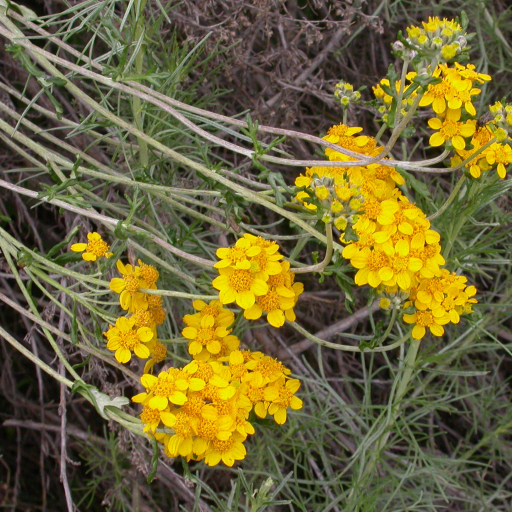
Known as "Golden Yarrow," Eriophyllum confertiflorum isn't a true yarrow, though it mimics the flat-topped floral look of its namesake. This California native is a superstar of the chaparral, painting dry hillsides in vibrant mustard-yellow. It is a favorite for "water-wise" gardeners who want a splash of sunshine without the heavy water bill.
🔍 How to Identify
- 🌼 Flower Clusters: Look for dense, flat-topped clusters of tiny, brilliant yellow flower heads. Each "flower" is actually a collection of many smaller florets packed tightly together.
- 🌿 Woolly Foliage: The leaves and stems are covered in fine, white, cobweb-like hairs. This gives the entire plant a soft, silvery-green or dusty-grey appearance.
- ✂️ Deeply Lobed Leaves: The foliage is deeply divided into narrow, thread-like lobes. This unique shape reduces surface area to help the plant survive in intense heat.
🏡 In Your Garden
- ☀️ Sun Worshiper: This plant thrives in the harshest full sun. If tucked into a shady corner, it will become "leggy" and lose its compact, mounded shape as it stretches for the light.
- 💧 Drainage is Vital: Because it evolved in rocky, dry soils, it is extremely prone to root rot in heavy clay. It prefers "lean" soil with excellent drainage and requires very little water once established.
- 🦋 Wildlife Hub: It is a vital nectar source for native bees and butterflies. In a garden setting, it acts as a "pollinator filling station" during the hot months when other flowers might be wilting.
⚠️ Safety & Toxicity
- 🟢 Generally Safe: This plant is not considered toxic to humans or common household pets like cats and dogs.
- 🧤 Skin Irritation: The fine "wool" on the leaves can occasionally cause mild skin irritation or itching for people with sensitive skin. It is a good idea to wear gloves if you are doing heavy pruning or clearing.
✨ Fun Fact
🧶 Built-in Sunscreen: The genus name Eriophyllum literally translates to "woolly leaf." Those tiny white hairs aren't just for show—they act as a physical barrier that reflects UV rays and creates a micro-climate of cool air around the leaf surface!

Detailed Care Instructions
To grow Eriophyllum confertiflorum, also known as golden yarrow or yellow yarrow, you can follow these steps:
- Location: Choose a sunny location for your plant as Eriophyllum confertiflorum prefers full sun exposure.
- Soil: Prepare well-draining soil that is sandy or loamy. Amend the soil with organic matter, such as compost, to improve fertility and drainage.
- Planting: Sow the seeds directly into the ground during spring or fall. Rake the soil gently to create a fine seedbed, then sprinkle the seeds evenly over the area. Press the seeds lightly into the soil but do not cover them as they require light to germinate.
- Watering: Water the seeds regularly to keep the soil consistently moist until germination occurs. Once the plants are established, water sparingly as Eriophyllum confertiflorum is drought-tolerant.
- Thinning: After the seedlings emerge, thin them to allow enough space for growth. Leave about 6-12 inches between each plant.
- Mulching: Apply a thin layer of organic mulch around the plants to suppress weeds and retain moisture. Be careful not to cover the seedlings with mulch.
- Maintenance: Eriophyllum confertiflorum is a low-maintenance plant. However, you can prune it lightly after flowering to maintain its compact shape and encourage new growth.
- Pests and diseases: Golden yarrow is generally resistant to pests and diseases. However, watch out for aphids, snails, and slugs and treat if necessary.
- Propagation: Eriophyllum confertiflorum can also be propagated from cuttings. Take 3-4 inch long cuttings from healthy plants and root them in moist soil or water.
By following these steps and providing the plant with adequate sunlight, well-draining soil, and proper watering, you should be able to successfully grow Eriophyllum confertiflorum.

Place in a bright room that is sun drenched almost all day. Or directly in a south-facing window.

Watering Eriophyllum confertiflorum is essential for the plant's health and proper growth. Here are some guidelines on how to water the plant effectively:
1. Evaluate the soil: Prior to watering, assess the soil moisture level. Stick your finger about an inch deep into the soil near the plant's root zone. If the soil feels dry, it is an indication that watering is required.
2. Watering frequency: Eriophyllum confertiflorum prefers well-draining soil, so you need to be careful not to overwater. Generally, it is advisable to water the plant once every 7-10 days during the growing season (spring to fall). However, adjust the frequency based on the environmental conditions and the plant's specific needs.
3. Water deeply: When watering, make sure to thoroughly wet the soil. Water should penetrate the soil to a depth of at least 6-8 inches to encourage the plant's roots to grow deeper. This helps in establishing a strong and healthy root system.
4. Avoid waterlogging: Overly saturated soil can lead to root rot and other fungal diseases. Therefore, it is crucial to ensure that excess water drains away from the plant's root zone. If the soil retains water for an extended period or appears muddy, you may be overwatering. Adjust the amount of water accordingly.
5. Time of day: Watering Eriophyllum confertiflorum in the early morning or late afternoon is generally recommended. This minimizes water evaporation and allows the plant to absorb the moisture effectively. Avoid watering during the hottest part of the day to prevent excessive water loss through evaporation.
6. Mulching: Applying a layer of organic mulch around the plant can help retain moisture in the soil. Mulch acts as a barrier, preventing water from evaporating quickly and reducing weed growth. However, be cautious not to pile mulch against the plant's stem, as it can promote rotting.
7. Monitor plant response: Always keep an eye on the plant's overall health and appearance. If you notice wilting or yellowing leaves, it may indicate underwatering. Conversely, if the leaves appear to be turning brown or develop root rot, it could indicate overwatering. Adjust your watering routine accordingly.
It is important to note that environmental factors such as temperature, humidity, and the plant's stage of growth may influence watering requirements. Monitoring the soil moisture and being attentive to the plant's response will help you develop a suitable watering routine for your Eriophyllum confertiflorum.
Fertilizing recommendations for Eriophyllum Confertiflorum include:
- Choose a balanced, slow-release fertilizer with an N-P-K ratio of around 10-10-10 or 20-20-20.
- Apply the fertilizer during the plant's active growing season, typically in spring or early summer.
- Dilute the recommended amount of fertilizer in water according to the package instructions.
- Water the plant thoroughly before applying the fertilizer to avoid burning the roots.
- Pour the diluted fertilizer evenly around the base of the plant, avoiding direct contact with the stems or foliage.
- Use caution not to exceed the recommended dosage, as over-fertilizing can harm the plant.
- After applying the fertilizer, water the plant again to help the nutrients seep into the soil.
- Regularly monitor the plant's response to fertilization. If it appears healthy and thriving, there may be no need for additional fertilization.
- If the plant shows signs of nutrient deficiency, such as yellowing leaves or stunted growth, consider a foliar fertilizer to provide a quick nutrient boost.
- Remember to follow the manufacturer's instructions and guidelines specific to the fertilizer you choose for best results.
Eriophyllum confertiflorum, also known as (you mentioned not to mention the common names) is a perennial flowering plant native to California and other parts of the western United States. In order to provide optimal growing conditions for this plant, it is essential to select the appropriate soil type.
Eriophyllum confertiflorum thrives in well-draining soils that are slightly sandy or loamy in texture. The ideal soil pH for this plant ranges from slightly acidic to slightly alkaline, around 6.0 to 7.5. However, it can tolerate a wider pH range of 5.5 to 8.5 as well. It is crucial to ensure that the soil doesn't remain consistently wet or soggy, as this can lead to root rot and other diseases. Therefore, a soil mix that promotes good drainage is essential.
To create a suitable soil mix for Eriophyllum confertiflorum, you can start by incorporating organic matter such as compost or well-rotted manure. This helps improve both the structure and nutrient content of the soil. Additionally, adding a layer of organic mulch around the plant can help retain moisture and suppress weed growth.
Amending the soil with perlite, vermiculite, or coarse sand can improve drainage, preventing waterlogging and ensuring healthy root development. This is particularly important if you are planting in heavy clay soil, which tends to retain moisture. By adding these amendments, you can help break up the clay and improve aeration.
Before planting, it is advisable to perform a soil test to assess the nutrient levels and adjust them accordingly. If necessary, you can incorporate a balanced slow-release fertilizer into the soil mix, following the manufacturer's instructions. However, Eriophyllum confertiflorum generally prefers low to moderate nutrient levels.
In conclusion, Eriophyllum confertiflorum thrives in well-draining soils with slightly sandy or loamy texture. The soil should have a pH range of 6.0 to 7.5, although it can tolerate a wider range. Ensuring good drainage, incorporating organic matter, and adjusting nutrient levels if required will provide the optimal soil conditions for this plant's growth and health.
Eriophyllum confertiflorum is a perennial plant that belongs to the Asteraceae family. Here's a detailed explanation of how to propagate it:
- Propagation by Seed:
- Collect mature seed heads from the plant. These are small, dried seed heads that contain seeds.
- Once collected, break open the seed heads and collect the seeds.
- Fill a small tray or pot with a well-draining potting mixture. You can use a mixture of sand, perlite, and peat moss.
- Sprinkle the collected seeds evenly on the surface of the potting mixture.
- Gently press the seeds into the soil but do not cover them completely.
- Mist the soil with water until it is moist but not waterlogged.
- Place the tray or pot in a warm and well-lit area, but away from direct sunlight.
- Keep the soil consistently moist by misting it regularly.
- Germination should occur within a few weeks or months, depending on the conditions.
- Once the seedlings have become established, transplant them into individual pots.
- Collect mature seed heads from the plant. These are small, dried seed heads that contain seeds.
- Propagation by Division:
- Dig up the entire plant during spring or early fall when it is not actively growing.
- Carefully separate the root ball into smaller sections with a sharp and clean knife or spade. Each section should have some shoots and roots attached.
- Plant the divided sections immediately into well-prepared soil or individual pots filled with a well-draining potting mixture.
- Ensure the roots are placed at the same depth as they were in the original plant.
- Water the newly divided plants thoroughly and keep the soil consistently moist until they have become established.
- Dig up the entire plant during spring or early fall when it is not actively growing.
- Propagation by Stem Cuttings:
- Select a healthy and non-flowering stem from the parent plant. Cut a section of the stem that is around 3-6 inches long.
- Remove any lower leaves from the stem, leaving only a few leaves at the top.
- Dip the cut end in a rooting hormone powder to encourage root growth.
- Insert the treated end of the cutting into a small pot filled with a well-draining rooting medium, such as a mix of perlite and vermiculite.
- Make sure that at least one leaf node is submerged below the soil.
- Water the cutting lightly and cover it with a plastic bag or a clear plastic dome to create a humid environment.
- Place the pot in a warm location with bright, indirect light.
- Mist the cutting regularly to maintain humidity.
- After a few weeks, new roots should develop, and you can transplant the cutting into a larger pot or directly into the garden.
Remember to provide proper care, including adequate sunlight, water, and well-draining soil, to ensure the successful propagation and growth of Eriophyllum confertiflorum.
- Select a healthy and non-flowering stem from the parent plant. Cut a section of the stem that is around 3-6 inches long.








