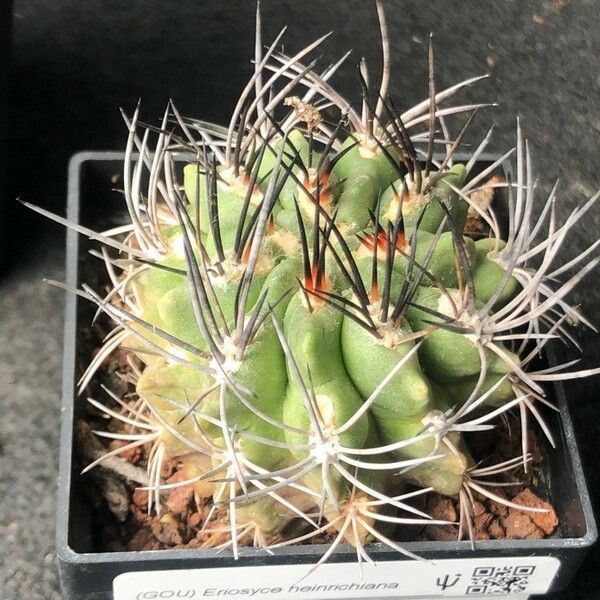
Plant Overview
Hailing from the rugged, arid coastlines of Chile, Eriosyce heinrichiana is often whispered about by collectors as a "Gothic Beauty" of the desert. This small but mighty succulent is a master of disguise, frequently shrinking deep into the stony ground during dry spells to hide from the sun. It is a slow-growing gem that rewards the patient gardener with a dramatic, dark-skinned aesthetic and surprisingly delicate, silky blooms.
🔍 How to Identify
- 🌵 The Body: Usually globose (ball-shaped) or slightly flattened, the skin is its most striking feature—ranging from a deep olive green to a moody charcoal-grey or even a purplish-chocolate tone.
- 🧶 Woolly Crown: The top of the cactus features a tuft of whitish wool. This isn't just for looks; it acts as a natural sunscreen for the emerging flower buds and new growth.
- 🌸 Silky Flowers: Despite its tough, dark exterior, it produces funnel-shaped flowers in soft shades of creamy yellow, pale pink, or brownish-orange, often appearing in late spring.
🏡 In Your Garden
- 🏜️ Mimic the Atacama: In the wild, this plant lives in rocky, mineral-rich crevices. It despises "wet feet," so avoid standard potting soil. Instead, use a very gritty mix (pumice, perlite, and lava rock) to ensure water drains away from the roots instantly.
- ☀️ The "Sun-Tan" Effect: To maintain its unique dark coloring, it needs bright, direct light. If kept in a dim corner, the plant will turn a generic green and begin to stretch (etiolate), losing its compact, circular charm.
⚠️ Safety & Toxicity
- 🌵 Physical Hazard: While Eriosyce is not chemically toxic to humans or pets, its spines are stiff and sharp. They can easily puncture skin or curious paws.
- 🐾 Placement: It is best kept on a high shelf or a dedicated plant stand where children or pets won't accidentally brush against its prickly defenses.
✨ Fun Fact
Many Eriosyce species possess a massive, turnip-like taproot hidden beneath the soil. This underground "water tank" can actually be larger than the visible cactus itself, allowing the plant to survive in some of the driest places on Earth for years without rain!

Detailed Care Instructions
Here are some steps you can follow to grow Eriosyce Heinrichiana plant:
- Obtain a healthy plant: Start by obtaining a healthy Eriosyce Heinrichiana plant from a reliable source, such as a reputable nursery or online plant retailer.
- Choose the right container: Select a well-draining container that is slightly larger than the plant's root ball. Ensure that the container has drainage holes at the bottom to prevent waterlogging.
- Soil mixture: Use a well-draining soil mixture specifically formulated for cacti and succulents. You can also create your own by combining equal parts of cactus soil, perlite, and sand to enhance drainage.
- Planting: Gently remove the plant from its nursery pot, being careful not to damage the roots. Place it in the new container and cover the roots with the soil mixture, leaving a small space between the soil surface and the rim of the container.
- Light requirements: Eriosyce Heinrichiana plants prefer bright, indirect sunlight. Place the plant in a location where it can receive at least 4-6 hours of bright light per day. If grown indoors, a south-facing window is usually ideal.
- Watering: Water the plant sparingly, allowing the soil to completely dry out between waterings. Overwatering can lead to root rot and other issues. During the winter months, reduce watering as the plant enters a dormant period.
- Temperature and humidity: Eriosyce Heinrichiana plants thrive in warm temperatures ranging from 70°F to 90°F (21°C to 32°C). They can tolerate low humidity levels, making them suitable for arid climates.
- Fertilizer: Use a balanced, water-soluble fertilizer formulated for cacti and succulents during the growing season, typically from spring to early fall. Follow the instructions on the fertilizer packaging for proper dilution and application.
- Pest control: Keep an eye out for common pests such as mealybugs or spider mites, and treat them promptly with insecticidal soap or neem oil if necessary.
- Maintenance and care: Eriosyce Heinrichiana plants generally require minimal maintenance. Prune any dried or damaged parts of the plant and remove any accumulated debris from the soil surface.
Remember, growing plants can take time and patience. Monitor the plant's growth, adjust care accordingly, and enjoy the process as your Eriosyce Heinrichiana plant develops.

Place in a bright room that is sun drenched almost all day. Or directly in a south-facing window.

Eriosyce Heinrichiana plant can be watered by placing it in an area where water can trickle slowly and steadily into the soil for about 30 seconds until it is fully saturated. It is important to not overwater the plant or let it sit in water for extended periods of time as this can lead to root rot. It is recommended to water the Eriosyce Heinrichiana plant sparingly, only when the soil has completely dried out. This can be tested by sticking a finger into the soil up to the second knuckle, if it feels dry it is time to water. Due to its slow-growing nature, it is important to avoid fertilizing the plant during its dormant period in the winter months.
To fertilize this plant, mix a balanced fertilizer with a high phosphorus content in water. Apply the fertilizer to the soil during the growing season (spring to autumn) every 4-6 weeks. Avoid fertilizing during the dormant season (winter). Water the plant thoroughly after fertilizing. Use caution not to over-fertilize as this may cause damage to the plant.
The ideal soil for this particular plant is well-draining and sandy, with a neutral to slightly acidic pH level. It should also contain some percentage of organic matter to provide the necessary nutrients and promote healthy growth. Additionally, it is important to avoid using heavy clay or dense soils that may retain too much moisture and lead to root rot. A good option would be a mixture of sand, perlite, and peat moss.
To propagate this plant, you will first need to collect its seeds. Once you have the seeds, you can prepare a pot with well-draining soil. The soil should be evenly moist but not wet.
Next, you can scatter the seeds on top of the soil and gently press them into the surface. Do not cover the seeds with soil as they require light to germinate.
Place the pot in a warm, bright location and keep the soil evenly moist. The seeds should germinate within a few weeks, and you can transplant the seedlings into individual pots once they have developed their true leaves.
You can also propagate the plant through stem cuttings. To do so, take a stem cutting that is at least 4 inches long and remove any leaves from the bottom half of the stem. Allow the cutting to dry for a few days before planting it in well-draining soil. Keep the soil lightly moist and the cutting in a bright, warm location until it develops roots and new growth.
Common pests of the eriosyce heinrichiana include Scale insect, mealybugs, spider mites. Make a habit of checking your eriosyce heinrichiana frequently for pests so that any infestations can be caught and managed early.








