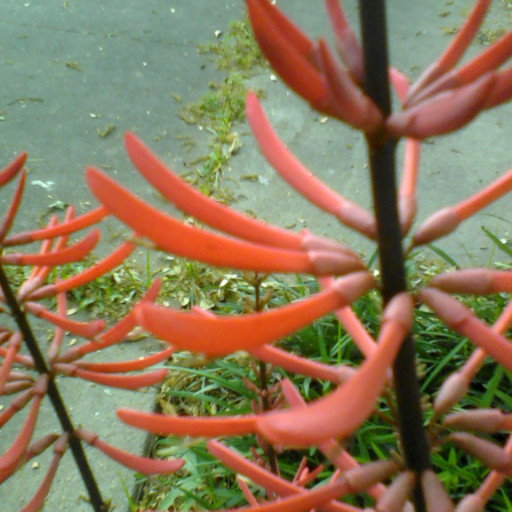
Plant Overview
Commonly known as the Colorín or the American Coral Tree, this striking deciduous tree is a vibrant staple of Mexican and Central American landscapes. Often nicknamed the "Zumpantle," it is beloved for its fiery, sword-shaped blooms that appear on bare branches before the leaves even emerge, creating a dramatic silhouette against the spring sky.
🔍 How to Identify
- 🌺 Flaming Flowers: The most iconic feature is the dense cluster of tubular, scarlet-red flowers that resemble a group of small machetes or coral sticks pointing upward.
- 🍃 Trifoliate Leaves: Once the flowers fade, the tree produces large, bright green leaves arranged in groups of three (trifoliate), often diamond-shaped or broadly ovate.
- 🌵 Prickly Bark: Look closely at the trunk and branches; they are often armored with small, sharp black prickles, giving the tree a rugged, protective texture.
- 🫘 Seed Pods: It produces long, dark woody pods that eventually split open to reveal "frijolitos"—brilliant, glossy red seeds with a distinctive black spot.
🏡 In Your Garden
- ☀️ Sun Seeker: This tree is a true sun-worshipper. To get those legendary red blooms, it needs a spot with full sun exposure and plenty of heat.
- 🦋 Pollinator Magnet: If you want a garden full of life, this is your tree. Its deep, tubular flowers are perfectly designed for the long beaks of hummingbirds, who act as its primary pollinators.
- 🌱 Soil & Drainage: As a member of the legume family, it’s a hardy "nitrogen-fixer," meaning it actually improves the soil quality around it. However, it absolutely demands well-draining soil; it hates "wet feet" and can suffer from root rot in soggy ground.
⚠️ Safety & Toxicity
- 🚫 High Toxicity: While beautiful, the bright red seeds (beans) are highly toxic if ingested. They contain potent alkaloids that can cause respiratory paralysis or severe stomach distress.
- 🐾 Pets & Children: Because the seeds look like bright candies or beads, they are a high risk for children and curious pets. Always clear away fallen pods if you have little ones or animals roaming the garden.
- 🧤 Thorny Handling: Use caution when pruning, as the small spines on the branches can easily puncture skin or gardening gloves.
✨ Fun Fact
In many parts of Mexico, the flowers of Erythrina americana are actually used in traditional cooking! Once the stamens and bitter parts are removed, the petals are boiled and added to scrambled eggs or spicy stews. However, the toxic seeds are strictly used for jewelry-making and folk amulets to ward off the "evil eye."

Detailed Care Instructions
To grow Erythrina americana, also known as the American coral tree, you can follow these steps:
- Choose the right planting location: Erythrina americana requires full sun and well-draining soil. Avoid planting it in low-lying areas prone to waterlogging.
- Obtain seeds or young plants: You can either collect seeds from existing trees or purchase young plants from a nursery.
- Prepare the soil: Loosen the soil in the planting area, removing any weeds or vegetation. If the soil is clayey or heavy, add organic matter like compost to improve drainage.
- Planting seeds or plants: If using seeds, soak them in water overnight before planting. Plant them about 1 inch deep in the soil and cover lightly. If using young plants, dig a hole slightly larger than the root ball and place the plant in the hole, making sure the top of the root ball is level with the ground.
- Watering: Water the newly planted seeds or plants thoroughly, ensuring the soil is moist but not soggy. Once established, Erythrina americana is drought-tolerant but still benefits from occasional watering during extended dry periods.
- Mulching: Apply a layer of organic mulch, such as wood chips or straw, around the base of the plant. Mulch helps conserve soil moisture and suppresses weeds.
- Pruning: Prune dead or damaged branches as needed to promote healthy growth and maintain an attractive shape. Erythrina americana can be pruned in the dormant season.
- Fertilizing: Erythrina americana doesn't require much fertilization. However, you can apply a balanced slow-release fertilizer in spring to provide some nutrients.
- Protect from cold: If you live in a region with frost or cold winters, consider protecting the plant during these periods. Covering it with a frost cloth or moving it to a sheltered location can help prevent frost damage.
- Pests and diseases: Erythrina americana is generally pest and disease-resistant. However, occasional attacks by aphids or caterpillars may occur. Regularly inspect the plant and apply appropriate treatments if necessary.
By following these steps and providing the necessary care, you can successfully grow Erythrina americana in your garden or landscape.

Place in a bright room that is sun drenched almost all day. Or directly in a south-facing window.

One needs to ensure that the plant gets a good amount of water while avoiding over-watering. It is recommended to wait until the soil has dried out before watering the plant again. One should also avoid getting the leaves wet while watering, as this may cause fungal growth or disease. When watering, it is best to water the plant at the base, directly at the soil. It is also important to make sure that the plant is getting enough water during the growing season and during periods of drought or extreme heat.
To fertilize this plant, use a balanced fertilizer with equal amounts of nitrogen, phosphorus, and potassium. Apply the fertilizer to the soil around the plant's base, avoiding direct contact with the stem. Water the plant immediately after fertilizing to aid in nutrient absorption. Fertilize once every two months during the growing season, which is typically spring and early summer. Avoid fertilizing during the dormant period, which occurs in late summer and autumn.
For optimal growth and health of the plant, it is recommended to use a well-draining and nutrient-rich soil. The ideal soil pH range for the plant is slightly acidic to neutral. A blend of organic matter such as compost or peat moss mixed with sand or perlite to improve soil drainage is suitable for the plant. The soil should be kept evenly moist, but not waterlogged, as the plant is intolerant of waterlogged soil. Additionally, regular fertilization using a balanced fertilizer is recommended to provide the plant with the necessary nutrients.
To propagate this particular plant, you can take stem cuttings from the parent plant. Choose a stem that is healthy and has several nodes, and cut a section about 6-8 inches long. Remove the leaves from the bottom half of the stem and dip it in rooting hormone. Plant the cutting in a pot of well-draining soil, and keep it in a warm and humid location. Keep the soil moist but not soaked, and avoid direct sunlight. Within a few weeks, roots should begin to form, indicating the cutting has taken root. After about two months, the cutting can be transplanted outdoors or into a larger container.








